
Bahlil Urges Swift Resolution of Technical Problems at Balikpapan Refinery
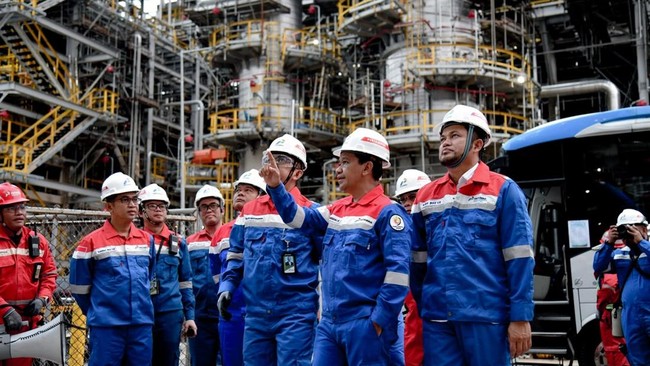
Energy and Mineral Resources Minister and Coordinating Minister for Infrastructure and Regional Development Bahlil Lahadalia has urged that technical problems at the Balikpapan Refinery Development Master Plan (RDMP) in East Kalimantan be resolved as quickly as possible.
The aim is to ensure the refinery can operate optimally and maximise fuel production. Bahlil said he had personally inspected its progress and operating conditions on site.
The RDMP Balikpapan, managed by PT Pertamina Patra Niaga, was inaugurated by the government in January 2026. However, several problems have emerged at production facilities during its operation.
The technical issues have directly affected fuel output. Bahlil said production of several oil and gas products at the refinery had yet to reach its full potential.
“I was there yesterday. It has indeed been inaugurated, but some products are not yet at full capacity because there have been problems,” Bahlil said at the Energy and Mineral Resources Ministry office in Jakarta on Friday (23 October 2026).
In response to the operational problems, he called for repairs to be carried out promptly. He said the rectification of faulty components should not delay the target of optimising the refinery.
“So I have asked for anything that is still problematic to be repaired as quickly as possible,” he said.
Balikpapan refinery inauguration
President Prabowo Subianto inaugurated the start of operations at the RDMP Balikpapan in East Kalimantan. The project, part of the National Strategic Projects programme, is Indonesia’s largest refinery, with processing capacity of 360,000 barrels per day (bpd), up 100,000 bpd from its previous capacity.
In his speech, Prabowo said an oil refinery in Indonesia had last been inaugurated 32 years ago, making the RDMP Balikpapan a historic milestone.
“It is quite historic. I am happy and very proud of what we have achieved today at this inauguration, and I thank everyone involved and all the staff who worked hard to make this possible,” Prabowo said at the inauguration on Monday (12 January 2026).
“Congratulations, and thank you to Pertamina and the Energy and Mineral Resources Ministry. Continue this work. I entrust you with building a great and efficient Pertamina, a national champion. Pertamina must once again become an agent of change, an agent of development and an agent of modernisation,” he said.
“By saying bismillahirrahmanirrahim, I, Prabowo Subianto, President of the Republic of Indonesia, hereby inaugurate Pertamina’s integrated energy infrastructure, the RDMP Balikpapan,” Prabowo said.
Energy and Mineral Resources Minister Bahlil Lahadalia said the RDMP Balikpapan was Indonesia’s largest refinery, with an investment value of Rp123 trillion. It raises capacity from 260,000 to 360,000 barrels per day, produces Euro V-standard fuels and supports the country’s goal of reaching net zero emissions.
Bahlil added that the project could save more than Rp60 trillion in foreign exchange by eliminating diesel imports.
“Going forward, there will be no diesel imports. Our diesel needs are 3.8 million [kilolitres], and with B40-B50 we will add 5 million. Our imports will be down to 5 million, which will be covered, with a surplus of 1.4 million. That is for C48 diesel, while imports of C51 are only 600,000 kilolitres. In the second half of the year, I will ask Pertamina to build [the necessary facilities] so we no longer have to import,” Bahlil said at the inauguration in East Kalimantan on Monday (12 January 2026).
Bahlil said production of RON 92, 95 and 98 petrol would also increase as a result of the project.
“That is so we no longer have to import it. Private businesses should buy domestic production through Pertamina,” he said.
Pertamina president director Simon Aloysius Mantiri said the RDMP Balikpapan was an integrated project spanning upstream and downstream operations. It begins with the 78-kilometre Senipah pipeline, while its centrepiece is the Residual Fluid Catalytic Cracking (RFCC) unit, which processes residue that was previously unused.
He said the refinery’s capacity had increased from 260,000 to 360,000 barrels per day, with environmentally friendly Euro V-quality output.
The RDMP Balikpapan is also connected to the Tanjung Batu terminal, which can supply eastern Indonesia and has a capacity of 125,000 kilolitres, as well as four jetties.
“This is a milestone in strengthening our energy independence. We are showing that we can stand on our own feet and achieve energy self-sufficiency,” Simon said at the inauguration site on Monday (12 January 2026).
He thanked President Prabowo, saying the project reflected Pertamina’s contribution and the dedication, capability and wholehearted service of its employees.
RDMP Balikpapan profile
The RDMP Balikpapan is one of the National Strategic Projects and is managed by PT Pertamina Patra Niaga.
The project is cited as an example of successful policy implementation. Work began in 2019 and slowed during the COVID-19 pandemic, but continued through the government and Pertamina’s sustained commitment.
The project, valued at US$7.4 billion or Rp123 trillion, increases capacity to 360,000 barrels of oil per day and raises the share of high-value products from 75.3% to 91.8%. Product quality meets Euro V standards, while the refinery’s complexity rating has risen from 3.7 to 8.
The refinery’s operation will strengthen domestic production of petrol, diesel, aviation fuel, LPG and petrochemical products such as propylene.
Its total production could reduce the value of fuel imports by around Rp68 trillion a year. The project has also employed tens of thousands of workers, increased the use of domestic products and is expected to contribute significantly to national GDP, by as much as Rp514 trillion.
A key unit in the integrated refinery development is the Residual Fluid Catalytic Cracking (RFCC) unit. It represents the government’s downstreaming strategy for the oil and gas sector, enabling residue to be converted into fuel and other higher-value products while improving the refinery’s efficiency and competitiveness.