
Bahlil Urges Contractors to Develop Approved Blocks Quickly to Cut Imports
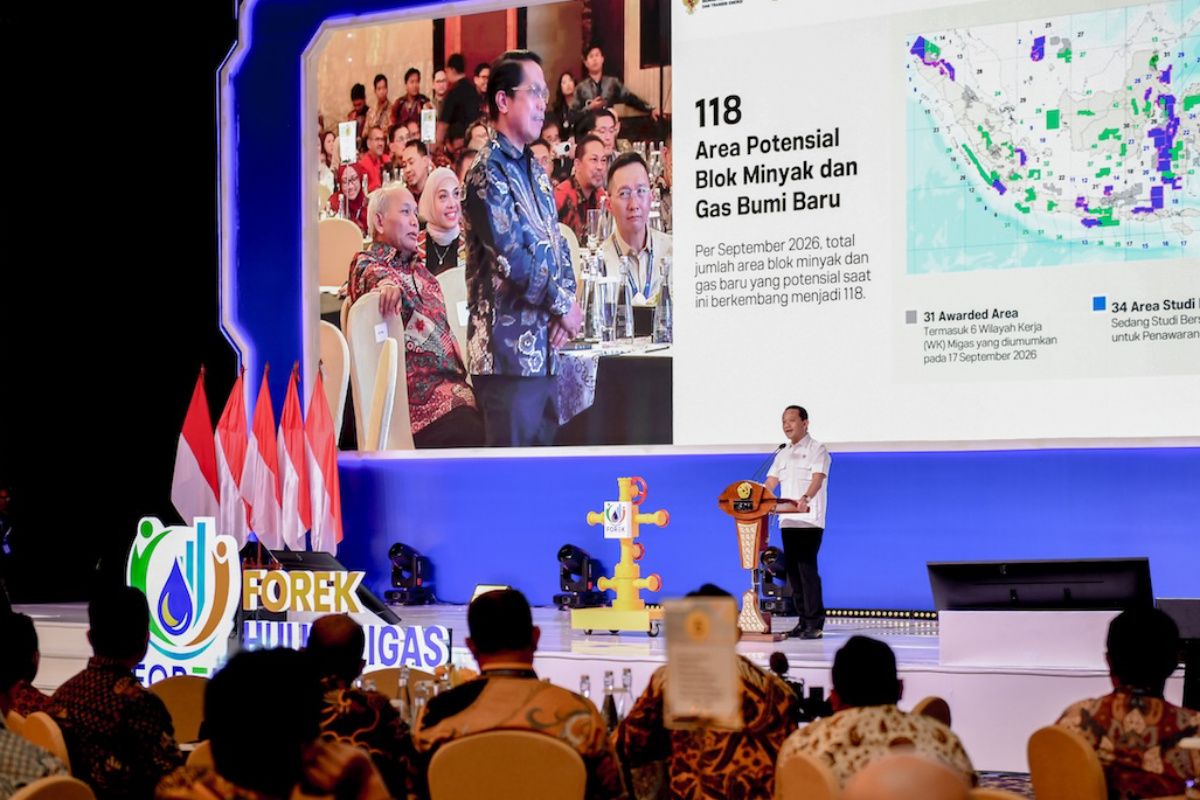
Jakarta (ANTARA) – Coordinating Minister for Downstreaming and Energy Transition and Energy and Mineral Resources Minister Bahlil Lahadalia has urged production-sharing contractors (KKKS) that hold concessions and have secured approval for a plan of development (PoD) to proceed with their projects immediately.
“If you are unable to do so, hand the concession over to the state. We will then offer it to whoever is capable of carrying out the work,” Bahlil said in a statement in Jakarta on Wednesday.
Indonesia currently imports around 700,000–750,000 barrels of oil a day, he said. To reduce that figure, projects on blocks with approved PoDs need to be expedited.
Bahlil made the remarks while opening the 2026 Upstream Oil and Gas Forum (FOREK Hulu Migas) at the Kempinski Grand Ballroom in Jakarta on Wednesday (28 October). The forum brought together regulators, KKKS, contractors, academics and upstream oil and gas investors.
The directive also applies to Pertamina. Bahlil said its status as a state-owned company was no excuse for working slowly. If it could not manage projects alone, Pertamina should share their development with other companies.
“Even though Pertamina is state-owned, I am not asking you to work slowly. You must move quickly,” he said.
The call reflects the wide gap between national oil consumption and production. Bahlil said consumption stood at around 1.6 million barrels a day, while production was only about 600,000–650,000 barrels a day. The B50 biodiesel programme covers around 250,000–300,000 barrels, leaving the country to import approximately 700,000–750,000 barrels a day to meet the remaining demand.
“The work that remains very challenging for us is how to increase lifting,” Bahlil said.
He said this was the right moment to act: global oil prices are rising and demand is strengthening. At the same time, uncertain geopolitical conditions are prompting every country to protect its own energy needs, while competition for oil could fuel tensions in various regions, including South-east Asia.
Efforts to raise production also face challenges. Most of Indonesia’s oil wells are ageing, and national lifting has continued to decline over the past decade. Bahlil called on KKKS to innovate and use engineering and technology to optimise output, as Exxon has done in Cepu, East Java.
Bahlil described his directive as an appeal rather than a threat, intended to encourage businesses to act quickly. He said he was optimistic that if all concession holders worked seriously and swiftly, President Prabowo Subianto’s target could be achieved in 2029–2030. Accelerating the projects is part of the government’s effort to achieve energy self-sufficiency.