
Bahlil Reveals Indonesia's Energy Challenges, Oil Imports Reach 1 Million Barrels Per Day
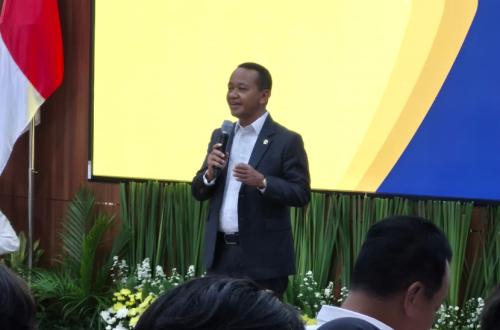
Energy and Mineral Resources Minister Bahlil Lahadalia stated that Indonesia’s energy sector is facing significant challenges amidst global uncertainty, particularly due to geopolitical tensions affecting supply, prices, and energy security. Bahlil explained the drastic changes in Indonesia’s energy landscape compared to the 1990s. He noted that Indonesia, once an oil exporter, now relies on imports due to declining domestic production. “Our nation now differs from 1996-1997 in two respects. First, our lifting at that time could reach 1.6 million barrels per day. Our consumption was only 500,000 barrels per day, so we exported around 1.1 million barrels per day,” Bahlil said during the launch of the INDEF 2026 Mid-Year Study, monitored online. However, conditions changed after the reform era. Oil production continued to decline, with Indonesia’s oil lifting in 2025 reaching only around 650,000 barrels per day. The government is even targeting a lifting of approximately 610,000 barrels per day in 2026. Simultaneously, the need for oil imports has increased. Bahlil mentioned that Indonesia now must import around one million barrels of oil per day, a complete reversal from two decades ago when the country exported a similar amount. According to him, one of the main causes of the production decline is the ageing of oil wells. Out of approximately 40,000 existing wells, only about 18,000 to 19,000 are still producing, with continuously declining productivity. “Because our wells are old. So, there are three approaches to increase lifting,” Bahlil said. The first approach is the use of technology, including the implementation of enhanced oil recovery (EOR) to boost production from existing oil fields. Second, the government is pushing for the acceleration of oil and gas projects that have been stalled. One project of concern is the Masela Block. Bahlil said the project has been delayed for nearly three decades due to various technical and policy debates. The government has now opted for an execution-oriented approach. “A good theory, if not executed, will never materialise even until death. I asked, which one can proceed quickly,” he stated. The government is targeting the start of construction for the project in 2027, with production expected to commence around 2029-2030. Additionally, the government is opening new exploration opportunities by tendering around 120 potential areas. This step is taken to find new reserves to strengthen the national energy supply. On the consumption side, Bahlil mentioned the government is striving to reduce dependence on imported fuel oil (BBM) through the development of plant-based energy. For diesel, the government is promoting an increase in the biodiesel blend to B40 and B50. According to him, this policy has meant Indonesia no longer imports diesel. National diesel consumption is around 39 million kilolitres per year, with needs met through a combination of fossil fuels and biodiesel. Meanwhile, for petrol, national demand is still around 40 million kilolitres per year. Current domestic production is about 20 million kilolitres, so a portion of the demand must still be met through imports. Bahlil said the government is pushing for the implementation of an ethanol blend in petrol, such as the E20 policy, to reduce imports and safeguard the country’s foreign exchange. “If B50 can meet diesel needs, why not petrol? The goal is so we can reduce imports and prevent foreign exchange from flowing out,” he said. According to Bahlil, energy imports are one of the biggest burdens on Indonesia’s foreign exchange reserves. He estimated that the foreign exchange needed to purchase fuel reaches nearly USD 30 billion per year. Amidst global geopolitical tensions, the government is also diversifying its sources of oil supply. Bahlil said Indonesia is not solely dependent on the Middle East region but has begun seeking supply sources from other countries, including Africa. “We already had a feeling before the war occurred. We immediately diversified,” he stated. He said this strategy has made Indonesia relatively capable of maintaining energy supplies when geopolitical conflicts occur. Indonesia, he said, will continue to apply the principle of a free and active foreign policy in seeking energy sources.