
Bahlil Plans Nickel Smelter Moratorium as Industry Weighs In
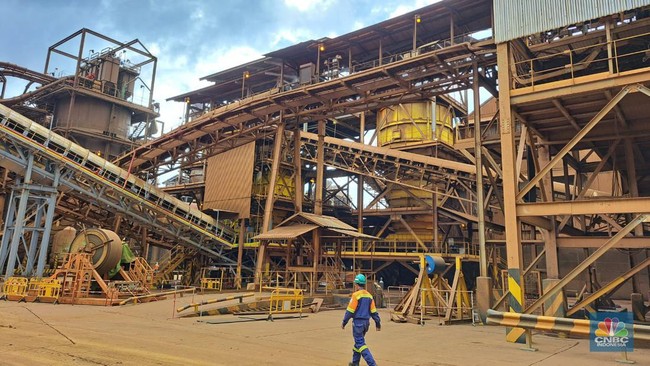
Jakarta, CNBC Indonesia – The Indonesian Nickel Industry Forum (FINI) has commented on the government’s plan to restrict the construction of new nickel refining and processing facilities, or smelters, in Indonesia. The proposed moratorium would specifically target new low-grade nickel smelters producing semi-finished goods.
Coordinating Minister for Downstreaming and Energy Transition and Energy and Mineral Resources Minister Bahlil Lahadalia has recently said the government is considering a nickel smelter moratorium. He cited oversupply of products from these smelters, which has driven down selling prices.
FINI chairman Arif Perdana Kusumah said the balance between global nickel supply and demand had changed dramatically. He said the government’s supply-control measures had helped rebalance the market and reduce the oversupply.
Indonesia currently accounts for around 60% of global nickel supply, with production reaching 2.5 million tonnes in 2025, according to Arif. Of that total, 2.05 million tonnes consisted of nickel pig iron (NPI), ferronickel (FeNi) and matte, while the remaining 450,000 tonnes comprised mixed hydroxide precipitate (MHP) and nickel sulphate.
“The balance between nickel supply and demand has in fact changed dramatically since the end of 2025. The tighter supply policies implemented by the Indonesian Government have, in theory, rebalanced the market, reducing the substantial oversupply seen in previous years,” Arif told CNBC Indonesia on Wednesday (14 October 2026).
FINI records show that Indonesia’s total nickel smelter production capacity in 2025 reached 2.7 million tonnes of nickel from pyrometallurgical and hydrometallurgical routes. Indonesia’s refined nickel production is projected to fall by around 3.5% to 4% in 2026 compared with the previous year.
“Higher marginal costs have led to price prospects now being at a higher level than previously forecast,” he said.
However, Arif said that in 2027, additional production capacity was expected to come from high-pressure acid leach (HPAL) hydrometallurgical projects completing construction. Indonesia’s MHP production capacity, which stood at 450,000 tonnes in 2025, is expected to rise to more than 900,000 tonnes of nickel by the end of 2027.
He said this could create a new problem for the market, potentially limiting price increases and adding uncertainty over domestic policy.
“However, inventories on the LME and in China, which could exceed 600,000 tonnes this year, remain a problem for the market and could limit price gains. Uncertainty over domestic and global policies and regulations, as well as geopolitical conditions, also remain concerns,” he said.
Bahlil considers moratorium
The government is studying a proposal to impose a moratorium or restrict the construction of nickel refining and processing facilities that still produce semi-finished goods. The review comes amid a global nickel surplus that has pushed down world prices.
Bahlil said most of the nickel smelters currently in operation produce only semi-finished materials, at around 50% to 60% of the processing chain. He said supply currently exceeds market requirements by as much as 2.5 million tonnes, directly affecting international nickel prices.
“There is an oversupply, which is why prices are falling. We can consider starting to minimise these semi-finished industries, and perhaps even imposing a moratorium. What we will encourage instead are industries that produce finished downstream products,” he said on the sidelines of the 2026 Investor Daily Summit in Jakarta, as quoted on Wednesday (14 October 2026).
Bahlil said the government would regulate national production volumes so that Indonesia’s mining commodities were not sold cheaply when the market was saturated. Although smelters’ installed capacity was theoretically high, actual operating levels would be adjusted in a measured way in response to global supply and demand.
“Even if installed capacity is, say, 10, while oversupply persists, production may not reach 10. That is what we will regulate. If we keep following smelter demand, our prices will certainly fall,” he said.
As well as stabilising prices and optimising state revenue, production controls are intended to ensure the sustainability of national natural resources. Bahlil noted that minerals such as nickel are finite and cannot regrow like agricultural or plantation crops.
“If prices are plunging, we should not flood the market either, because then our goods will be cheap. We do not want to sell our goods cheaply. Once nickel or coal is extracted, it cannot grow back. So we must also manage this sustainably for the nation’s future,” he said.
Source: jawawa.id (https://jawawa.id/newsitem/bahlil-plans-nickel-smelter-moratorium-as-industry-weighs-in-1791957029)
Originally published by CNBC Indonesia (https://www.cnbcindonesia.com/news/20261014111823-4-776038/bahlil-bakal-moratorium-smelter-nikel-industri-buka-suara), translated from Indonesian