
Bahlil Places Four Agencies Under the Coordinating Ministry for Downstreaming
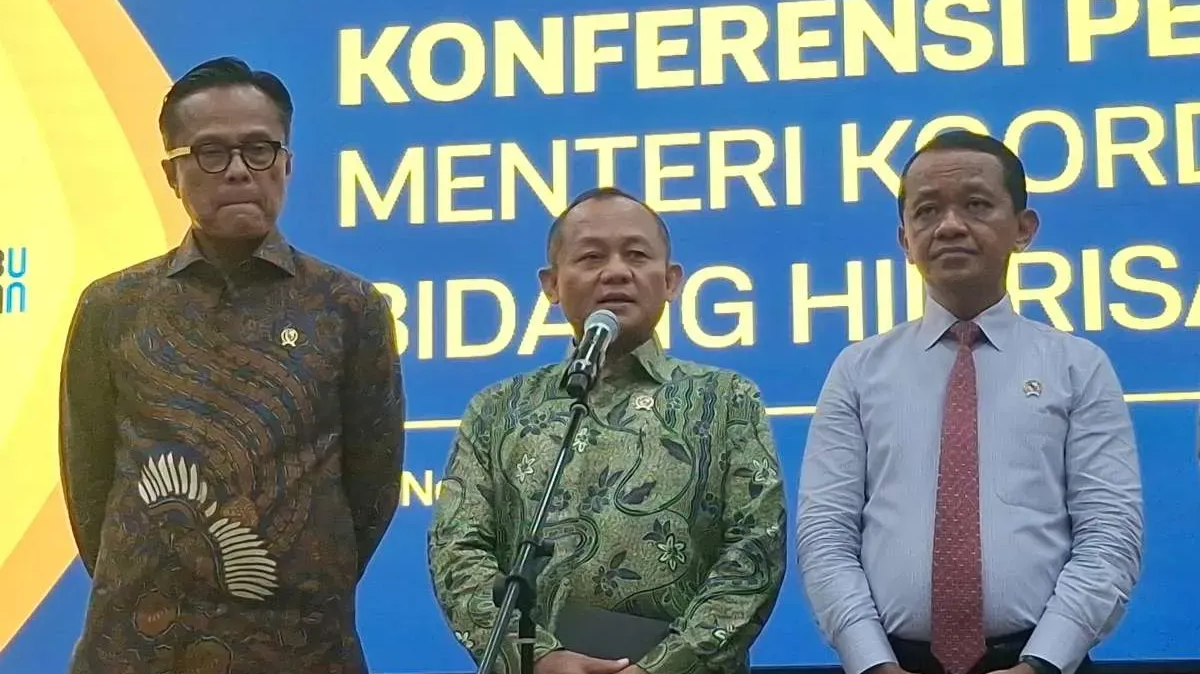
The government is beginning to consolidate policies on downstreaming, industry, investment and energy through the Coordinating Ministry for Downstreaming and Energy Transition. Bahlil Lahadalia announced four ministries and agencies under its coordination at the Energy and Mineral Resources Ministry office in Jakarta on Monday (23 November 2026).
The four institutions are the Ministry of Investment/Investment Coordinating Board (BKPM), the Ministry of Energy and Mineral Resources (ESDM), the Ministry of Industry, and the State-Owned Enterprises Regulatory Agency (BP BUMN). The coordination structure is based on Presidential Regulation No. 99/2026.
Bahlil said the regulation allows the energy minister to serve concurrently as Coordinating Minister for Downstreaming and Energy for the first time.
“Article 41 on transitional provisions in Presidential Regulation No. 99/2026 states that, for the first time, the Coordinating Minister for Downstreaming may be the minister responsible for energy, who serves as the coordinator,” said Bahlil Lahadalia, Coordinating Minister for Downstreaming and Energy.
The consolidated coordination is intended to accelerate the downstreaming agenda, a priority of President Prabowo Subianto. The government is targeting stronger industry, job creation, higher tax revenue and greater economic value from domestic products.
Bahlil said economic transformation through industrial development was one of the policy’s main objectives.
“We are transforming our economic growth, and one of the aims is industry and downstreaming, followed by creating jobs, tax revenue and competitive added value,” he said.
On administrative matters, Bahlil said holding both positions would not mean he received two salaries. Under Presidential Regulation No. 99/2026, he would receive one salary as Minister of Energy and Mineral Resources.
“There is no separate salary for the coordinating minister, because under the regulation it is the ESDM minister who becomes the coordinating minister. There is only one salary,” he said.
The coordinating ministry’s operating costs will also temporarily be covered by the ESDM Ministry’s budget. The arrangement will be accompanied by the use of staff from several relevant ministries.
“There is one operating budget and one salary. For now, the budget will come from ESDM. Efficiency is certain: one salary, two jobs. Previously it was one salary, one job; now it is one salary, two jobs,” Bahlil said.
According to Bahlil, personnel carrying out the coordination function will come from the ESDM Ministry, the Ministry of Investment and Downstreaming/BKPM, and the Ministry of Industry. Staffing needs will reflect the coordinating ministry’s role in bringing institutions together.
“Some staff will come from ESDM, and I have also asked for some from the Ministry of Investment and the Ministry of Industry. A coordinating ministry only needs a small staff; its role is just coordination,” he said.
The inclusion of the Ministry of Industry in the structure was welcomed by Industry Minister Muhammad Sarmuji. He said downstreaming was directly linked to industrialisation and that the two required integrated coordination.
“We were invited today to the first meeting by the Coordinating Minister for Downstreaming and Energy. We welcome the Ministry of Industry being placed under the coordinating ministry because the connection is very close,” Sarmuji said.
Sarmuji described downstreaming as one stage in the broader process of industrialisation. Bringing coordination together is expected to align policies for developing national industry.
“We all know that industry and downstreaming are closely connected; downstreaming can also be one stage of industrialisation as a whole,” he said.
He also highlighted the participation of the Ministry of Investment and BP BUMN in the coordination structure. A conducive investment climate, he said, was necessary for industrial development.
“We are also pleased that the coordinating ministry includes the Minister of Investment and BUMN. At the outset, we must ensure that a good investment climate can be created so that industry can grow,” Sarmuji said.
State-owned enterprises and the private sector could also provide complementary sources of economic growth, he said, with both helping to drive national industrial development.
“These are two engines of economic growth that can help Indonesia reach greater heights: one in the private sector under the Ministry of Industry, and the other in state-owned companies under BP BUMN,” he said.
The Coordinating Ministry for Downstreaming and Energy Transition has also been tasked with promoting national energy security. Its priorities include developing 100-gigawatt (GW) solar power capacity and nuclear energy.
The government is also aiming to increase national oil reserves. Bahlil said Indonesia’s current stocks were sufficient for only about 21 days of demand, while the government’s target is 60 days, in line with its minimum standard.
The inaugural coordination meeting was attended by Investment Minister and BKPM head Rosan Roeslani, Industry Minister M Sarmuji and BP BUMN head Dony Oskaria.
Source: jawawa.id (https://jawawa.id/newsitem/bahlil-places-four-agencies-under-the-coordinating-ministry-for-downstreaming-1795427499)
Originally published by limapagi.id (https://www.limapagi.id/struktur-kemenko-hilirisasi-bahlil), translated from Indonesian