
Bahlil is Intensifying Efforts: What is CNG and How Does it Differ from LPG?
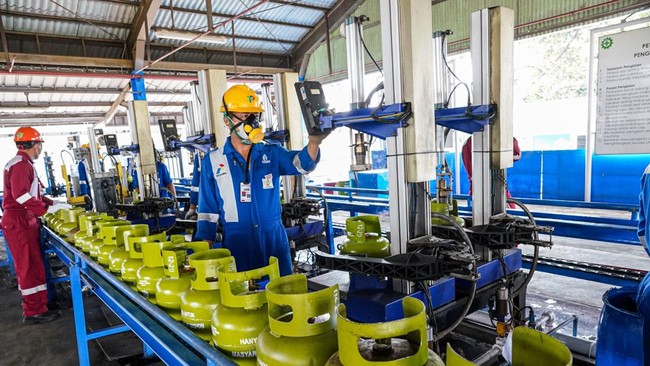
Jakarta, CNBC Indonesia - Minister of Energy and Mineral Resources (ESDM) Bahlil Lahadalia is promoting alternative energy to replace Liquefied Petroleum Gas (LPG). That energy is Compressed Natural Gas (CNG).
The Ministry of ESDM is currently conducting trials for the development of CNG in 3 Kilogram (kg) form, with implementation to be carried out this year in 2026. The plan prioritises the application of 3 kg CNG, especially in major cities on Java island first.
The government appears more serious in pursuing the CNG project to curb the volume of 3 kg LPG imports, which have become an annual burden on the state budget. CNG itself is considered more economical because Indonesia has natural gas resources as the basis for CNG.
“CNG for 3 kg is still undergoing exercises and trials for its cylinders. CNG is expected as one alternative to substitute our large imports,” said Bahlil after the inauguration event at the Ministry of ESDM, quoted on Thursday (7/5/2026).
The use of CNG as a replacement for LPG has actually been implemented domestically, but in 12-20 kg cylinder forms for the hotel, restaurant, and cafe (horeca) sector. Its use is considered quite efficient.
Thus, the government is now developing 3 kg CNG cylinder technology to make it more suitable for household use.
“But for CNG, the 12 kg and 20 kg ones are already in operation for hotels and restaurants. And it’s good, more efficient. But we can’t ask the people to use the heavy ones, 20 kg. So this is what we’re working on,” said Bahlil.
Advantages of CNG
The Indonesian Liquefied & Compressed Natural Gas Companies Association (APLCNGI) has outlined several advantages of using CNG as an alternative to LPG for public needs.
APLCNGI Chairman Dian Kuncoro explained that Indonesia currently has far more abundant natural gas reserves compared to crude oil reserves. According to him, CNG offers distribution flexibility as it can reach remote areas that are difficult to access by conventional gas pipeline networks.
“Speaking about the utilisation of natural gas for households, one effective and efficient method that already exists is through pipeline clusters. And that can serve areas far from pipelines,” he said at a discussion event by ASPEBINDO, quoted on Thursday (7/5/2026).
Additionally, another advantage from a technological storage perspective is the shift to using composite or carbon materials. Innovations in CNG cylinders have a much lighter weight and stronger durability compared to the Type 1 steel cylinders traditionally used in the gas industry.
The use of CNG for the household sector can also be done through a pipeline clustering model that has been implemented in some areas like Yogyakarta and Sleman. That scheme allows communities to enjoy gas flow without fully relying on the availability of the national transmission pipeline infrastructure.
Furthermore, the use of CNG also offers business economic advantages that are more stable.
Differences Between CNG and LPG
APLCNGI notes various differences between LPG and CNG, here is a summary:
LPG
Main Composition: Mixture of Propane (C3H8) and Butane (C4H10) gases
Storage Form: Stored in liquid form with low pressure.
Storage Container: Uses conventional gas cylinders in 3 kg, 12 kg, and 50 kg sizes.
Main Use: Focused on household consumption, restaurants, and small industries.
Advantages: Very practical because it is easy to distribute and use by the general public.
Disadvantages: Has higher emission levels compared to natural gas.
CNG
Main Composition: Methane (CH4)
Storage Form: Remains in gaseous form compressed at very high pressure (200-250 bar).
Storage Container: Uses special cylinders (to withstand high pressure).
Main Use: Currently more widely used for transportation (buses, cars), industry, and small power plants.
Advantages: More environmentally friendly (low emissions) and more cost-effective.
Disadvantages: Distribution is still limited due to technical constraints on high-pressure storage.