
Bahlil Highlights Rise in Non-Tax State Revenue Despite Lower Coal Production
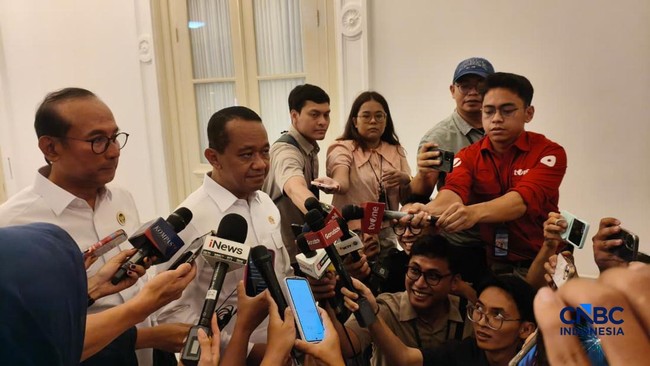
Jakarta, CNBC Indonesia - The Minister of Energy and Mineral Resources, Bahlability Lahadalia, has revealed that non-tax state revenue (PNBP) from the mining sector has experienced an increase. This comes despite the reduction in coal production outlined in the 2026 Work Plan and Budget (RKAB).
This increase in revenue was achieved through the restructuring of supply and demand regulations, which successfully boosted the value of domestic commodity prices in the international market. The Ministry is currently prioritising the optimisation of state revenue rather than merely driving excessive coal production levels. This production limitation policy has proven effective in returning control of coal prices to the Indonesian government and curbing price manipulation by external parties.
“Reports from the Director General of Mineral and Coal to me indicate that coal production will not be as high as in 2025, but the PNBP is higher compared to 2025. This means we want production to not be too high, but state revenue is what is most important,” Bahlil stated during his speech at a blood donation event for the 81st Mining Anniversary in Jakarta.
In addition to increasing state revenue, the restructuring of supply governance is also aimed at creating equitable opportunities for micro, small, and medium enterprises (MSMEs) in the mining sector. MSMEs are noted to contribute 61% to the national gross domestic product (GDP) and have proven to be a primary pillar of the national economy during crises.
“MSMEs are now present in mining as well. Those requesting RKAB for 500, 200,000, 700,000, or 1,000,000 [tonnes] are MSMEs. If one company dominates everything, I would prefer more people to earn a living rather than one person holding all the power,” said Bahlil.
The Ministry of Energy and Mineral Resources (ESDM) emphasised that the government will protect small and medium-scale entrepreneurs from being crushed by competition with large conglomerates. This mining sector restructuring has been carried out gradually since the regulatory reforms in 2025, continuing with RKAB management in 2026, and moving towards policy maturation in 2027.
“This is only the second year; in 2025, we laid the groundwork through regulatory reform. 2026 is the follow-up to that reform. By 2027, we will further mature and sharpen it, so that we can protect the dignity of the state and the Ministry of ESDM,” he concluded.
The Ministry of ESDM noted that non-tax state revenue (PNBP) from the mineral and coal (minerba) subsector reached IDR 108 trillion as of 31 August 2020. This increase in state contributions of IDR 21 trillion coincides with the policy of reducing coal and nickel production volumes in the RKAB.
Previously, the Director General of Mineral and Coal, Tri Winarno, explained that the 2026 RKAB restructuring reduces average monthly coal production by 8 million tonnes and nickel production by 13 million tonnes of ore.
According to him, measured production governance has proven capable of boosting state revenue without the need for excessive exploitation.
“This means that with good management, and by not being excessive in production, it will actually provide a positive impact on the state and all of us,” he added.
PNBP from the coal sector increased to IDR 66 trillion as of 31 August 2026, from IDR 59 trillion during the same period the previous year. This increase of IDR 7 trillion in coal contributions occurred amidst a decrease in average monthly production from 68 million tonnes in 2025 to 60 million tonnes in 2026.
“So, in terms of production, our monthly volume decreased by 8 million tonnes, but our PNBP increased by IDR 7 trillion. This means every year we experience an increase of IDR 1 trillion while production drops by 8 million tonnes,” he explained.
Similarly, in the nickel sector, PNBP contributions surged to IDR 21 trillion as of 31 August 2026, from IDR 10 trillion as of 31 August 2025. This surge of IDR 11 trillion in nickel revenue was achieved despite a reduction in nickel production volume of 13 million tonnes of ore.
“For nickel, as of 31 August 2026, our PNBP is IDR 21 trillion, whereas on 31 August 2025, it was IDR 10 trillion. As for production, it decreased by about 13 million tonnes of ore,” he clarified.
The RKAB reduction is focused on coal and nickel commodities by applying an ‘optimum production’ approach. This policy balances production volumes with market needs, Domestic Market Obligation (DMO) requirements, price movements, logistics, and reserve sustainability to provide maximum results for the state.
“Therefore, our approach is optimum production, where production must be balanced with the market, market needs, DMO, price conditions, logistics, and reserve sustainability. That is the spirit of the RKAB restructuring we are undertaking,” he concluded.
Source: jawawa.id (https://jawawa.id/newsitem/bahlil-highlights-rise-in-non-tax-state-revenue-despite-lower-coal-production-1790063681)
Originally published by CNBC Indonesia (https://www.cnbcindonesia.com/news/20260922121601-4-769862/bahlil-pamer-pnbp-naik-walau-produksi-batu-bara-tak-sebanyak-2025), translated from Indonesian