
Bahlil: Government Begins Drafting Roadmap for E50 Development
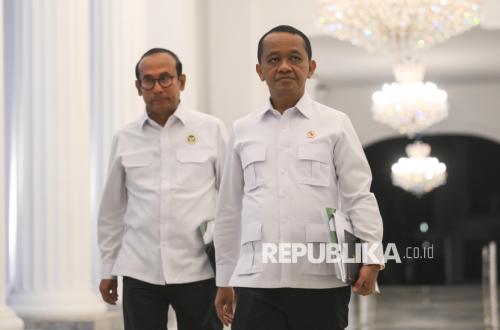
The government has begun drafting a roadmap for the development of 50 per cent ethanol-blended fuel, known as E50. This plan was discussed following the proposal of E50 as an alternative energy source during the National Energy Council (DEN) session.
The Minister of Energy and Mineral Resources, Bahllagil Lahadalia, stated that the development of E50 is part of the government’s efforts to find alternative energy sources to strengthen national energy security. He noted that Indonesia needs to develop energy sources whose raw materials can be produced domestically.
“As we discussed in the recent DEN session, we are seeking alternative energy solutions amidst uncertain global conditions. Today, we cannot place our hopes on other nations, especially regarding energy,” Bahlil said in Jakarta on Monday (21/9/2026).
Bahlil noted that the development of E50 could serve as a continuation of Indonesia’s success in developing biodiesel up to the B50 level. The ethanol used as a raw material for E50 can be derived from several agricultural commodities, such as sugarcane, cassava, and maize.
“Building on our success in developing biodiesel, we have now reached B50, a blend of fossil and plant-based fuels,” he said.
According to Bahlil, the development of E50 also takes into account the implementation of ethanol-based fuels in several other countries. He mentioned that Brazil has implemented E100, while several states in the United States also use ethanol blends up to E100.
The government aims for E50 development to reduce dependence on petrol imports. However, Bahlil emphasised that this target must be supported by domestic ethanol production to ensure that the implementation of ethanol blends does not create a new dependency on imported raw materials.
“If we can achieve E50, God willing, our target is that we will no longer need to import finished petrol products,” Bahlil said.
Consequently, the Ministry of Energy and Mineral Resources, together with the Directorate General of Oil and Gas, will draft a roadmap for the gradual implementation of ethanol blends. Bahlil provided a projection of implementing E10 in 2027 and developing E20 in 2028 before moving towards higher blend levels.
“When will this be implemented? There is a roadmap. It was just decided in the DEN session. Our task now, along with the Directorate General of Oil and Gas, is to design the roadmap,” he said.
Bahlil emphasised that the implementation of E10, E20, and eventually E50 will be adjusted to the readiness of the industry and domestic ethanol production capacity.
“We do not want to implement E10, E20, or E50 if the ethanol is imported from abroad; that would be the same thing. We want to utilise our domestic production,” he added.
On the upstream side, the Minister of Agriculture, Andi Amran Sulaiman, stated that the government is beginning to consolidate land provision to support the development of ethanol using cassava, sugarcane, and maize as raw materials. This step follows a limited meeting regarding ethanol development held under the direction of President Prabermowo Subianto.
Amran noted that 44 regents (Bupati) have expressed support for the programme. The government will begin preparing the development of ethanol raw material commodities, including a pilot programme for maize with an initial area of 1,000 hectares per regency.
“For maize, we are providing assistance to regents for trial plots. We will observe the results of the 1,000 hectares per regency. If the maize is good and the yield is high, I will increase the maize area in January,” said Amran.
According to Amran, ethanol development requires approximately 1 to 2 million hectares for these three strategic commodities. The government is also preparing for the construction of ethanol factories in various regions.
“This ethanol requires 1 to 2 million hectares across three strategic commodities. God willing, we will build the factories and move massively across Indonesia,” he said.
Amran stated that the government will prioritise the use of available land before considering the release of forest areas. One source of land being studied includes land that has already been released, covering approximately 1.3 million hectares.
Furthermore, the government is preparing an investment scheme involving State-Owned Enterprises (SOEs) and the private sector. Amran mentioned that the SOE portion could reach 30 per cent, with the remainder coming from the private sector.
Amran noted that the development of E50, alongside B50, has the potential to save approximately $30 billion in foreign exchange per year if the entire programme is realised. This saving, he said, would stem from the reduced need for energy imports.
“Our savings could reach $30 billion if E50 is fully realised, combining E50 and B50. This means approximately 500 trillion Rupiah per year in foreign exchange savings,” Amran explained.
Amran said the government is still in the early stages of land consolidation and preparation, and the development of ethanol blends will be carried out gradually. He estimated that the implementation of E20 could take place in 2029, continuing towards higher blend levels in subsequent years.
“We have E5, E10, and E20 in 2029. Our estimate is that if we move from now, we could reach E40 by 2030 or 2031,” he said.
Amran also mentioned that the ethanol industry development has the potential to create at least 8 million permanent jobs. The programme is directed as part of the effort to achieve energy independence, involving farmers, SOEs, the private sector, and local governments.