
Bahlil: Geothermal Development Key to Indonesia's Energy Self-Sufficiency
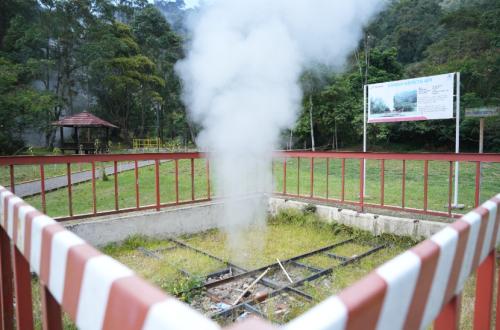
Energy and Mineral Resources Minister Bahlil Lahadalia has stated that geothermal development is a crucial part of supporting the government’s energy self-sufficiency and downstreaming agenda, in line with the Asta Cita vision. Accordingly, the Ministry of Energy and Mineral Resources has set four main priorities: increasing energy supply, expanding energy access and service coverage, accelerating the energy transition, and speeding up downstreaming.
Indonesia currently ranks second in the world in installed geothermal capacity, Bahlil said while opening the 12th Indonesia International Geothermal Convention & Exhibition at the Jakarta Convention Centre on Wednesday. He noted that Indonesia’s total geothermal potential reaches 23,202.77 MW, while installed capacity stands at around 2,776.39 MW. This means only about 11.6 per cent of the potential has been utilised, leaving around 88.4 per cent untapped.
Bahlil explained that Indonesia’s geothermal potential is spread across various regions. Sumatra has potential of around 9,441.10 MW, Java around 7,587.80 MW, Sulawesi around 3,006 MW, and Nusa Tenggara around 1,272.87 MW. Kalimantan, Bali, Maluku, and Papua also have geothermal potential but do not yet have installed capacity, he added.
Through the 2025–2034 Electricity Supply Business Plan, the government is pursuing a vision of making Indonesia the world’s largest geothermal energy producer by 2030. Bahlil said geothermal development is directed not only at supporting the energy transition but also at strengthening national energy security and independence.
For this year, the government is preparing development at two Preliminary Survey and Exploration Assignment locations and four Geothermal Working Areas with total resources of around 131 MW, additional capacity of around 185 MW, and projected investment value of around US$1.16 billion. Bahlil said the government is also preparing regulatory and investment catalysts to accelerate geothermal development, including revising Government Regulation No. 7 of 2017 to support indirect geothermal utilisation and improve investment returns, as well as revising Presidential Regulation No. 112 of 2022 to accelerate new and renewable energy development.
Geothermal development is being pushed towards a ‘Beyond Geothermal’ or geothermal economy concept, namely optimising geothermal resources not only for electricity generation, Bahlil said. One example is mineral extraction at the Dieng Project, with potential production of around 2,190 tonnes of lithium per year and 8,000 tonnes of silica per year. In this way, geothermal can also support the development of value-added minerals and the national downstreaming agenda.
Bahlil noted that direct geothermal utilisation has already been applied in community economic activities. In Kamojang, geothermal energy is used for coffee drying, reducing the drying process to around three to four days. In Lahendong, geothermal energy is used in palm sugar processing as a replacement for conventional wood-fired methods, making it more environmentally friendly and saving more than 330 trees per year.
Bahlil added that geothermal development has delivered economic benefits to the state and regions. Geothermal non-tax state revenue reached around Rp 2.46 trillion, or about 112 per cent of the Rp 2.19 trillion target, last year. Additionally, from 2014 to 2025, production bonuses distributed to producing regions reached around Rp 1.42 trillion.
Bahlil said geothermal benefits are also directed to be felt directly by communities through programmes in education, health, people’s economy, environment and social affairs, as well as local job creation. One example is an agricultural empowerment programme around geothermal power plants that produced around 14.4 tonnes of harvest, empowering around 90–100 local workers each harvest season, with around 90 per cent of the workforce being women.
At IIGCE 2026, Bahlil said the government handed over Geothermal Permits to state electricity company PT PLN for the Gunung Ungaran Working Area and to PT Telaga Rano Geothermal for the Telaga Ranu Working Area, as part of efforts to accelerate geothermal project development from the potential stage to the execution stage. The government is also preparing to offer five Geothermal Working Areas and seven Preliminary Survey and Exploration Assignment areas in 2026 to increase investment and expand geothermal exploration activities.
Overall, the pipeline covers potential development of around 392 MW with planned investment of around US$2.23 billion, he said. The five Geothermal Working Areas prepared for offer are Danau Ranau, Hamiding, Songgoriti, Oka Ile Ange, and Gunung Sirung, with total reserves of around 304 MW and planned capacity of around 145 MW. The planned capacity consists of Danau Ranau 40 MW, Hamiding 50 MW, Songgoriti 40 MW, Oka Ile Ange 10 MW, and Gunung Sirung 5 MW.
In addition to the working areas, the government is preparing seven Preliminary Survey and Exploration Assignment prospect areas: Talamau and Simisiuh in West Sumatra, Srirejo in Lampung, Lili Seporaki in West Sulawesi, Maranda Kawende in Central Sulawesi, Massepe Sulili in South Sulawesi, and Banda Baru in Maluku. These seven areas have total resources of around 321 MW and total possible reserves of around 247 MW.
Through accelerated exploration, improved project economics, strengthened regulation, and expanded investment, geothermal is expected to become one of the backbones of energy self-sufficiency as well as a new source of economic growth for Indonesia, Bahlil said.