
Bahlil Explains the Origins of Rule Requiring Mines to Use Local Contractors
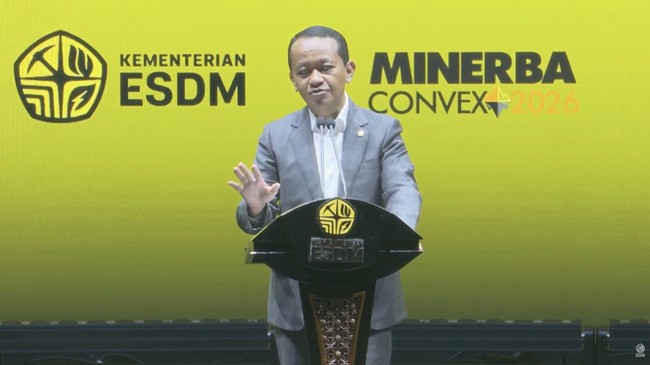
Energy and Mineral Resources Minister Bahlil Lahadalia, who also serves as Coordinating Minister for Downstreaming and Energy Transition, has issued a rule requiring mining companies to prioritise local contractors and prohibiting the use of affiliated contractors without approval.
The rule is set out in Energy and Mineral Resources Ministerial Decree No. 365.K/MB.01/MEM.B/2026 on Technical Guidelines for Approving the Use of Subsidiaries and/or Affiliates in Mineral and Coal Mining Services.
Bahlil explained the reasons for the policy to mining industry representatives. “Secondly, ladies and gentlemen, yesterday I issued a ministerial decree. I have also been criticised over it by some of my friends among the big business owners. It says contractors must not be affiliated and local people must be used. Do you know why we issued that decree? I’ll explain,” Bahlil said at the 2026 Minerba Convention & Exhibition (Convex) at JIExpo on Monday (2 November 2026).
He said procurement for mining and downstreaming projects had previously tended to be dominated by businesses from outside the regions where projects were located. As a result, local businesses and communities did not receive a share of the economic benefits from managing natural resources in their areas.
“When I was chairman of Hipmi, businesses in Jakarta would build downstreaming industries in the regions, and everything—from nail clippers to hair clippers—would be procured from Jakarta. What, then, were local people supposed to become? The government has an obligation to ensure fairness. That is why the decree was issued,” he said.
The decree is intended to prevent the procurement of goods and services in the mining sector from being monopolised by certain groups. Allocating work to local contractors is expected to generate direct economic growth in the regions.
“Not all work should be controlled or monopolised by one particular group. It must be shared with local people so they can also take part in generating economic activity in their respective regions. That is the policy now,” he said.
Bahlil said he remained committed to enforcing the rule despite opposition from some large businesses, adding that the interests of local communities should take precedence over those of a particular business group.
“For me, when faced with a choice between the interests of the people and the interests of a group, I would rather prioritise the people,” he said.
The decree, issued in Jakarta on 18 September 2026, also revokes Directorate General of Minerals, Coal and Geothermal Regulation No. 376.K/30/DJB/2010.
The decree states:
FIRST: Holders of Mining Business Permits or Special Mining Business Permits that use mining services in their operations must use companies holding Mining Services Business Permits, prioritising mining-services companies based in the regency or municipality surrounding the Mining Business Permit or Special Mining Business Permit area.
SECOND: Holders of Mining Business Permits or Special Mining Business Permits are prohibited from involving subsidiaries and/or affiliates in mineral and coal mining services without the Minister’s approval.
THIRD: The prohibition on involving subsidiaries and/or affiliates in mineral and coal mining services covers:
direct share ownership by a Mining Business Permit or Special Mining Business Permit holder in a Mining Services Business Permit holder; or
one or more common ultimate beneficial owners of a Mining Business Permit or Special Mining Business Permit holder and a Mining Services Business Permit holder.
FOURTH: Approval to use subsidiaries and/or affiliates in mineral and coal mining services may be granted only to Mining Business Permit or Special Mining Business Permit holders carrying out assignments from the Government, including:
implementing a national strategic project;
building mineral processing and/or refining facilities, or developing and/or utilising coal; and/or
meeting domestic demand for minerals or coal.
FIFTH: Applications for approval to use subsidiaries and/or affiliates under the fourth provision must be submitted to the Minister.
SIXTH: The Minister must issue a decision on an application to use subsidiaries and/or affiliates in mineral and coal mining services within 14 working days of receiving a complete and correct application.
SEVENTH: Approval to use subsidiaries and/or affiliates in mineral and coal mining services:
is granted for the fields and subfields covered by the subsidiary’s and/or affiliate’s Mining Services Business Permit, in accordance with the application; and
remains valid until that permit expires.
EIGHTH: Holders of Mining Business Permits issued by a Governor within the Governor’s authority may apply to the Governor for approval to use subsidiaries and/or affiliates.
NINTH: Where administrative or evaluation errors occur in issuing an approval or rejection for the use of subsidiaries and/or affiliates in mineral and coal mining services, the Minister or Governor, as appropriate, may correct them.
TENTH: This Ministerial Decree applies, with the necessary modifications, to holders of Special Mining Business Permits as continuations of Contract/Agreement Operations, Contract of Work holders, and Coal Contract of Work holders.
ELEVENTH: When this Ministerial Decree comes into force, Directorate General of Minerals, Coal and Geothermal Regulation No. 376.K/30/DJB/2010 on Procedures and Requirements for Applications to Approve the Participation of Subsidiaries and/or Affiliates in Mining Services is revoked and no longer applies.
TWELFTH: This Ministerial Decree comes into force on the date it is stipulated. If any errors are discovered later, corrections will be made in accordance with applicable laws and regulations.
Source: jawawa.id (https://jawawa.id/newsitem/bahlil-explains-the-origins-of-rule-requiring-mines-to-use-local-contractors-1793710285)
Originally published by CNBC Indonesia (https://www.cnbcindonesia.com/news/20261103163846-4-781967/bahlil-beberkan-asal-mula-aturan-tambang-wajib-pakai-kontraktor-lokal), translated from Indonesian