
Bahlil Ensures Balance Between Downstream Factory Capacity and Mining Work Plans
Jakarta, CNBC Indonesia - The Minister of Energy and Mineral Resources (ESDM), Bahlil Lahadalia, has ensured a balance between the production capacity of mineral refining and processing facilities (smelters) and the availability of raw materials through the mining Work Plan and Budget (RKAB). The government emphasised that industrial activities can continue with certainty regarding raw material production.
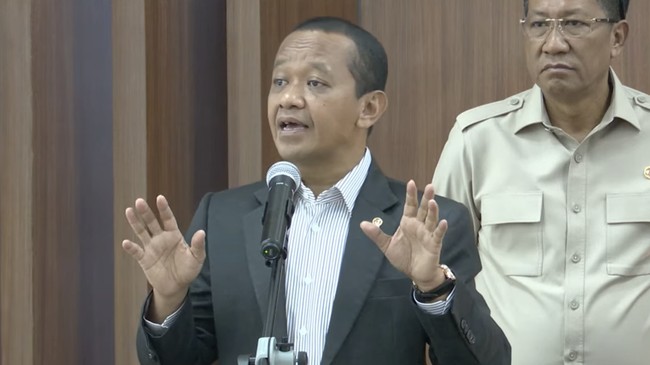
Bahlil explained that the government bears the responsibility of maintaining the investment climate for downstream industries entering Indonesia. He emphasised that the government is focusing on synchronising data so that production permits granted to mining companies align with the needs of smelters. “In order to guarantee the investments made in our beloved country regarding downstreaming, the obligation of the government, particularly the ESDM, is to ensure that all raw materials sourced from our country are available. This means that the production capacity and the RKAB we provide must be balanced so that industry can operate,” he stated during a press conference following a meeting with the Deputy Speaker of the House of Representatives, Sufmi Dasco Ahmad, and the COO of Danantara, Dony Oskaria, at the DPR Building on Monday (08/06/2026).
Notably, the government previously decided to cut nickel ore production targets in the 2026 RKAB. This move aims to drive up nickel prices in the global market and maintain the sustainability of national nickel reserves. In early January 2026, Bahlil explained the reasoning behind the plan to adjust nickel production targets for 2026. “For nickel, we will adjust it to industrial needs and create even distribution. Large industries must purchase nickel ore from mining entrepreneurs; there should be no monopoly. We want regional companies to be strong to foster collaboration so that downstreaming is equitable. We support it, but there must be collaboration,” he said.
For nickel ore, production restrictions are targeted at 250-260 million tonnes in 2026, a decrease from the 2025 RKAB target of 379 million tonnes. Previously, several nickel companies reported receiving lower production quotas compared to the previous year. PT Weda Bay Nickel Indonesia, owned by Eramet Indonesia, noted that its nickel production in North Maluku only lasted until mid-May 2026. While applying for a revision to its 2026 RKAB, the company’s mining activities will temporarily cease for maintenance and care. “The application for an increase in permit revision is currently being submitted by PT Weda Bay Nickel (PT WBN), following the approval of the initial RKAB which was limited to 12 Mwmt of nickel ore for 2026, with production reaching its limit in mid-May; the mine is preparing to be placed on Care and Maintenance in May, awaiting this revision,” management wrote in an official Eramet report.
Eramet Group CEO Christel Bories explained that the company is currently applying for a production quota increase revision. The company is awaiting an official decision regarding additional production volumes to allow mining activities to continue until the end of the year. The company noted that as of mid-April 2026, the target for nickel ore sales to external parties, which was limited to 9 Mwmt, had been fully achieved. Currently, the remaining production quota is allocated strictly to ensure the continuity of raw material supply for the company’s Nickel Pig Iron (NPI) processing plant. “This first quarter confirms the Group’s ability to adapt and mobilise to meet targets, despite uncertainty,” said Bories.
Similarly, PT Vale Indonesia reported that the government has only approved 30% of the 2026 nickel ore production quota requested by the company. The President Director of PT Vale Indonesia, Bernardus Irmanto, stated that if only such a quota is provided for the entire year, it will be difficult to supply the three Vale smelter projects located in South Sulawesi (Sorowako Limonite), Central Sulawesi (Morowali), and Southeast Sulawesi (Pomalaa). These downstream projects, including the Indonesia Growth Project (IGP), are targeted to operate in 2026/2027, with a total estimated investment of US$ 8.7 billion or approximately Rp 147 trillion. “Currently, we have obtained approval for the RKAB, however, the quota provided to PT Vale is only about 30% of what we requested. It will likely be impossible to meet our commitments to the plants I mentioned,” Bernardus stated during a hearing with Commission XII of the House of Representatives in Jakarta on Monday (19/01/2026). The raw material requirements for the three High Pressure Acid Leaching (HPAL) projects are substantial. Bernardus noted that for the Pomalaa project, which has a capacity of 120,000 tonnes of Mixed Hydroxide Precipitate (MHP) per year, the company requires a supply of low-grade nickel ore (limonite) of 21 million tonnes and 7 million tonnes of high-grade nickel ore (saprolite) per year.