
Bahlil: Electricity Export Rules to Be Drafted After Price Agreement
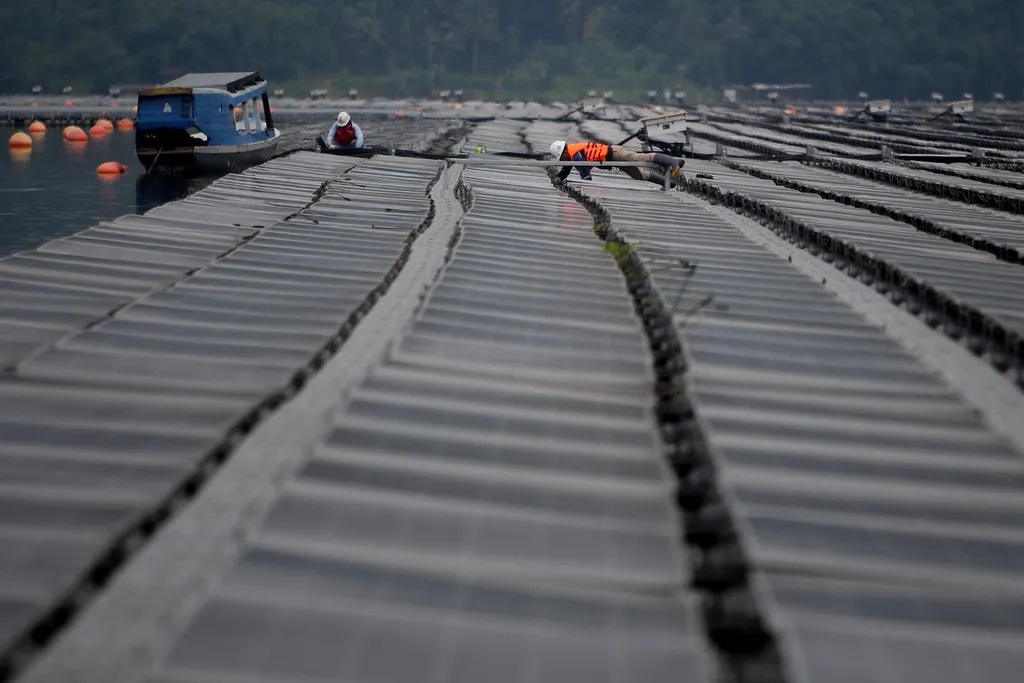
The acceleration of electricity export projects to Singapore is currently awaiting a mutually beneficial price agreement. Although discussions regarding electricity exports have been underway since 2022, the specific regulations and export permits remain pending until a consensus on pricing is reached.
The Minister of Energy and Mineral Resources, Bahlil Lahadalia, explained on Tuesday (7/7/2026) that electricity exports to Singapore are still in the negotiation phase, despite a Memorandum of Understanding (MoU) having been signed in 2025. Regarding regulation, pricing, and various permits, the authority lies with the government, specifically the Ministry of Energy and Mineral Resources.
The implementation of these exports will be conducted on a business-to-business (B2B) basis, potentially between Danantara Investment Agency and Singaporean State-Owned Enterprises, or between private companies. The most critical factor, according to Buju, is that the terms must meet requirements and be mutually beneficial.
Because a price has not yet been agreed upon, technical rules and export permits have not been issued. “There has been no meeting point on the price, so no agreement has been reached. Once the price is established, I will create the regulations,” he told journalists at the Presidential Palace complex in Jakarta.
Bahlil and Singapore’s Minister for Energy, Science, and Technology, Tan See Leng, signed an MoU in Jakarta on 13 June 2025. This MoU covers electricity export cooperation until 2035, including the development of the solar panel industry, carbon capture and storage (CCS), and industrial zones, with a total investment value reaching US$10 billion.
Previously, during the tenure of Minister Arifin Tasrif, a similar MoU was signed with Tan See Leng on 8 September 2023, covering low-carbon electricity cooperation and Indonesia-Singapore cross-border electricity interconnection. This follows subsequent MoUs from 2022 and early 2023, where PT PLN was appointed as the coordinator for the Indonesian side.
During the Leaders’ Retreat at the Merdeka Palace in Jakarta on 6 July 2026, attended by President Prabowo Subianto and Singaporean Prime Minister Lawrence Wong, the Head of the Danantara Investment Management Agency, Rosan P. Roeslani, signed an MoU with several Singaporean energy companies to accelerate this cross-border electricity trade project.
Currently, no specific regulations regarding electricity exports exist, even though Government Regulation Number 40 of 202lar on National Energy Policy has opened the option for such activities. Article 26, Paragraph 1, states that the export of energy sources in the form of cross-border electricity can be conducted to increase efficiency, reliability, and energy security, whilst prioritising local electricity needs.
Furthermore, Paragraph 3 of the same article stipulates that the export and import of cross-border electricity must be carried out by the state electricity company of the exporting or importing nation, or by a business entity appointed to represent said nation.
PT Vanda Energy Indonesia, one of the companies participating in these electricity exports, is awaiting and welcomes the commitment reaffirmed by President Prabowo and PM Wong to strengthen and accelerate cross-border electricity trade (CBET). “We view this development as a very positive step,” said Enda Ginting, Country Manager of Gurīn Energy and Director of PT Vanda Energy Indonesia, in a written statement.
The Vanda Solar & Battery project, according to Enda, has reached the ‘ready to build’ stage. He noted significant progress in commercial, technical, licensing, and environmental aspects, though physical construction is still awaiting the issuance of export permits from the Indonesian Government.
While power generation, transmission, and renewable energy sales are established sectors, cross-border renewable energy cooperation remains a relatively new sector in Southeast Asia. “Therefore, regulations continue to evolve as the government refines policies and licensing processes, and we understand that this is an ongoing process,” he added.
Muhammad Indra Al Irsyad, a researcher at the National Research and Innovation Agency (BRIN), noted that electricity exports are attractive for increasing foreign exchange reserves and driving the new and renewable energy (EBT) industry. However, he emphasised the importance of ensuring that the technology for these ‘clean’ power plants does not rely on imports. “Ensuring eco-friendly products will facilitate entry into developed markets,” he concluded.