
Bahlil Discusses Parliamentary Threshold in Election Law Revision: 5% is Ideal
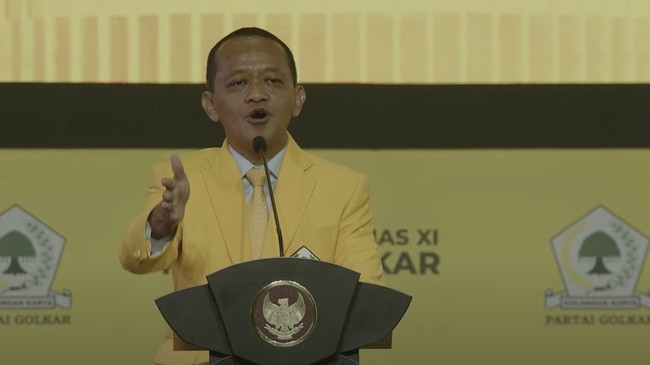
The Chairman of the Golkar Party Central Leadership Board, Bahl_hil Lahadalia, considers a 5% parliamentary threshold (PT) to be the ideal figure for the revision of the Election Law. This assessment was conveyed to journalists at the Presidential Palace in Central Jakarta on Thursday evening (17/09/2026).
According to him, communications between Golkar and various other parties have revealed several different preferences regarding the parliamentary threshold. “There are those who want 6%, 7%, 5%, or even lower. But perhaps the ideal figure is 5%; 5% is suitable,” said Bahlil.
However, he did not clarify whether a meeting between all chairmen of the government-supporting coalition parties and President Prabowo Subianto took place recently to discuss the Election Law revision.
Previously, the Secretary General of the Gerindra Party, Sugiono, stated that Gerindra agrees with a 5% parliamentary threshold in the Election Law revision. “We agree with 5 per cent,” Sugiono said at the MPR/DPR RI Complex in Jakarta on Wednesday (16/09/2026).
Sugiono explained that the chairmen and leaders of the government coalition parties met recently. At that time, Gerindra was represented by the Daily Chairman of the Gerindra Party, Sufmi Dasco Ahmad. Sugiono did not attend as he was accompanying Prabowo to the BRICS Summit in New Delhi, India.
The meeting discussed various aspects of the Election Law revision, including the parliamentary threshold agreed upon during the session. “Gerindra also agrees on a 5% PT, just as Golkar stated yesterday, and I believe that is what we have agreed upon,” he said.
Sugiono stated that there will be follow-up meetings between the chairmen of the government coalition parties to finalise the collective decision. “That is what was discussed yesterday. Ultimately, we will gather again for a final agreement,” said Sugiono.
Another issue discussed was how future elections could be conducted more efficiently and effectively, ensuring that the people’s voices are accommodated as optimally as possible. This is because, in previous elections, a significant number of votes have been wasted. Gerindra does not want the aspirations expressed by the public during elections to go to waste.
“The essence is how this election can be more efficient and effective, and how the people’s voices—those that remain—can still be well accommodated, because ultimately, those are their voices and aspirations,” said Sugiono.
Conversely, the Deputy Chairman of the PAN Party, Viva Yoga Mauladi, stated that PAN objects to the parliamentary threshold rising above 4%. “PAN’s stance is not due to a fear of failing to secure seats in the DPR RI, as PAN has proven to pass into Parliament from the 1999 to 2024 elections,” said Viva Yoga.
For PAN, any increase in the PT would tend to contradict the Constitutional Court Decision Number 116/PUU-XXI/2023 regarding the PT. This ruling provides a conditional constitutional mandate for lawmakers to implement changes before the 2029 Election.
This means that while lawmakers have legislative space as part of ‘open legal policy’, that space is bounded by the constitutional framework established by the Court, rather than being a blank cheque based on the subjective considerations of political parties.
The Court requires that such changes consider essential aspects, including political representation, proportionality, popular sovereignty, electoral fairness, and ensuring that a large number of valid votes are not wasted or rendered unconvertible into seats, alongside the rational simplification of political parties.
According to Viva Yoga, in electoral theory, a higher PT leads to a tendency for valid votes to fail to convert into seats. This is exacerbated when more participating parties fail to meet the threshold, increasing the volume of ‘lost’ votes. “From this condition, it will cause the election to have a high level of disproportionality, thereby lowering the value of democratic representation,” said Viva Yoga.
He noted that the Court is seriously concerned about the relationship between the PT and the proportion of votes that are not converted into seats. In the 2024 legislative election, with a 4% PT, the number of valid national votes that could not be converted into seats was 17,304,303 (11.4%). Similarly, in the 2019 election, it was 13,595,842 (9.71%), and in 2014, it was 2,964,975 (2.37%).
Regarding the ideal PT value, Viva Yoga stated there is no single ideal figure. The priority is that the Court’s mandate for change must remain within the framework of maintaining the proportionality of the proportional election system, specifically to prevent a massive number of votes from being unconvertible into seats.
“The idea of simplifying political parties in the DPR must not clash with the necessity of maintaining the principle of proportionality in election results. The PT must not be raised solely to produce fewer parties in the DPR if the consequence is increased disproportionality and a higher number of unconvertible valid votes,” concluded Viva Yoga.
Source: jawawa.id (https://jawawa.id/newsitem/bahlil-discusses-parliamentary-threshold-in-election-law-revision-5-is-ideal-1789703554)
Originally published by CNBC Indonesia (https://www.cnbcindonesia.com/news/20260918082339-4-768897/bahlil-bicara-ambang-batas-parlemen-dalam-revisi-uu-pemilu-5-cocok), translated from Indonesian