
Bahlil Considers Moratorium on Smelters Producing Semi-Finished Goods
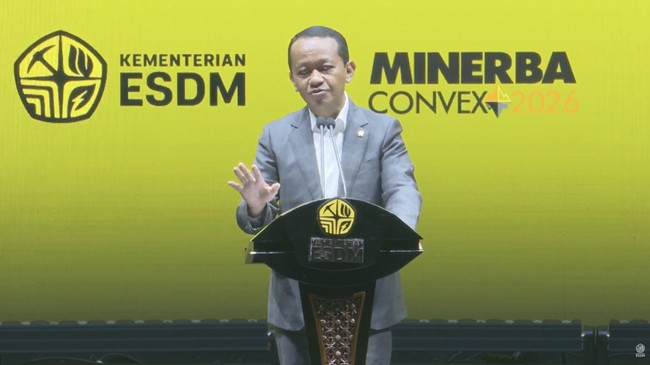
Jakarta — Coordinating Minister for Downstreaming and Energy Transition and Energy and Mineral Resources Minister Bahlil Lahadalia said the government is considering a moratorium, or restrictions on permits for new refining and processing facilities (smelters) that produce only semi-finished goods.
The measure is intended to encourage domestic industry to make finished products, enabling Indonesia to capture the full added value.
Bahlil said downstreaming projects in Indonesia, including nickel projects, are still dominated by semi-finished goods — products that have undergone only 50–60% of the processing required for finished goods. He said he had instructed the Directorate General of Mineral and Coal to assess whether permits for smelters producing semi-finished goods should continue to be issued.
“To be honest, I would tell businesspeople that most of our downstreaming industry is still producing goods that are only halfway there — at 60% or 50% — and this is now booming. So perhaps we need to study, Director General of Mineral and Coal, whether we should still allow smelters producing only semi-finished goods to be built, or whether we should impose a moratorium,” he said at the 2026 Minerba Convention & Exhibition (Convex) at JIExpo, Jakarta, on Monday (2 November 2026).
A key reason for reviewing a moratorium is to ensure that semi-finished raw materials are not all exported, but instead further processed into finished goods in Indonesia.
“For smelters producing semi-finished goods, what we need to promote is the final product. The aim is to ensure that these semi-finished raw materials are not all exported, so Indonesia truly benefits from them in full. This is what we are now looking into,” he said.
Another concern is that excess supply of commodities on global markets could put downward pressure on prices. Global nickel demand currently stands at 3.5 million tonnes a year, but supply is almost 800,000 tonnes higher than demand because of abundant production.
“Why are prices falling? Because we are producing on such a massive scale. Global demand is only 3.5 million tonnes a year. There is now an oversupply of almost 800,000 tonnes. How could prices possibly be good?” he added.
Bahlil also highlighted the increase in economic value generated by mineral downstreaming. Indonesia’s nickel exports, worth only US$3.3 billion in 2017–2019, rose to between US$33 billion and US$34 billion in 2023–2024 after processing shifted to Indonesia.
“By way of example, when I was still at BKPM, our nickel exports in 2017, 2018 and 2019 amounted to only US$3.3 billion. We stopped nickel exports and built an industry and developed downstream processing. What happened? In 2023 and 2024, our exports reached US$33 billion to US$34 billion,” he said.
Nickel production from downstreaming
The Indonesian Nickel Industry Forum (FINI) previously recorded total domestic production of processed nickel from downstreaming at 2.5 million tonnes in 2025. This made Indonesia a leading supplier, accounting for up to 60% of global nickel demand.
FINI chairman Arif Perdana Kusumah said the country’s total nickel refining capacity reached 2.7 million tonnes of nickel in 2025. Production came from domestic pyrometallurgical and hydrometallurgical processing.
“In 2025, total national nickel production reached 2.5 million tonnes in the form of intermediate (semi-finished) products. This comprised 2.05 million tonnes of NPI, FeNi and matte products, as well as 450,000 tonnes of nickel in the form of MHP and nickel sulphate,” Arif told CNBC Indonesia on Wednesday (14 October 2026).
FINI estimates that Indonesia’s processed nickel output will fall by 3.5% to 4% in 2026 compared with 2025. However, production is projected to rise again in 2027 as new projects add capacity.
“2027 will see additional production capacity from HPAL-based hydrometallurgical projects that are nearing completion of construction and will soon enter commissioning and full operation,” he said.
The additional HPAL capacity is focused on processing nickel feedstock for electric vehicle batteries. National MHP production capacity, which stood at 450,000 tonnes in 2025, is expected to exceed 900,000 tonnes of nickel by the end of 2027.
“This level of production has made Indonesia the world’s largest nickel supplier, at around 60%,” he said.
Source: jawawa.id (https://jawawa.id/newsitem/bahlil-considers-moratorium-on-smelters-producing-semi-finished-goods-1793616624)
Originally published by CNBC Indonesia (https://www.cnbcindonesia.com/news/20261102155033-4-781597/bahlil-kaji-moratorium-smelter-berproduk-setengah-jadi-ini-alasannya), translated from Indonesian