
Bahlil Confirms Indonesia's New B50 Fuel to Take Effect on 1 July 2026
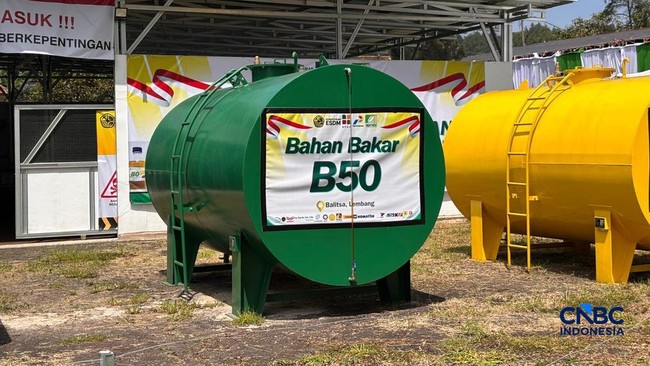
Minister of Energy and Mineral Resources (ESDM) Bahlil Lahadalia has confirmed that the mandatory 50% biodiesel or B50 policy for diesel fuel will begin implementation on 1 July 2026.
Bahlil explained that the government is currently conducting a series of trials to ensure the smooth rollout of B50 and to avoid technical issues in various transportation and industrial sectors.
“B50 will start implementation on 1 July, and we have been conducting continuous tests. Pray that we agree on the schedule for implementation and that the tests go well. Currently, tests are being done on ships, some heavy equipment, and trains. Hopefully, there are no issues. If it follows the schedule without problems, implementation will be on 1 July,” said Bahlil at the Ministry of ESDM in Jakarta on Monday (11/5/2026).
Nevertheless, Bahlil stated that the government remains open to adjustments if technical challenges are found during testing regarding engines or fuel performance.
“But if during the trials there are engine issues or something not quite right, we will make adjustments,” said Bahlil.
Previously, Bahlil mentioned that the government has conducted B50 trials for six months. These trials were carried out on various engine types, from heavy equipment and trains to trucks. Thus, the target for B50 implementation can proceed from 1 July 2026.
“But soon it will be finalised, and up to today, the trials have been going quite well, alhamdulillah. And implementation of B50 will start on 1 July,” he said when met at the Ministry of ESDM office, quoted on Tuesday (7/4/2026).
The implementation of B50 is also in line with the current government’s goal of diversifying domestic energy sources. This aligns with anticipating the uncertain escalation of global geopolitics.
“Imagine if we didn’t diversify now, who would we rely on?” he added.
As is known, the government has conducted road trials on various vehicle types, including Mercedes-Benz and Japanese UD Trucks large trucks and buses.
Director General of New, Renewable Energy, and Energy Conservation (EBTKE) of the Ministry of ESDM, Eniya Listiani Dewi, stated that the results of these road trials have met the set targets. This shows that the tested vehicles can use B50 fuel effectively.
In addition, these results also indicate that B50 performs reliably, is safe to use, compatible with current technology, and has no significant issues.
Currently, her side is continuing to prepare the readiness of distribution infrastructure and raw material supply. The aim is for all supporting facilities to be ready when the B50 policy is officially implemented on the scheduled date.
“Insha Allah, according to the directives, it can be on 1 July (2026),” she said at the B50 Road Trial Fuel Blending and Filling Station in Lembang on Tuesday (21/4/2026).
“All sectors for B50, so there won’t be some at 40 and then 50, that would complicate the infrastructure; thus, it will start simultaneously. All sectors in Indonesia,” she added.
She explained that the B50 road trials began with laboratory tests from early 2025. Then, continued with usage trials of B50 on diesel engines starting simultaneously from December 2025 in several user sectors: automotive, maritime transport, agricultural engines and equipment, mining heavy engines and equipment, rail, and power generation, where the automotive sector is one of the main focuses to ensure readiness for B50 implementation, including through road trials under daily operational conditions.
“Early 2025, we conducted laboratory technical tests and finished them in mid-last year. Then we kicked off and simultaneously tested in six sectors. So automotive, mining, agricultural equipment, maritime, power generation, and rail. That was done simultaneously starting 9 December 2025,” she clarified.
She added that all testing processes are carried out gradually and measurably, including covering various vehicle types and operational conditions, to ensure technical standards, reliability, and safety are maintained.
After completing the road trials, vehicles will be thoroughly checked to assess performance and the impact of B50 fuel on the vehicle engines.
“In May, all automotive sector vehicles under 3.5 tons will reach the 50,000 km target. After completing 50,000 km, there will be a full engine check (engine test). For vehicles over 3.5 tons, they have already met the 40,000 km mileage target,” she explained.
Up to April 2026, preliminary road trial results show that using B50 on diesel vehicles is in safe condition with no significant issues found.
In addition to trucks, the government has also conducted B50 trials on trains since December 2025.
Eniya stated that the B50 trials for trains will involve two tests: the first at Lempuyangan Station is for the train’s genset, which will travel to Jakarta and back to Yogyakarta for 2,400 hours. The other test is for the locomotive in Surabaya, which will be conducted for six months.
For the results of B50 testing on trains, Eniya hopes they will be as good as the automotive sector trials, and will await detailed reports from PT KAI on filter conditions and when filter replacements are needed.
“So for railways, train engines are slow, categorised as low-speed engines, while automotive has the highest speed engines. That can be assured to work for trains. Then we’ll see what the filters are like in railways,” she added.
Source: jawawa.id (https://jawawa.id/newsitem/bahlil-confirms-indonesias-new-b50-fuel-to-take-effect-on-1-july-2026-1778504029)
Originally published by CNBC Indonesia (https://www.cnbcindonesia.com/news/20260511184834-4-734164/bahlil-pastikan-bbm-baru-ri-b50-berlaku-1-juli-2026), translated from Indonesian