
Bahlil Commences Dual-Fuel Vehicle Trial Using Diesel and Hydrogen
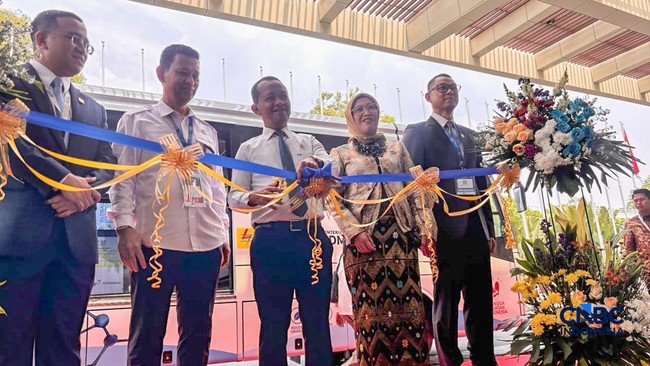
Jakarta, CNBC Indonesia – Minister of Energy and Mineral Resources (ESDM) Bahlil Lahadalia is promoting the use of dual energy through a combination of diesel fuel and hydrogen for the national transport sector.
This is seen as a way to accelerate the transition from fossil fuels to clean energy whilst also reducing dependence on crude oil imports.
Bahlil stressed that utilising hydrogen alongside biofuels such as B50 is important to safeguard Indonesia’s energy sovereignty.
“This reflects the government’s commitment to driving progress in the implementation of hydrogen in the Republic of Indonesia. Ladies and gentlemen, hydrogen development is in line with the eight aspirations (asta cita) of President Prabowo, because hydrogen is one of the alternative energies,” he said at the Global Hydrogen Ecosystem Summit and Exhibition (GHES) 2026 in Jakarta on Tuesday (21 July 2026).
Indonesia currently still depends on oil imports averaging 1 million barrels per day (bpd) to meet national needs. National oil demand stands at around 1.6 million bpd, while domestic production remains at roughly 600,000 bpd.
Oil imports will fall with the implementation of 50% biodiesel blending (B50). With B50, oil imports are expected to fall by 250,000–300,000 bpd.
“So currently our total crude imports are still roughly around 700,000 to 750,000 barrels per day out of that 1 million barrel-per-day gap,” he said.
“But we have all agreed that we must bequeath this Earth to our children and grandchildren in a better state, so Indonesia, under the direction of the President, remains committed to the decision that we will reach net zero emissions by 2050 to 2060. That is why we must prepare the breakdown now,” he added.
Bahlil affirmed that the government is promoting hydrogen because its energy sources can be produced domestically.
“Ladies and gentlemen, today we will push for hydrogen. In my view, hydrogen is one of the alternatives because it has three main functions. First, it is a demand of the world. Second, it is part of downstream processing. Hydrogen can be produced from water, from gas, and from low-calorie coal. So we can convert our low-calorie coal into hydrogen with technology. And we have water,” he explained.
Nevertheless, he acknowledged that the challenge in hydrogen development is that its selling price remains higher, including when compared with the price of non-subsidised diesel fuel.
“The problem is… well, this is the challenge. The problem is that hydrogen is indeed still more expensive compared with other energy products. Earlier I discussed this with the Deputy Head of BRIN, Mrs Eniya. How much is the cost difference for non-PSO (non-subsidised) B50? Non-PSO industrial costs are roughly around Rp 18,600. Using diesel, one litre equates to 3.5 to 4 kilos. When converted to hydrogen, it turns out the energy is still priced above B50. Hydrogen is still somewhat more expensive,” he explained.
“Ladies and gentlemen, this is a challenge for all of us in terms of how we obtain more efficient technology so that it becomes competitive,” he added.
Although hydrogen production costs are currently still high, Bahlil believes the technology will become more competitive within the next 5 to 10 years. He also plans to promote the use of hydrogen-powered buses for public transport in the DKI Jakarta area as a pilot project.
“Earlier, what was conveyed by Mr Darmo (PLN President Director) about buses, I will communicate with the DKI Governor to utilise this. Please do the best you can; whatever we can assist with from a regulatory standpoint, I will help,” he concluded.
Hydrogen Bus Trials
Eniya Listiani Dewi, Director General of New, Renewable Energy and Energy Conservation (EBTKE) at the Ministry of Energy and Mineral Resources, said the use of dual fuel in vehicles can reduce fuel consumption.
“We requested direction from the Minister to launch a two-fuel system, a so-called dual fuel, dual diesel fuel system. So the fuel usage is in one place (not one type of fuel), but there are two fuels: biosolar and hydrogen gas,” Eniya said at the same event.
“And this can reduce or save on fuel itself. With gas entering the engine, fuel consumption can be reduced. And this will later apply not only to buses, but also passenger cars, drones, forklifts, and hydrogen gas stoves,” she said.
“This hydrogen utilisation was directed by the Minister last year; we accelerated cooperation with industry and various academic stakeholders to create a hydrogen transportation corridor. This cooperation is also supported by BRIN and international cooperation with various countries to stage a hydrogen road test later,” she added.
Eniya said her directorate has 93 hydrogen ecosystem development initiatives, with projects already spread across Indonesia.
“These projects have generated Rp 32 trillion in investment that we will oversee,” she added.
It is worth noting that the pilot project for the Hydrogen Diesel Dual Fuel Bus, or H2 DDF Bus, is the result of modifying a diesel-engine bus from the DAMRI state-owned company into a vehicle using a combination of diesel and hydrogen fuel.
The programme marks an initial step towards lower-carbon, sustainable hydrogen-based transport.
According to records from the Ministry of Energy and Mineral Resources, the trial programme was developed through cooperation between the ministry, PT PLN (Persero), Perum DAMRI, PT Sucofindo (Persero), and PT Tritunggal Prakarsa Global.
The development of the H2 DDF Bus is aimed at reducing diesel fuel consumption, replacing part of diesel use with a more environmentally friendly fuel, lowering exhaust gas emissions, building a low-carbon hydrogen transport ecosystem, and preparing vehicle development towards the commercial stage.
Based on testing by PT Sucofindo (Persero), the pilot bus achieved a reported 47.45% reduction in diesel fuel consumption, a 57.66% reduction in opacidade emissions, a 45.45% reduction in carbon monoxide (CO) emissions, a 39.37% reduction in carbon dioxide (CO₂) emissions, and a 21.16% reduction in nitrogen oxide (NOx) emissions.