
Bahlil Comes Clean on Why He Dislikes Imports
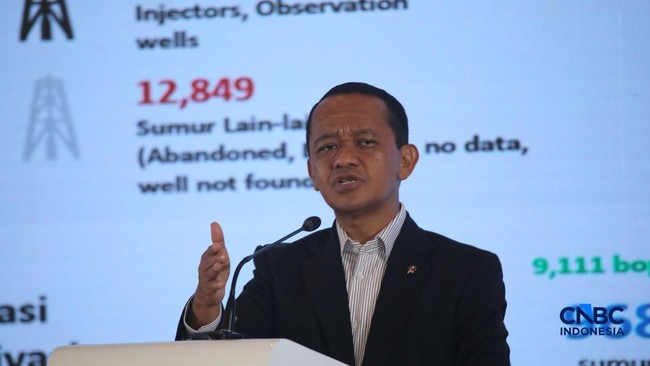
Minister of Energy and Mineral Resources (ESDM) Bahlil Lahadalia has firmly stated that he dislikes import activities, particularly for fuel oil (BBM). The reason is that imports carry the potential for ‘rent-seeking’.
Initially, Bahlil explained the gap between fuel consumption and production. Referring to material in his presentation at the CNBC Indonesia Energy Forum, it was recorded that in 2025, fuel needs will be 37.3 million kilolitres. Of that figure, 23.03 million kilolitres are imported and 14.27 million kilolitres are domestically produced.
‘Once our refinery is inaugurated, it will produce 5.5 million kilolitres. That means we will still import around 20 million kilolitres,’ Bahlil explained at the CNBC Indonesia Energy Forum.
Bahlil came clean that fuel imports originate from Southeast Asian countries, particularly Singapore and Malaysia. ‘Let’s be honest about it,’ he said. In his presentation, 62% of Indonesia’s fuel supply comes from Singapore, 35% from Malaysia, and 3% from others. Meanwhile, 16% of crude oil imports come from Saudi Arabia and African countries such as Nigeria, Angola, Gabon, and others, as well as Kazakhstan.
‘That’s why I am confused. If you ask me whether I like it or not, I do not like it. Because I am a minister who does not like imports. I am just being honest. Because wherever there is an import, there is always potential for rent-seeking there. This is what causes the best people in this nation to be investigated by law enforcement officials,’ Bahlil revealed. ‘So the way to eliminate suspicion is to stop imports. That is why we must increase domestic production,’ Bahlil added.
One of the efforts Bahlil is making to increase domestic production is by utilising Biofuel (BBN) through ethanol blending. ‘I once entered a campus and was laughed at when I proposed the idea of making E20. Oh, I was attacked: is this a dream, did you not go to school, there is nothing on Google, you are talking about E20 like an oil person,’ he recounted.
Bahlil explained that E20 is a prototype of the B40 or 40% biodiesel programme that is already running. ‘The raw materials for ethanol are cassava, sugarcane, and maize. If we succeed in moving towards B50, why don’t we start from this? This is to reduce imports. If we make E20, it means we can save 4 million kilolitres per year,’ he said. ‘We can increase people’s income through their agriculture, create economic growth zones, create jobs, and on the other hand, we can promote energy independence. So, both from plant-based and fossil sources,’ Bahlil explained.