
Bad News for the World! Panama Canal Congestion Brings Serious Consequences
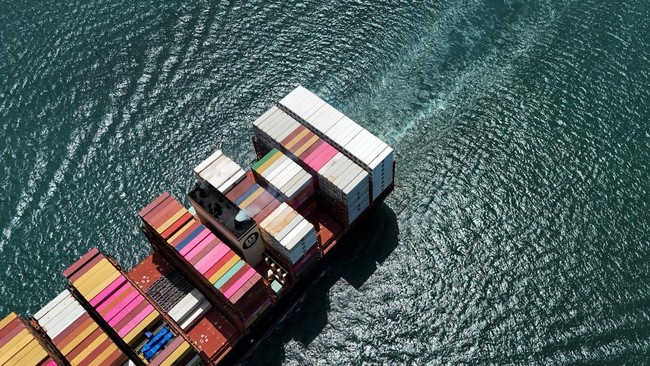
Jakarta, CNBC Indonesia – A worsening drought caused by the El Niño climate phenomenon has forced the Panama Canal to once again restrict vessel traffic. The situation threatens to worsen queues at one of the world’s most important shipping routes.
According to a draft policy submitted to Panama’s parliament, from October onwards an average of only 29.5 ships per day will be permitted to transit the canal. That figure represents a drop of around 18% compared with August, when an average of 36 vessels could still make the crossing.
In September, local authorities had already cut the number of daily transits from 36 to 32 ships because of the drought.
The Panama Canal handles around 5% of global maritime trade and nearly 40% of United States container traffic. The 82-kilometre waterway connecting the Caribbean Sea with the Pacific Ocean is favoured by shipping companies because it typically cuts costs and journey times, particularly for trade between China, Asia and the US.
However, disruption caused by the war between the US and Israel against Iran, as well as disturbed shipping through the Strait of Hormuz, has further complicated logistics chains and raised costs for companies using the Panama Canal.
In August, when ships had to wait up to 10 days to enter the canal — the longest waiting time since May — a container vessel was reported to have paid around US$4 million to skip the queue.
Shipping companies normally pay a fixed fee to book a transit slot. However, the authorities also hold daily auctions allowing shipowners to bid to jump the queue. Bidding prices generally rise when demand is high.
The restrictions could still be tightened further. El Niño is expected to peak at the end of this year and is predicted to be the strongest in four decades.
El Niño is a natural weather pattern that triggers changes in winds, air pressure and rainfall patterns across various parts of the world. Its effects are felt strongly in Central America and the northern parts of South America.
Panama Canal operations rely heavily on fresh water from rivers flowing into Gatun Lake. That water is used to operate the lock system that allows ships to move from one side of the canal to the other.
In September, local officials said the catchment area had received lower rainfall than forecast.
The canal’s locks work like a lift. Each chamber is filled with water to raise a ship around 26 metres above sea level towards Gatun Lake, before lowering it back to sea level on the other side.
If lake water levels are no longer safe for large vessels, the Panama Canal Authority will impose restrictions for the safety of navigation while also preserving water reserves.
A similar situation occurred in 2023. At the time, water levels in the lakes supplying the Panama Canal dropped drastically, prompting the authorities to cut daily transits from 38 to 22 ships.
Those restrictions triggered a pile-up of vessels and left shipping companies scrambling to find alternative routes.
The impact of El Niño is also visible in extreme temperatures around the world. This year, nine countries in Central America and northern South America experienced their hottest June–August period on record.
An AFP analysis of meteorological data from the European Union’s Copernicus programme showed that 52 countries across the continent broke seasonal temperature records for that period.
Extreme heatwaves have taken many forms, ranging from unprecedented heatwaves in Europe and severe drought in Sudan to toxic smoke from forest fires in Indonesia.
More than a third of people who experienced the hottest northern summer on record live in Africa, particularly the Sahel region and areas to its south.
A total of 18 African countries broke seasonal temperature records for the June–August period. Those countries stretch from Mauritania and Sierra Leone in West Africa to Eritrea and Ethiopia in the east.
Source: jawawa.id (https://jawawa.id/newsitem/bad-news-for-the-world-panama-canal-congestion-brings-serious-consequences-1789487578)
Originally published by CNBC Indonesia (https://www.cnbcindonesia.com/news/20260915141621-4-768078/kabar-buruk-untuk-dunia-terusan-panama-macet-dampaknya-tak-main-main), translated from Indonesian