
Back and Forth to the Moon, China Now Possesses Information the US Does Not Have
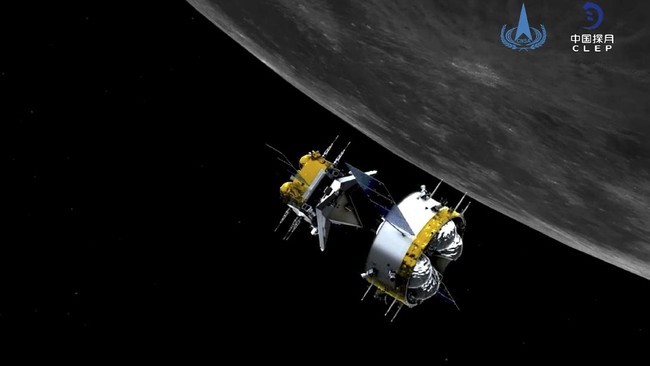
China has produced the latest geological map of the entire lunar surface. The map was made at a scale of 1:5 million and is a new version of the 2024 map. “The geological history of the Moon has been rewritten, or more precisely refined and systematised,” said Yang Zhiming, Director of the China Academy of Geological Sciences (IGCAGS). The map measures 2.8 by 1.2 metres. More than 13,500 impact craters and 81 basins were identified by researchers in the map. One of the features shown is an update to the age boundaries of three ancient lunar geological periods, namely the Aitkenian, Nectarian, and Imbrian. The map also uses data collected from Chang’e-5. Samples brought back by Chang’e-5 confirmed the existence of volcanic activity on the Moon 2 billion years ago. This finding extends the geological time range by up to 1 billion years. The map also shows the far side of the Moon, including its volcanic history. “The lunar samples and the map will provide a new starting point for scientific discussion regarding the far side of the Moon,” said Jin Ming, an associate researcher at IGCAGS. The latest lunar map also uses an exclusive cartographic standard. In addition, there is a colour scheme linked to traditional Chinese geology and aesthetics. Going forward, the same standard will be applied to geological mapping for other objects such as Mars and asteroids. In this way, China can leave behind dependence on systems previously owned by foreign parties. “This standard will be extended to future planetary geological mapping, an independent intellectual property framework for space exploration in China,” Yang explained.