
Babinsa and Tax: Guarding Boundaries, Preserving Trust
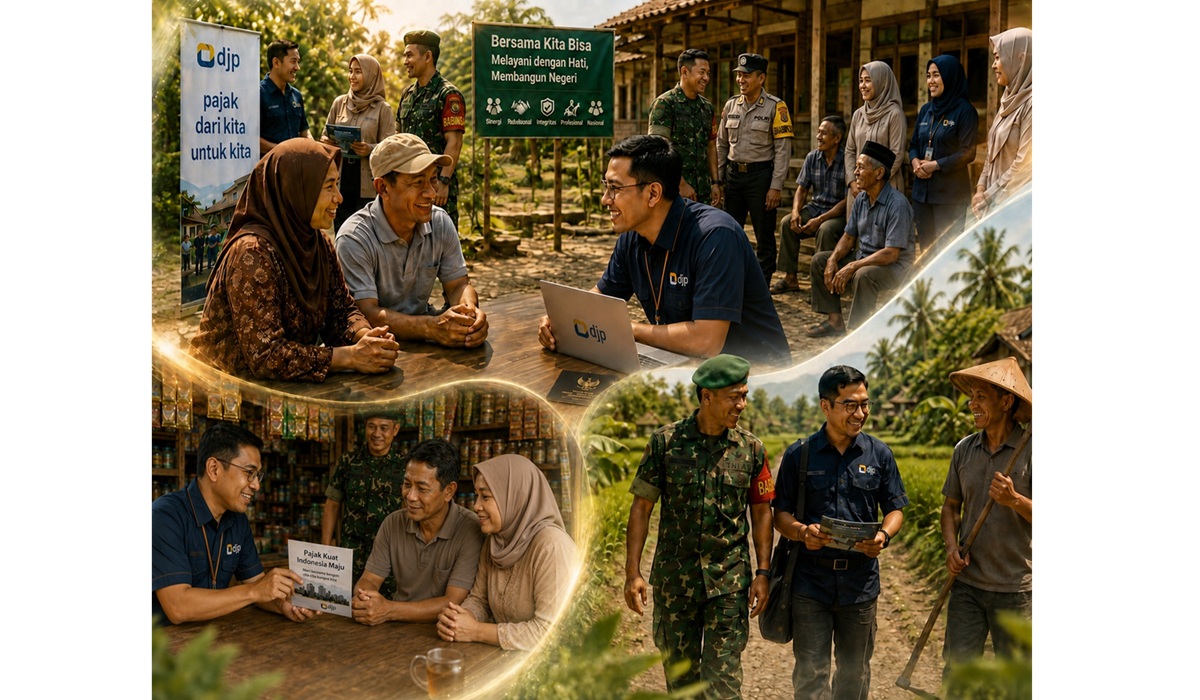
In a village, an officer from the Directorate General of Taxes (DJP) met a small business owner who had never received tax education. Beside him stood a Babinsa (village supervisory non-commissioned officer). There was no loud voice, threat, inspection, or collection. The Babinsa merely showed the business location, introduced the tax officer to village officials, and facilitated communication with residents he already knew.
However, this simple scene raised a more complex question: why was a territorial military officer present? Is the Babinsa involved in tax supervision or part of tax law enforcement?
The question arose after the Directorate General of Taxes issued Director General of Taxes Circular Number SE-8/PJ/2026 concerning Guidelines for Supervision of Taxpayer Compliance on 15 July 2026. On the second page, Babinsa and Bhabinkamtibmas (police community officers) are mentioned in the context of ‘information network development’. Some members of the public worry that Babinsa will become new ‘tax collectors’, while others link it to the expansion of the military’s role into civilian administrative affairs. In fact, upon closer examination, the polemic stems more from perception than from the substance of the regulation.
Director General of Taxes Bimo Wijayanto explained that coordination involving Babinsa and Bhabinkamtibmas is not a new policy, as similar provisions have been in place since 2020. Territorial officers are not tax officials and have no authority to examine, assess compliance, collect, pursue, or take action against taxpayers. Assistance is only provided when necessary to ensure that tax officers’ duties proceed in an orderly, safe, and smooth manner. No authority for examination, compliance assessment, collection, or tax law enforcement has been transferred to the TNI or the National Police.
This explanation is important, but in modern governance, a policy is not sufficient merely by being normatively correct. Policy must also be properly understood by the public, because public trust is built not only by the content of regulations but also by how regulations are communicated and implemented.
In Indonesia’s tax system, which adheres to the principle of self-assessment, the state places trust as its main foundation. Taxpayers are trusted to calculate, pay, and report their obligations independently. Therefore, any policy that could create the impression of state pressure needs to be explained openly so as not to disturb the trust that has been built.
Between Coordination and Authority
Babinsa have long been part of various government programmes because they are able to reach communities and build strong emotional bonds. They assist farmers in food security programmes, help accelerate stunting reduction, support the provision of clean water through the Manunggal Air Programme, are involved in disaster management, and accompany development in remote areas. All of these are part of Military Operations Other Than War as mandated by law.
Chief of Staff of the Army General TNI Maruli Simanjuntak has also repeatedly emphasised that the Indonesian Army must provide tangible benefits to the community through programmes that support government policy. The dedication of soldiers is realised not only through readiness to safeguard state sovereignty but also through contributions that improve people’s welfare. This spirit of service is the soul of the Babinsa’s duties.
They know their assigned areas, understand the character of the community, and have communication networks down to the village level. This social capital often serves as a bridge for government agencies in providing services. If DJP officers need assistance in locating hard-to-reach business premises, understanding local wisdom, coordinating with village officials, or establishing initial communication with the community, the Babinsa’s territorial knowledge can be beneficial.
However, this benefit must stop precisely at that boundary. Babinsa are not authorised to request tax documents, examine business books, calculate tax obligations, demand payment, or take administrative action against taxpayers. The entire substantive process remains the exclusive authority of DJP officers.
Key Boundaries as the Core Issue
In state administration, inter-agency coordination is common. The more complex a country, the greater the need for cross-sector collaboration. However, collaboration must not be interpreted as a transfer of authority. Each institution must work according to its legal mandate.
Head of the Army Information Service Brigadier General TNI Donny Pramono also affirmed that there is no expansion of Babinsa duties in tax law enforcement. The presence of Babinsa is purely coordination support when needed, not the execution of tax functions that legally remain with the DJP. Territorial knowledge and information networks enable Babinsa to serve as a communication bridge. That is the meaning of ‘information network development’ in SE-8/PJ/2026, as well as the answer to speculation that the Indonesian Army would carry out functions beyond its main duties.
This polemic provides an important lesson on how public policy should be built. In the era of information openness, the public does not only read legal documents but also captures symbols that appear in the field. The presence of camouflage uniforms, however limited the role, carries a different psychological meaning compared to civilian officials. Therefore, communication and socialisation of policy are as important as the substance of the policy.
The government needs to ensure that coordination mechanisms are implemented transparently. Assistance from territorial officers should only be provided when truly necessary, have a clear administrative basis, and be accompanied by accountable procedures. In this way, the public understands who is authorised to do what and who is merely an accompanying party.