
Babel Law Ministry Sharpens Criminal Provisions in Regional Regulations
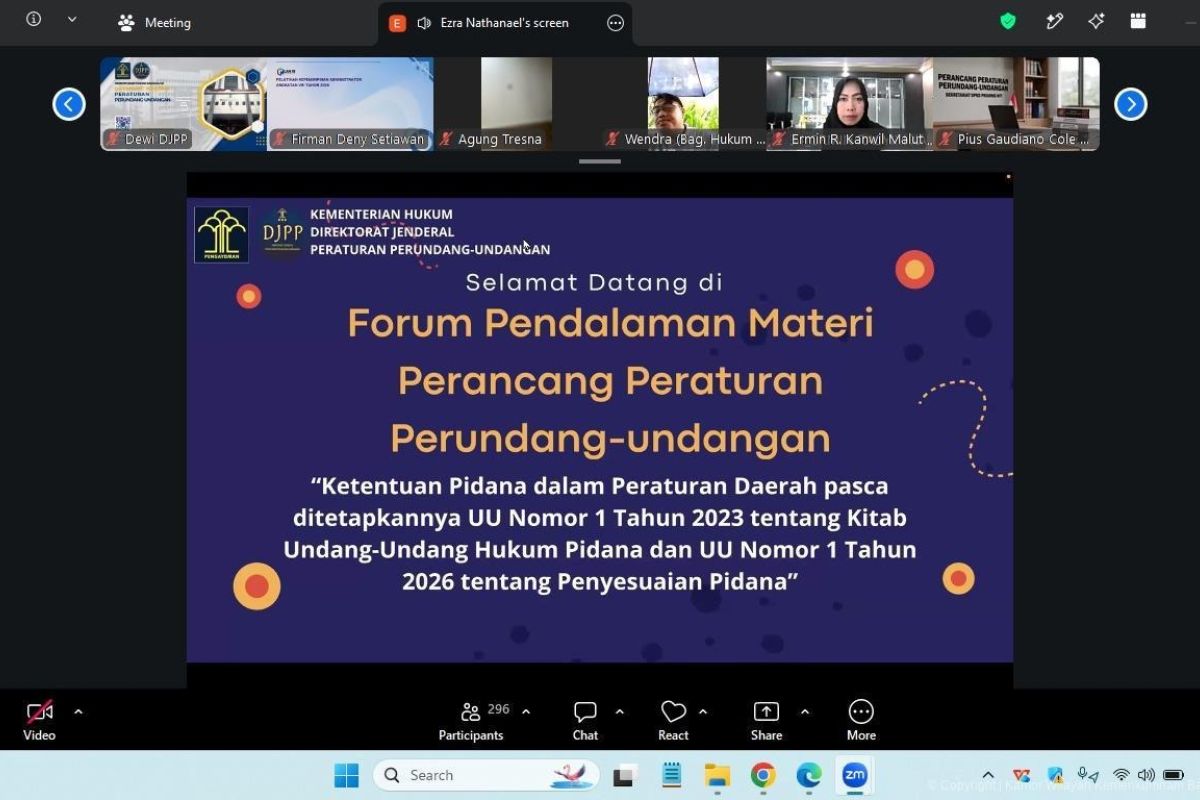
The Bangka Belitung Islands Regional Office of the Ministry of Law is sharpening and adjusting criminal law provisions within regional regulations (Perda) to ensure the drafting of these local legal products is more precise, harmonious, and does not conflict with higher regulations.
“The changes in the National Criminal Code and the provisions for criminal adjustments must be immediately understood and implemented in the drafting of regional legal products,” said Johan Manurung, Head of the Babel Regional Office of the Ministry of Law, after attending an in-depth session for legislative drafters in Pangkalpinang on Saturday.
He stated that the in-depth material session for legislative drafters, themed “Criminal Provisions in Regional Regulations Following the Enactment of Law Number 1 of 2023 concerning the Criminal Code and Law Number 1 of 2026 concerning Criminal Adjustments,” was attended by ministries and agencies, Regional Offices of the Ministry of Law, provincial and district/city governments, provincial and district/city DPRD secretariats, as well as Functional Legislative Drafters within the Ministry of Law.
“Drafters have a strategic role in ensuring that every criminal provision is formulated clearly, proportionally, and in accordance with the national legal system,” he remarked.
He stated that the harmonisation process is not only oriented towards formal compliance but must also ensure that every sanction formulated is truly necessary, enforceable, and provides legal certainty and benefit to the public.
“Criminal provisions in regional regulations must not be drafted excessively. Administrative sanctions and a coaching approach must be prioritised, while criminal penalties are placed as a last resort in accordance with the ‘ultimum remedium’ principle,” he said.
Ultimum remedium is a legal principle stating that criminal sanctions should be used as a final measure or last resort. This sanction may only be applied if other means have failed. These other means include peaceful settlement, civil sanctions (compensation), or administrative sanctions.
He expressed hope that the Functional Legislative Drafters at the Babel Regional Office of the Ministry of Law will continue to improve their competence and precision in drafting and harmonising regional legal products.
“This activity is certainly part of the commitment of the Babel Regional Office of the Ministry of Law to support the realisation of quality regional regulations that provide legal certainty and are aligned with the development of national criminal policy,” he said.
The Director General of Legislation at the Ministry of Law, Dhahana Putra, conveyed that changes in national criminal policy not only impact the formation of laws but also demand adjustments in the drafting and harmonisation of regional regulations.
These adjustments include the elimination of imprisonment in regional regulations, the limitation of criminal threats to a maximum fine of Category III, and the strengthening of the application of administrative sanctions by positioning criminal sanctions as a last resort, or ultimum remedium.
“I emphasise the importance of the harmonisation process to ensure that criminal provisions in regional regulations do not conflict with higher laws and regulations or with provisions already stipulated in sectoral laws,” he said.