
Babah Alun’s ‘Earthquake-Resistant’ Skyway Toll Road Set to Open in 2028
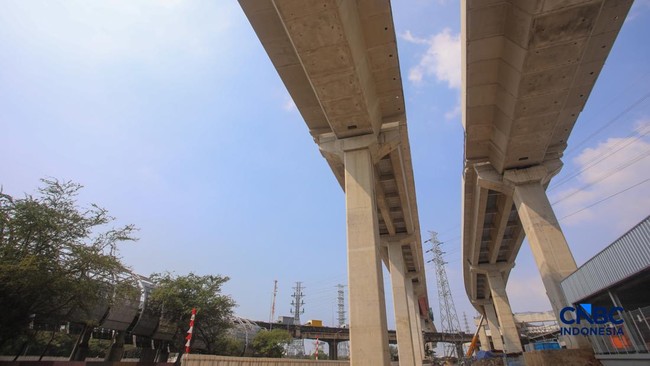
Jakarta, CNBC Indonesia – Construction of the Ancol Timur–Pluit Toll Road, also known as Harbour Road II, continues to make progress. Construction is currently 47.41% complete, while land acquisition is ongoing to support the project.
PT Citra Marga Nusaphala Persada Tbk (CMNP) president director Arief Budhy Hardono said this during an inspection of construction work on Harbour Road II. He explained that one of the project’s main challenges was the complex land acquisition process, involving both ownership and legal issues.
According to Arief, the situation means the land acquisition process must be handled carefully and in compliance with regulations to avoid potential problems in the future.
“Land acquisition has reached 64.57% so far,” he said.
Arief said the use of the project’s construction technology was one of its advantages, given that work is taking place in an urban area where residents’ activities and other local operations are continuing.
In addition to completing land acquisition under the previous location determination, an updated determination is being processed for around 3.9 hectares. A new location determination is also needed for around 8.4 hectares to support construction, particularly in sections requiring additional space for staging and other work.
Once these stages are completed, Harbour Road II is targeted to begin operating on a limited basis in the first quarter of 2028. This will be an initial step before the road enters full operation.
Deputy Public Works Minister Diana Kusumastuti stressed the importance of completing construction on schedule. Efforts to speed up the work must be accompanied by sound project management and attention to the benefits the infrastructure will bring to the public.
Diana also emphasised the need for coordination and integration among the parties involved, so that each stage can proceed effectively without holding up other infrastructure work in the surrounding area.
“On the construction side, this project has special characteristics, including the use of 14.3-metre-wide box girders supporting three lanes and a road shoulder. The structure has a span of about 45 metres. This technology enables the girders to be installed while taking account of activity in the area and facilities beneath the toll road,” Diana said.
Efforts to improve connectivity to the airport area are also continuing alongside construction of Harbour Road II. Plans for the next stage of those connections are still undergoing the initiator’s licensing process and other related procedures. Overall, connectivity to the airport is planned to be developed in stages.
Acting secretary of the Toll Road Regulatory Agency (BPJT), Ira Ariani Chaerunisa, said the government would continue to provide policy support within its authority to help construction proceed smoothly. This support would involve coordination and cooperation with the business entity and other relevant stakeholders.
The policy support is expected to help address various project requirements, including the remaining land acquisition stages and other matters needed to ensure construction proceeds in line with regulations and established targets.
The inspection also covered the importance of integrating toll road construction with drainage improvements and flood control in the surrounding area. Such integration is needed to ensure the road works proceed alongside water management and other supporting infrastructure projects.
Coordination is important because infrastructure projects in urban areas are closely interconnected. Integrating the work from the construction stage is expected to make it more effective and prevent projects from obstructing one another.
Harbour Road II is an elevated toll road linking Ancol Timur and Pluit, with a length of about 9.68 kilometres. The project forms part of Jakarta’s toll road network development, aimed at improving connectivity and increasing road capacity.
The elevated road is being built above the existing Sedyatmo Toll Road. Its 38-metre-high stacked structure will make Harbour Road II Jakarta’s highest toll road, surpassing the MBZ Elevated Toll Road, which stands 15 metres high. The project has an investment value of Rp15.08 trillion.
Jusuf Hamka, an adviser to CMNP, said the toll road could withstand the threat of earthquakes for up to 1,000 years. He added that the technology used to build the project was entirely domestically produced.
“Harbour Road II has long been an aspiration of mine because it is elevated above an existing road. You could say that where there used to be a single deck, there will now be a double deck. I should report that this has been built by Indonesians themselves, without any foreign workers, and, Director General, it has also not used the state budget. Hopefully, we hardworking people will continue to receive support from the government, particularly from Bina Marga, BPJT and KSP. We will do the work well, and God willing, this road’s earthquake resistance will not be just 100 years, but 1,000 years,” he said recently.
Source: jawawa.id (https://jawawa.id/newsitem/babah-aluns-earthquake-resistant-skyway-toll-road-set-to-open-in-2028-1791715845)
Originally published by CNBC Indonesia (https://www.cnbcindonesia.com/news/20261010225711-4-775020/tol-langit-anti-gempa-1000-tahun-milik-babah-alun-dibuka-2028), translated from Indonesian