
B57+ Strategy Targets $10.5 Trillion Halal Economy Opportunity
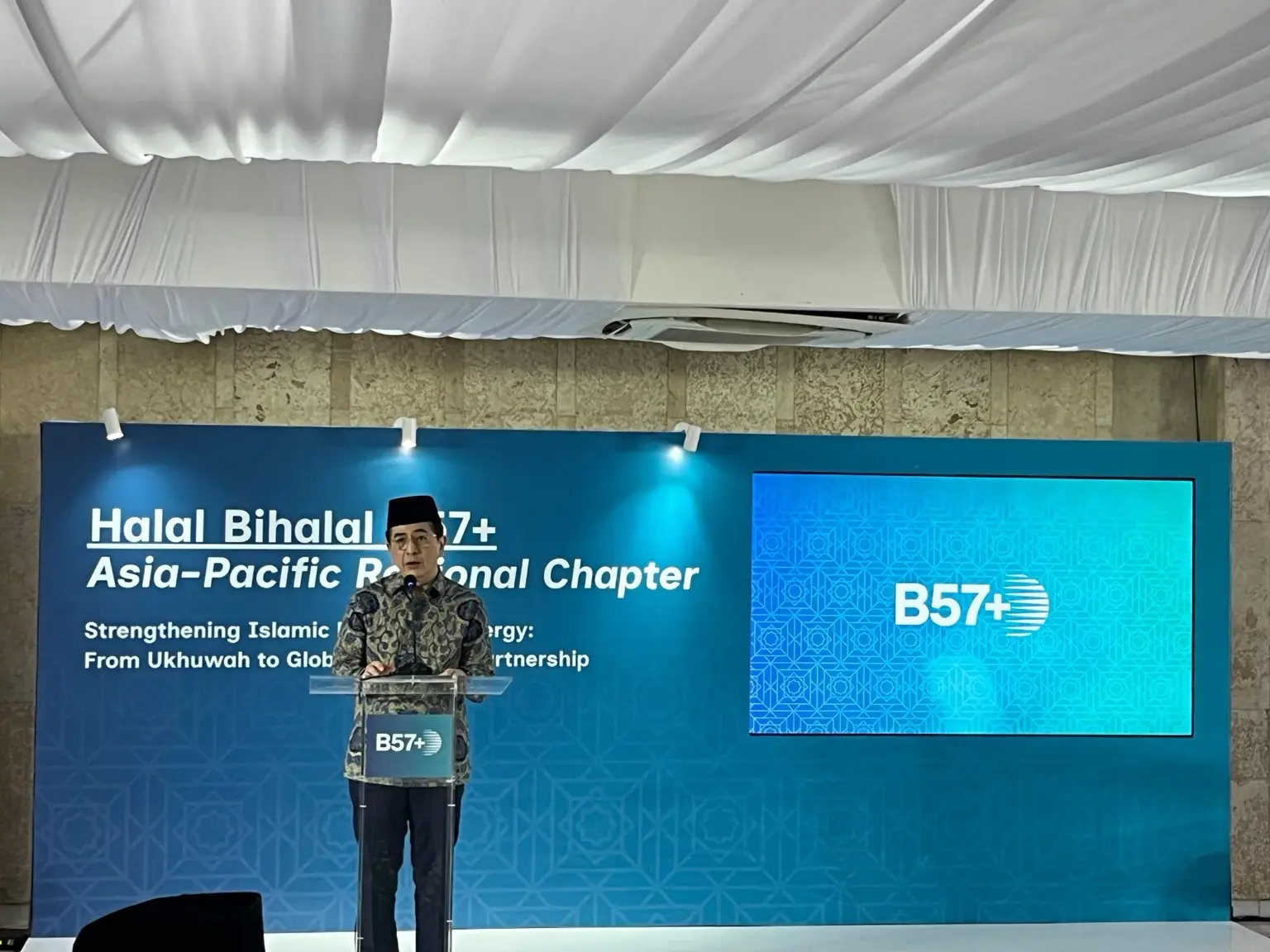
Indonesia is working to strengthen its position in the global halal economy, projected to reach $10 trillion by 2030.
Through the B57+ Asia Pacific Chapter, business actors and Islamic economic institutions are encouraged to build investment and trade networks connecting domestic markets with the Asia-Pacific region.
B57+ Indonesia Secretary General Eka Sastra said the B57+ Asia Pacific Chapter is designed as an economic collaboration platform bringing together business actors, Islamic economic institutions, investors, and cross-border strategic partners.
The move focuses on strengthening institutions and programs to spur investments in the halal economy sector.
‘Initially, the focus is on building institutional foundations, strengthening member networks, and preparing priority programs in halal economy, trade, investment, Islamic finance, youth entrepreneurship, and business matchmaking,’ he said.
Eka noted Indonesia plays a crucial role for B57+. Besides being the regional headquarters for B57+ Asia-Pacific, Indonesia also hosts several important forum agendas.
‘For Indonesia, the main agenda is to make B57+ a platform connecting national Muslim economic potential with Asia-Pacific regional networks. Indonesia has already carried out several activities, including the declaration and launch of B57+ in early February and the Halal Bihalal B57+ Indonesia event attended by government representatives, business organisations, and civil society,’ he said.
Furthermore, Eka stated the B57+ Asia Pacific Chapter is relevant for both OIC and non-OIC member countries with significant interests in halal value chains, trade, investment, logistics, technology, and the global Muslim market.
B57+ Asia Pacific Chapter also aims to expand its presence in non-OIC countries to develop the halal economy in the Asia-Pacific (APAC) region.
‘Therefore, the approach is an inclusive economic platform, not a political or religious one. Countries like Singapore, Australia, New Zealand, India, China, Japan, South Korea, and the Philippines remain strategic due to their production capacity, technology, markets, investment, and trade connectivity crucial for the regional halal economy,’ Eka said.
He added B57+ is openly ready to collaborate with various parties to open new opportunities in halal economy investment.
‘Essentially, B57+ is open to cooperation with anyone contributing to halal economic growth, ethical trade, and productive investment,’ Eka said.
Moreover, B57+ Indonesia aims to connect Indonesia’s Muslim economic potential with global business networks.
‘Our focus is not just building a forum, but creating an ecosystem that generates investment, trade, jobs, and strengthens Indonesia’s position in the global halal economy,’ he said.
Promising Prospects
B57+ projects global halal economy potential to reach around $9.5-10.5 trillion by 2030.
Indonesia has the opportunity to leverage this potential, as its halal product exports in 2024 reached approximately $51.4 billion, growing 1.70% year-on-year (YoY).
According to the State of Global Islamic Economy (SGIE) Report 2024/2025, Indonesia ranks third in the Global Islamic Economy Indicator.
‘This shows Indonesia’s sharia economic ecosystem is increasingly recognised globally,’ Eka concluded.