
B50 Targeted to Reduce Greenhouse Gas Emissions by 46.72 Million Tonnes of CO2
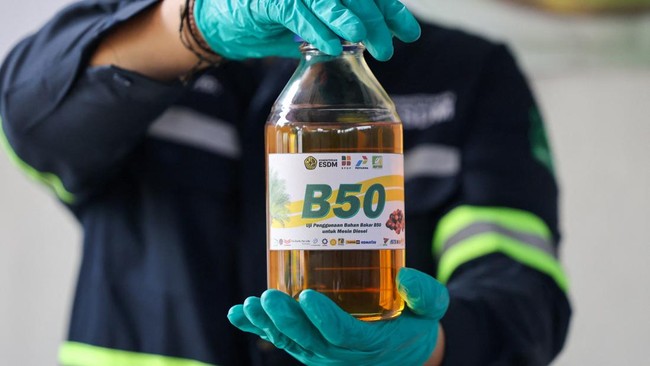
Lembang, CNBC Indonesia - The Ministry of Energy and Mineral Resources (ESDM) targets the implementation of palm-based fuel with a 50% blend (B50) to reduce greenhouse gas emissions by up to 46.72 million tonnes of CO2 in 2026. This emissions reduction target aligns with the government’s commitment to achieving Net Zero Emissions by 2060.
Director General of New, Renewable Energy, and Energy Conservation (EBTKE) at the Ministry of ESDM, Eniya Listiani Dewi, explained that B50 is projected to have a greater environmental impact compared to previous programmes. With the B50 target moving from the current B40, Eniya assessed that the higher vegetable fuel blend could support the national decarbonisation agenda.
“Now, when mixed, when mixed with diesel, this FAME functions to reduce sulphur as well. If the blend is 50%, the sulphur drops to 50% of it. There’s no sulphur content, right, then mixed to only around half from the sulphur content in B0. Approximately approaching Euro-4,” she stated at the B50 Road Test Blending and Fuelling Station, Lembang, quoted on Wednesday (22/4/2026).
Citing ESDM data, the projected greenhouse gas emissions reduction of 46.72 million tonnes of CO2 marks an increase from the initial B40 target of 41.53 million tonnes of CO2. In addition to environmental benefits, the use of B50 is estimated to save national foreign exchange up to Rp 157.28 trillion and absorb more than 2.2 million workers.
“Insyaallah in line with the directives, it can be 1 July. All B50 sectors, no more 40 then 50 like that, the infrastructure would be difficult, so it starts simultaneously. All sectors in Indonesia,” said Eniya.
The government is currently conducting technical tests in various sectors, from automotive to mining and railways. The latest results show that vehicles using B50 maintain stable performance with fuel consumption within the manufacturer’s standard range.
In terms of quality, B50 fuel specifications are tightened by limiting the water content parameter to a maximum of 300 ppm. Additionally, the monoglyceride parameter is adjusted to a maximum of 0.47% by mass to ensure fuel quality during storage and distribution across Indonesia.
“So these are the requirements for the vegetable fuel business entities, we stipulate them like that so that the performance is good. Certainly improved because we also test this performance, that’s why we set the B100 specifications much better,” she emphasised.
Thus, the government targets the completion of all automotive sector testing series by June 2026. Meanwhile, national biodiesel distribution realisation up to mid-April 2026 has reached 3.90 million kilolitres, or about 24.9% of the initial annual allocation of 15.65 million kilolitres.
The government targets the completion of all automotive sector trials by June 2026, while other strategic sectors such as heavy equipment and railways will be completed gradually until the end of the year. With interim test results showing reliable and safe performance, B50 is ready to strengthen national energy independence.