
B50 Officially Launched, Bahlil Says It Will Absorb 2.1 Million Workers
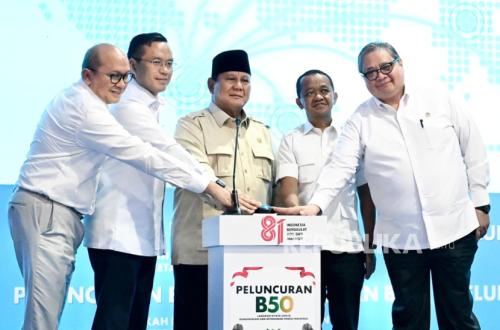
JAKARTA – Minister of Energy and Mineral Resources (ESDM) Bahlil Lahadalia said the implementation of the Mandatory B50 Biodiesel Programme is projected to increase employment absorption to around 2.1 million people. That figure rises from approximately 1.8 million workers under the B40 programme.
According to Bahlil, the increase in employment absorption is one of the important economic impacts of implementing B50. Beyond strengthening palm oil downstreaming, the policy also boosts biodiesel industry activity and increases demand for domestic raw materials.
“Increasing employment absorption from around 1.8 million people under the B40 programme to 2.1 million workers with B50,” the Energy Minister said while delivering a report to President Prabowo Subianto at the launch of the Mandatory B50 Biodiesel Programme at the Rest Area KM 57, Karawang, West Java, quoted on Friday (10/7/2026).
The government has officially launched the Mandatory B50 Biodiesel Programme, which requires a 50 per cent blend of biodiesel into diesel-type fuel oil (BBM). The programme forms part of the national strategy to reduce dependence on imported fuel, strengthen the added value of natural resources, and enhance national energy and economic resilience.
Bahlil explained that the implementation of B50 will also increase demand for crude palm oil (CPO) from around 15.2 million tonnes to between 16.3 million and 17 million tonnes. This is considered capable of providing market certainty for palm oil farmers when export demand slows.
“If CPO prices abroad are low and other countries don’t want it, well, we set aside a portion to build B50 downstreaming so that farmers’ prices rise, industry rises, and the nation prospers,” he said.
In addition to absorbing more workers, Bahlil said the B50 programme is estimated to increase foreign exchange savings to around Rp 170 trillion in 2026. That figure is higher than the savings of around Rp 133 trillion achieved through the implementation of B40.
The programme is also projected to raise the added value of the CPO industry from around Rp 20.92 trillion to Rp 23.49 trillion. On the environmental side, the implementation of B50 is estimated to reduce greenhouse gas emissions by up to around 44.46 million tonnes of CO2 in 2026.
The government assured the readiness of the B50 implementation through technical testing involving six sectors of diesel engine users: automotive, agricultural tools and machinery, mining heavy equipment, sea transport, power generation, and railways. Preliminary test results show that B50 is safe to use and meets performance and compatibility requirements across various diesel engine applications.
The Mandatory B50 Biodiesel Programme has a legal basis in Minister of Energy Regulation (Permen ESDM) Number 4 of 2025 on the Cultivation and Utilisation of Biofuels, and Ministerial Decree (Kepmen ESDM) Number 257.K/EK.01/MEM.E/2026 on the obligation to blend 50 per cent biodiesel into diesel oil. The government has also granted a transition period until 30 September 2026 for fuel business entities to exhaust their B40-specification biodiesel stocks before the B50 implementation takes full effect.