
B50, Middle East Turmoil and Energy-Food Sovereignty
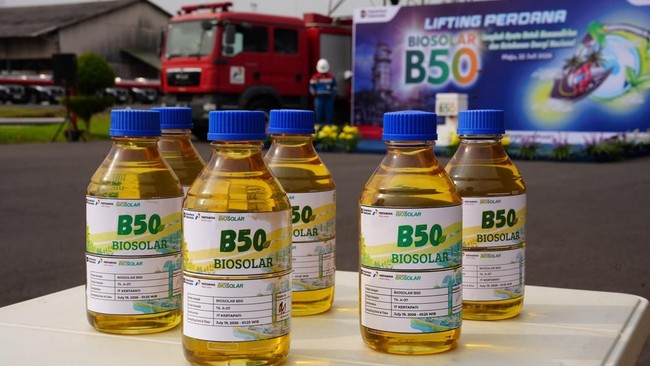
When Houthi attacks again targeted Saudi Aramco facilities on 14 October 2026, Brent crude rose to around US$106.58 a barrel. For most developed countries, the increase may have been little more than a headline on trading screens. In Indonesia, however, such turmoil affects household kitchens, logistics costs, the exchange rate and the government’s decision on B50 biodiesel.
As the Prabowo Subianto-Gibran Rakabuming Raka administration approaches its second anniversary, Indonesia faces a moment requiring both courage and caution. The government launched B50—a blend of 50% palm biodiesel and 50% diesel—on 1 July 2026. At the same time, conflict in the Middle East is a reminder that dependence on imported energy can quickly become an economic burden for the public.
In a reshuffle of the Red and White Cabinet on 1 October 2026, President Prabowo appointed Arrmanatha Christiawan Nasir as Foreign Minister, replacing Sugiono. The change matters because Indonesian diplomacy must be able to explain that developing countries often bear the consequences of wars they did not create: higher energy prices, disrupted shipping routes and more expensive food.
High hopes for B50
The government’s reasons for promoting B50 are clear. Indonesia still imports around 3–4 million kilolitres of diesel a year, out of total national consumption of 38–40 million kilolitres. With B50, the government aims to save up to Rp170 trillion in foreign exchange in 2026, up from around Rp133 trillion under B40. The policy also creates opportunities for the country’s farmers and palm-oil industry.
Domestic biodiesel production reached 14.2 million kilolitres in 2025, or 105.2% of its target. B50 is projected to require 16.7–18 million kilolitres of biodiesel a year, using around 15.2–16.3 million tonnes of crude palm oil (CPO).
Yet behind these encouraging figures lie issues that cannot be ignored. CPO is not only a biodiesel feedstock; it is also essential to cooking oil, the oleochemicals industry and exports. As the amount of CPO needed for biodiesel rises from around 12 million tonnes under B40 to approximately 16 million tonnes under B50, pressure on cooking-oil prices is unavoidable. The government has responded to this risk by strengthening the Domestic Market Obligation (DMO).
Trade Ministerial Regulation No. 20 of 2026 requires producers to supply packaged cooking oil for household use before exporting or supplying the biodiesel industry. The policy is sound, but its success depends heavily on rigorous enforcement and transparent data.
A test from the Middle East
Houthi attacks on Saudi Aramco facilities show how fragile global energy supply chains are. Aramco supplies around 10% of the world’s oil needs, so any disruption in the region immediately affects markets.
The IEA said crude oil exports from Saudi Arabia and Gulf producers reached 13.9 million barrels a day in the previous month, or around 75% of pre-war levels. For Indonesia, the effects include higher import costs, rising shipping insurance premiums and logistics expenses that push up the prices of goods.
In this context, B50 is more than an energy programme: it is a bulwark for the national economy. Hashim Djojohadikusumo, the President’s Special Envoy for Climate and Energy, has said that developing biofuels is a response to geopolitical turmoil. At COP30, he also reaffirmed Indonesia’s commitment to achieving net zero emissions by 2060 or sooner, while stressing that the energy transition must benefit the entire population.
This message must not remain mere rhetoric. B50 will be credible as part of a just energy transition only if additional CPO comes from higher productivity, replanting and compliance with sustainability standards—not from land expansion that risks deforestation or disregards Indigenous peoples’ rights.
Six steps to accelerate
The government should take six concrete steps in the fourth quarter of 2026. First, the Trade Ministry, the National Food Agency (Bapanas), Bulog, the Agriculture Ministry and the National Police should publish monthly DMO allocations and take action against distribution violations. The National Police chief and the chief of criminal investigations should lead enforcement, while the Home Affairs Ministry activates regional price task forces.
Second, the Trade Ministry, Bapanas, the Energy and Mineral Resources Ministry, BPH Migas and the National Food Agency should develop an integrated dashboard covering CPO and cooking-oil stocks, producer and retail prices, and distribution figures. GAPKI, APROBI and cooking-oil business associations such as GAPMMI should be required to report supply data regularly.
Third, the Energy and Mineral Resources Ministry, through its Directorate General of Oil and Gas, together with BPH Migas, Pertamina, the Transport Ministry and independent testing bodies, must ensure B50 quality at petrol stations, in logistics fleets, heavy equipment and the maritime sector. The Directorate General of Oil and Gas has issued Director General’s Decree No. 75.K of 2026 as the standard and quality reference for B50.
Fourth, the Finance Ministry, Social Affairs Ministry, Bapanas and Bulog should prepare cooking-oil reserves, targeted market interventions and well-targeted subsidies. The National Police and the Indonesian Military (TNI), through their regional commands, should help secure distribution, while modern retailers and traditional markets should be involved in controlling retail prices.
Fifth, the Agriculture and Finance ministries, the Palm Oil Plantation Fund Management Agency (BPDPKS), lending banks, cooperatives and local governments should accelerate the replanting of smallholders’ oil-palm trees. GAPKI, APROBI and palm-oil companies participating in IPOC 2026 should provide farmers with technology, improved seedlings and technical support.
Sixth, the Foreign Ministry, led by Foreign Minister Arrmanatha Nasir, and Indonesian ambassadors in Saudi Arabia, Malaysia, the United Arab Emirates and Gulf countries should build a coalition of developing nations. The National Police chief and counterparts in partner countries should strengthen maritime security cooperation through Interpol and regional policing mechanisms, while the Foreign and Defence ministries promote stability along the Red Sea and Strait of Hormuz routes.
Looking towards 2027
In 2027, B50 should be implemented in full but with flexible mechanisms. If CPO production falls sharply or cooking-oil prices exceed a critical threshold, biodiesel allocations could be adjusted temporarily without abandoning the policy. GAPKI forecasts that CPO production will fall to around 56.64 million tonnes in 2027, while domestic consumption rises to about 30 million tonnes.
The government should also prioritise food over energy, increase palm-oil productivity without expanding land, secure biodiesel financing through BPDPKS, and build up strategic stocks of diesel, biodiesel and cooking oil. Palm-oil exports are projected to fall by around five million tonnes to 26.5 million tonnes in 2027 as domestic consumption increases. B60 and B100 should not be accelerated.
B60 in 2027 could raise biodiesel requirements to 20–21.6 million kilolitres and CPO needs to 18–19.6 million tonnes. B100 would be better treated as a controlled trial rather than a nationwide mandate. Indonesia needs to establish a clear policy hierarchy: domestic food first, biodiesel second and exports third, while still maintaining export markets.
The cooking-oil DMO must be enforced consistently, with transparent supply and price data. Internationally, the Foreign Ministry should deliver a firm message: war and geopolitical escalation leave developing countries ‘on a knife edge’ over energy and food.
Developing countries bear higher energy prices, logistical disruption and food pressures despite not being parties to the conflicts. To ensure the policy does not remain mere rhetoric, the government should involve senior practitioners in governance, risk management and organisational transformation as independent advisers.
Their role would be to audit DMO governance, assess risks to CPO and cooking-oil supplies, test the effectiveness of the price dashboard and ensure that coordination across ministries is working in practice. Independent oversight of this kind would strengthen accountability, reduce policy risks and make B50 an instrument of energy sovereignty that genuinely serves the public.
Source: jawawa.id (https://jawawa.id/newsitem/b50-middle-east-turmoil-and-energy-food-sovereignty-1792129857)
Originally published by CNBC Indonesia (https://www.cnbcindonesia.com/opini/20261016113404-14-776801/b50-gejolak-timur-tengah-dan-kedaulatan-energi-pangan), translated from Indonesian