
B50 Mandate Takes Effect Tomorrow, 1 July 2026: Tracing Indonesia's Long Biodiesel Journey
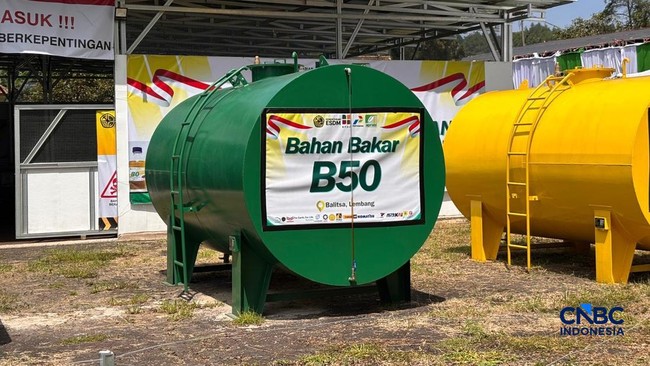
The Indonesian government officially commences the implementation of the 50% biodiesel mandate (B50) tomorrow, 1 July 2026, marking a new chapter in a national energy policy that has been nearly two decades in the making. Unlike previous rollouts, the adoption of B50 will not be immediate. The government has established a three-month transition period to allow the distribution chain and blending processes to adjust gradually before all filling stations sell B50 in full by 1 October 2026.
Director General of New, Renewable Energy and Energy Conservation at the Ministry of Energy and Mineral Resources, Eniya Listiani Dewi, explained that the transition period is intended to use up existing B40 biodiesel stocks while giving businesses time to make operational adjustments. During this period, blending will be carried out in stages with specifications gradually increasing towards B50. The government noted that around 30 biofuel business entities are involved in the blending process, with PT Pertamina (Persero) and AKR controlling approximately 70% of the national distribution share. Distribution volumes will be adjusted according to each company’s readiness, and the government has stressed that all business entities must comply with the implementation schedule, with administrative sanctions facing those who fail to meet the blending obligations.
President Prabowo Subianto previously stated that the launch of B50 is part of a strategy to strengthen national energy security. Speaking at the XVII National Farmers and Fishermen Week in Gorontalo on 24 June 2026, Prabowo said that utilising a 50% blend of diesel and palm oil would slash Indonesia’s dependence on diesel imports. ‘With this, we will no longer import diesel from abroad,’ Prabowo declared.
Indonesia’s biodiesel policy did not begin with B50. The programme has evolved over almost two decades through a series of incremental increases in the biodiesel blend rate. Each phase was designed to maximise the use of domestic palm oil while reducing reliance on imported fossil fuels. The use of biodiesel as a diesel blend actually began in 2006 with a rate of around 5%. Two years later, the government strengthened the legal foundation through Minister of Energy and Mineral Resources Regulation No. 32 of 2008 concerning the Provision, Utilisation, and Trading of Biofuel. This regulation became the starting point for the national biodiesel mandate, targeting gradual increases in blend rates across various sectors, including transportation, industry, power generation, and commercial sectors.
Between 2013 and 2015, the government revised the rules several times to accelerate biodiesel development. The mandate was increased to 10% (B10) on 1 September 2013, and further revisions targeted a 30% blend. The launch of the B15 mandate on 23 March 2015 was governed by Ministerial Regulation No. 12 of 2015, which remains the legal basis for the national biodiesel mandate today. The next phase began in 2016 when Indonesia widely implemented the B20 mandate in the transportation sector, paving the way for B30 implementation in 2020. According to the Ministry of Energy and Mineral Resources, Indonesia became the first country to implement a 30% biodiesel blend nationally. Former Minister Arifin Tasrif explained in 2022 that the development of biodiesel was triggered by the surge in world oil prices in the mid-2000s, while Indonesia had an abundant supply of palm oil. The ministry noted that B30 implementation generated an economic value of more than US$4 billion in 2021 and reduced emissions by approximately 25 million tonnes of CO₂ equivalent.
The mandate was subsequently increased to B35, effective from 1 February 2023. Data from the Downstream Oil and Gas Regulatory Agency (BPH Migas) indicated that B35 implementation throughout 2023 saved approximately Rp120.54 trillion in foreign exchange. During this period, the government also began preparing for the next increase through technical testing, distribution adjustments, and ensuring raw material supply readiness from the national palm oil industry. In 2025, the government increased the blend rate to B40 as a stepping stone before B50. The Ministry of Energy and Mineral Resources confirmed that all technical testing for B40 had been completed and the programme was ready to run at the beginning of the year. At that time, Minister Bahlil Lahadalia also stated that the government had prepared a roadmap for biodiesel development up to B100 in the coming years. B40 served as a crucial phase to test industry readiness, distribution infrastructure, and raw material supply capacity before Indonesia raised the blend to 50% in 2026.
These stages have now culminated in the implementation of B50, effective 1 July 2026. The target for B50 was actually announced as early as the end of 2024, when Minister Bahlil Lahadalia stated that Indonesia had the opportunity to stop diesel imports once the biodiesel blend rate reached 50%. Regarding raw material supply, Minister of Agriculture Andi Amran Sulaiman noted that national crude palm oil (CPO) production is around 46 million tonnes per year, while the additional requirement to support B50 is estimated at 5.3 million tonnes. This figure forms the basis of the government’s confidence that the programme is viable.