
B50 Biodiesel Road Test Already Conducted on Mercedes Trucks and Buses, Here are the Results
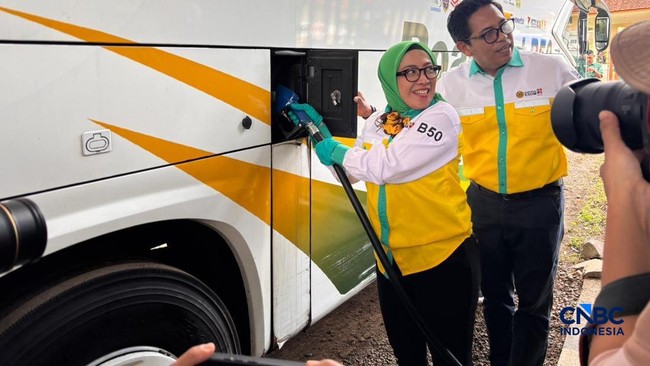
The government has decided to implement a mandatory 50% biodiesel blend, or B50, in diesel fuel starting 1 July 2026.
As preparation, the government has conducted road tests on various types of vehicles, including large Mercedes-Benz trucks and buses, as well as Japanese UD Trucks.
The Director General of New, Renewable Energy, and Energy Conservation (EBTKE) of the Ministry of Energy and Mineral Resources, Eniya Listiani Dewi, stated that the results of these road tests have met the set targets. This indicates that the tested vehicles can use B50 fuel effectively.
Additionally, the test results show that B50 offers reliable performance, is safe to use, and is compatible with current technology, with no significant obstacles.
Currently, efforts are underway to enhance the readiness of distribution infrastructure and raw material supply. The goal is to ensure all supporting facilities are prepared when the B50 policy is officially implemented on the scheduled date.
“Insya Allah in line with the directives, it can be 1 July (2026),” she said at the B50 Road Test Fuel Blending and Filling Station in Lembang on Tuesday (21/4/2026).
“All sectors for B50, so not some at 40 then 50, that would complicate the infrastructure; thus, it starts simultaneously. All sectors in Indonesia,” she added.
She explained that the B50 road tests began with laboratory tests from early 2025. They were then followed by simultaneous usage tests of B50 on diesel engines starting December 2025 in several user sectors, namely automotive, maritime transport, agricultural engines and equipment, mining heavy engines and equipment, railways, and power plants, with the automotive sector as a primary focus to ensure B50 implementation readiness, including road tests under daily operational conditions.
“Early 2025, we conducted technical laboratory tests and completed them in mid-last year. Then we kicked off and simultaneously tested in 6 sectors. So automotive, mining, agricultural equipment, maritime, power plants, and one more railways. That was done simultaneously starting 9 December 2025,” she clarified.
She added that all testing processes were conducted gradually and measurably, covering various vehicle types and operational conditions to ensure technical standards, reliability, and safety are maintained.
After completing the road tests, the vehicles will be thoroughly inspected to assess the performance and impact of B50 fuel on the engines.
“Next month in May, all automotive sector vehicles under 3.5 tons will reach the 50,000 km target. After completing 50,000 km, there will be a full engine check (engine test). For vehicles over 3.5 tons, they have already met the 40,000 km mileage target,” she explained.
As of April 2026, interim road test results indicate that B50 use in diesel vehicles is safe, with no significant issues found.
Vehicles in the over 3.5-ton category have fully completed the 40,000 km mileage target, while those under 3.5 tons have reached 40,000 km out of a 50,000 km target, with engine and fuel filter conditions rated good and within the manufacturer’s recommended standards.
She noted that there are nine vehicles involved, consisting of four passenger vehicles under 3.5 tons and five over 3.5 tons.
In addition to Japanese manufacturers, B50 testing also involves European brands for large buses and trucks, such as Mercedes-Benz and UD Trucks.
“Large buses and trucks, UD Trucks, that’s Mercedes. So Europe is also participating now, and unlike B40 previously, more vehicles are involved this time. Earlier, 9 units for the automotive sector,” she stated.
Besides road vehicles, testing targets the agricultural sector with various two-wheeled tractors, hand tractors, and four-wheeled tractors. The maritime sector is also conducting direct sea trials using ship engines, while the mining sector involves two major companies in Samarinda.
“Then the mining one, mining involves two companies. The one I’ve inspected is at PT HPU Samarinda, and the other is ongoing. Next, we’re going to maritime ships; these sea vessels are also testing directly on the ships themselves for the first time,” she added.
Furthermore, the railway sector will follow with long-distance inter-provincial route testing using the Yogyakarta to Jakarta route, while genset testing is conducted for the power generation sector.
The government projects that the final results of this entire series of trials will provide insights into engine durability against high-level vegetable-based fuels.
“The railway next week, next week we’ll run it using the route from Yogya to Pasar Senen from Lempuyangan Station to Pasar Senen continuously. Then the gensets are there too. One more locomotive from Gambir to Pasar Turi,” she emphasised.
Based on Ministry of Energy and Mineral Resources data, the B50 programme implementation targeted for July 2026 is projected to save state foreign exchange up to Rp157.28 trillion. Besides economic aspects, the policy is also expected to boost national employment with a target absorption of more than 2.2 million workers.
From an environmental perspective, B50 use is targeted to reduce greenhouse gas emissions by 46.72 million tons of CO2 in 2026. As of mid-April 2026, national biodiesel distribution has reached 3.90 million kilolitres, or about 24.9% of the initial annual allocation of 15.65 million kilolitres.
Technically, B50 specifications have been enhanced to maintain engine performance, including limiting water content to a maximum of 300 ppm and monoglyceride to a maximum of 0.47% by mass. Oxidation stability has also been improved.