
B50 Biodiesel Policy Fails to Lift TBS Prices, Independent Palm Oil Farmers Struggle
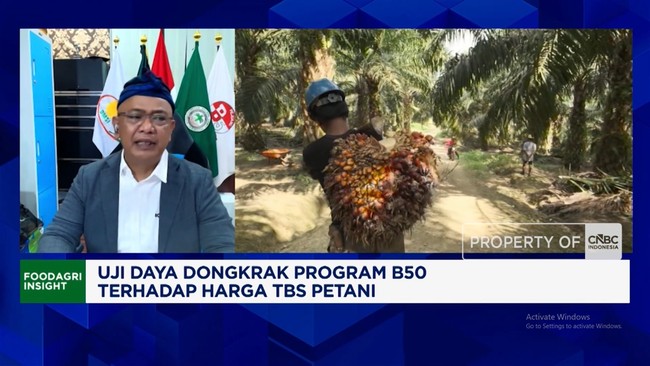
Jakarta, CNBC Indonesia – The Chairman of the Central Leadership Council of APKASINDO (Indonesian Palm Oil Farmers Association), Gulat Medali Emas Manurung, has revealed the impact of the B50 biodiesel programme on palm oil Fresh Fruit Bunch (TBS) prices at the farmer level.
Gulat said that following the implementation of B50 on 1 July 2026, farmers’ TBS prices had failed to rise, which he linked to global Crude Palm Oil (CPO) prices. After 1 July 2026, CPO prices at Kharisma Pemasaran Bersama Nusantara (KPBN) as well as on the commodity futures exchange (ICDX) did not rise and in fact continued to fall.
However, only after President Prabowo touched on the already-high CPO prices on the Rotterdam exchange did CPO prices begin to move upwards, though not significantly. Independent farmers’ TBS prices were recorded in the range of Rp2,400–3,200, whilst plasma farmers’ TBS prices stood at Rp2,800–3,800 — even though prices had been better before B50 was introduced. As a result, APKASINDO assesses that B50 has had no impact on TBS prices at the farmer level.
APKASINDO hopes the government, through the food task force, can strengthen oversight, including pushing for regulations obliging Palm Oil Mills (PKS) to build partnerships with independent palm oil farmers, in order to safeguard the sustainability of independent farmers.
To find out more about the impact of B50 on farmers’ TBS prices, watch the full dialogue between Shania Alatas and the Chairman of APKASINDO’s Central Leadership Council, Gulat Medali Emas Manurung, on Squawk Box, CNBC Indonesia (Monday, 03/08/2026).