
Ayatollah Khamenei's Body Lies in State, 20 Million Expected to Attend Funeral
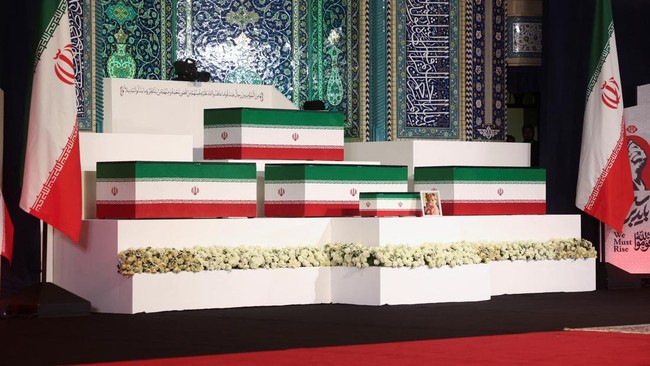
The body of Iran’s Supreme Leader Ayatollah Ali Khamenei was laid to rest at the Grand Mosalla Mosque in Tehran on Friday, marking the start of a multi-day funeral expected to draw massive crowds. Iranian authorities estimate more than 20 million people will attend the ceremonies, which begin on Saturday and will span six days. Khamenei was killed alongside several family members in the first wave of Israeli and US airstrikes on Tehran more than four months ago.
Ahead of the procession, foreign dignitaries including Russian Deputy Security Council Chairman Dmitry Medvedev and Chinese Vice Chairman of the Standing Committee He Ligong arrived to pay their respects, alongside representatives from Pakistan, Iraq, India, Turkey, and other nations. State media broadcast images of five simple coffins draped in the Iranian flag inside the mosque, one of them a small casket reportedly containing the body of Khamenei’s one-year-old granddaughter, also killed in the strikes.
The government is seeking to use the mass mobilisation to bolster public support amid a fragile ceasefire with the United States, following months of conflict that caused widespread destruction across Iran. Hossein Ansari, a translator planning to attend the final ceremony in Mashhad on 9 July, said the large crowds would send a message to the world that many Iranians still respect Khamenei, even if not all are religious.
In the days leading up to the funeral, many shops in Tehran closed and car parks filled with vehicles as people flocked to the capital. The funeral of Khamenei’s predecessor, Ayatollah Ruhollah Khomeini, in 1989 drew an estimated 10 million mourners and sparked chaos when authorities briefly lost control of the coffin due to the surging crowd.
The Tehran procession will last three days, with parts of the capital’s airspace closed temporarily. The body will then be moved to the holy city of Qom on Tuesday before being taken to Najaf and Karbala in Iraq on Wednesday. Khamenei is scheduled to be buried on Thursday in his birthplace, Mashhad, in eastern Iran.
Officials have not confirmed whether Mojtaba Khamenei, the late leader’s son and designated successor, will appear during the ceremonies. He was reportedly wounded in the same attack that killed his father and wife, and has not been seen in public since.
Resistance to foreign powers has been a central tenet of the Islamic Republic’s ideology for nearly five decades. Senior Iranian official and current chief negotiator Mohammad Bagher Ghalibaf described the funeral as a renewal of the nation’s pledge to the path of the martyrs and a reminder of the revolutionary values underpinning the state. Large posters of Khamenei have been erected across Tehran, with supporters praising his simple lifestyle and efforts to strengthen Iran’s sovereignty and military capabilities.
Despite the official narrative, Khamenei leaves behind a deeply divided nation. Many young Iranians, who grew up under political repression and economic hardship, hold negative views of his leadership. Narges Bajoghli, an associate professor at Johns Hopkins School of Advanced International Studies, noted that the recent war has altered some perceptions, with Iran’s ability to withstand attack and pressure its adversaries seen by some as vindication of his hardline strategy. She added that Khamenei’s death transforms his image from a repressive figure to the architect of a strategy that preserved Iran’s integrity during a historic threat, though his domestic record remains impossible to ignore.
A 23-year-old student in Tehran suggested history might judge Khamenei more favourably, arguing that Iranians tend to admire leaders who expand the country’s international influence. While Khamenei’s popularity had waned in recent years, millions of conservative Iranians continue to support clerical and military rule, viewing the country’s military strength as one of his greatest achievements. In recent days, conservative figures and military commanders have delivered a series of anti-Israel and anti-US speeches, citing Iran’s missile stockpiles and drone capabilities as key parts of Khamenei’s legacy. Meanwhile, President Masoud Pezeshkian faces pressure from moderate factions to secure the release of Iran’s frozen funds.