
Awaiting Regulatory Backing for PT DSI to Oversee 50 Indonesian Export Ports
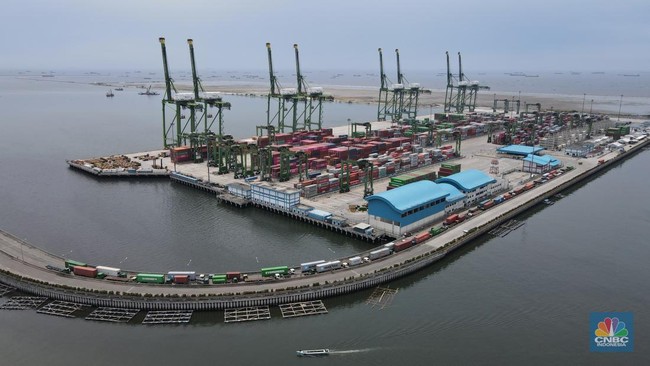
Jakarta, CNBC Indonesia - Certainty over the legal foundation for PT Danantara Sumberdaya Indonesia (DSI) as the supervisor of export governance for strategic natural resource commodities is considered important for strengthening its operational activities.
Herry Gunawan, Director of NEXT Indonesia Center, said that with such a mandate, the institution’s functions would be more effective, particularly in preventing potential foreign exchange leakage in export trade.
“DSI is very capable of receiving the mandate as supervisor of strategic natural resource commodity exports, which is currently a serious concern for the government. Now, it just needs to be equipped with an adequate legal umbrella,” Herry said in a written statement on Saturday (22/8/2026).
Herry noted that, in accordance with the provisions set out in Government Regulation No. 24 of 2026 on the Governance and Export of Strategic Natural Resource Commodities, Article 3 Paragraph 3, the export state-owned enterprise is determined in accordance with statutory provisions.
Therefore, he argued that operational sustainability is not merely a matter of the deed of establishment, but also requires an assignment based on regulation, for example in the form of a Government Regulation or Presidential Regulation.
This regulatory affirmation is particularly important, Herry said, given that President Prabowo Subianto’s speech at the Annual Session of the People’s Consultative Assembly on 14 August 2026 revealed that DSI has managed export proceeds worth US$14 billion from three commodities: palm oil, coal, and ferro alloy.
DSI has even identified a potential additional US$5 billion from differences and adjustments in price, quality, and payment of export proceeds.
Going forward, the institution established on 20 May 2026 will increase supervision at 50 ports in 25 provinces, as well as other commodities.
“As a follow-up to the President’s statement, DSI’s assignment as the institution overseeing exports needs to be mandated through clear regulations,” Herry said.
The regulatory certainty is intended solely to ensure that DSI’s position as an institution assigned to oversee export governance has a strong legal basis. It also aims to enable DSI to carry out its supervisory function more effectively.
“Let export activities continue to be carried out by the business community as has been the case so far. DSI is present to ensure that export governance runs properly as mandated by the government,” he said.
The supervision carried out by DSI is in line with the provisions in the Elucidation of Article 7 Letter a of Government Regulation No. 24 of 2026. The supervisory scope set out in the regulation includes export documents, sales contracts, and other related documents as well as additional data and information required by DSI as the export state-owned enterprise.
These documents are submitted through an integrated system, including the Customs Excise Information System and Automation (CEISA), the Indonesia National Single Window (SINSW), and the Integrated Foreign Exchange Monitoring Information System (SiMoDIS).
DSI’s position as a supervisory institution is also important to prevent potential conflicts of interest. If DSI were to perform a dual function as transaction supervisor and simultaneously as an offtaker taking over commodities for resale, the burden would be too great. Such a model could potentially mix the supervisory function with commercial interests.
“DSI does not need to become a player in the market. Its main focus must be to ensure that export transactions take place transparently and in accordance with the value, volume, quality, documents, and foreign exchange obligations that should enter Indonesia,” Herry said.
As is known, President Prabowo Subianto has spoken openly about the reasons for establishing PT Danantara Sumberdaya Indonesia (PT DSI). In essence, the company was formed as a single gateway for the export process of three commodities: coal, crude palm oil (CPO), and ferro alloy.
“This is a single gateway for processing the export of Indonesian commodities. I repeat, the processing, not that one company will control the commodities and export them. No, but now we can monitor how much is loaded onto ships, how many tonnes, how much is reported on paper, and how much reaches the export destination,” Prabowo said at the Annual Session of the MPR and the Joint Session of the DPR and DPD in the framework of the 81st Anniversary of the Republic of Indonesia at the Nusantara Building, Parliament Complex, Senayan, Central Jakarta, on Friday (14/8/2026).
Prabowo added that the establishment of PT DSI was an effort to address discrepancies between reports and conditions on the ground.
Since its establishment two months ago, PT DSI, according to Prabowo, has managed export proceeds (DHE) reaching US$14 billion.
“Since starting operations on 1 June 2026, with only three commodities — coal, palm oil, and ferro alloy steel — in 2 months and 13 days, PT DSI has now managed DHE worth US$14 billion. More than 6,000 export transactions of these three export commodities have been monitored by DSI,” Prabowo asserted.
Furthermore, PT DSI, Prabowo said, will increase its supervision to cover 50 ports in 25 provinces. And in the near future, DSI will manage all of Indonesia’s strategic export commodities, not just three.
“We no longer want the Indonesian nation to be cheated. Indonesia’s wealth must not enrich a handful of people, especially abroad, while leaving its own people living in hardship. This is not only unjust, it is truly not the attitude of a wise nation,” Prabowo concluded.
Source: jawawa.id (https://jawawa.id/newsitem/awaiting-regulatory-backing-for-pt-dsi-to-oversee-50-indonesian-export-ports-1787385096)
Originally published by CNBC Indonesia (https://www.cnbcindonesia.com/news/20260822141825-4-761486/menanti-bekal-regulasi-pt-dsi-awasi-50-pelabuhan-ekspor-ri), translated from Indonesian