
Awaiting a Fatwa on Cryptocurrency
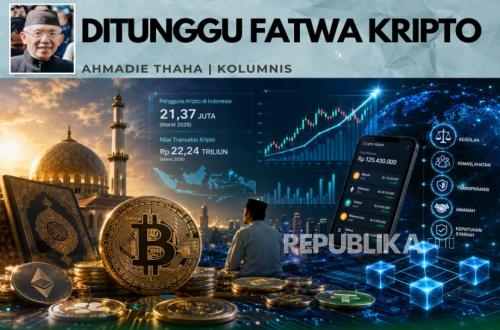
By Ahmadie Thaha, Columnist
In the meeting room of the Indonesian Ulema Council (MUI) on Monday, 6 July 2026, discussion about the economy of the ummah flowed as it typically does in a Focus Group Discussion (FGD). Many academic views emerged, and no shortage of practical ones.
The forum was held to prepare materials for the Congress of Indonesian Muslims (KUII), a milestone-setting event to be held at the end of this month. Nobody anticipated that from that quiet room would emerge a theme bringing together the books of fiqh with the world of blockchain.
Ulema, economists, academics and practitioners took turns discussing the constitution, poverty, food security, the halal industry, productive waqf, and the future of the sharia economy. All of it important. All of it serious. Because the economy, in the end, is not merely a matter of numbers, but also of human dignity.
Yet attention suddenly shifted when one participant raised a theme that a few years ago might still have sounded foreign in a clerical forum: crypto. The man was not a digital asset businessman, nor an investment influencer. He was Anggito Abimanyu.
“I am also a crypto player,” admitted the senior economist, who also once headed the Hajj Financial Management Agency (BPKH), simply, causing the room to fall momentarily silent. Several heads turned spontaneously. The sentence was not finished. “But abroad,” he added. An admission that sounded ordinary, yet concealed an extraordinary anxiety.
He then explained his reasons. In Indonesia, according to him, the halal and haram status of the crypto business has yet to receive certainty. For that reason, he hoped the KUII, to be held in Jakarta, would be able to produce an important decision in the form of a fatwa giving direction and certainty to the ummah. Not to hinder innovation, but so that the ummah has a compass when entering new territory.
I observed that the participants were not discussing the price of Bitcoin that day. No one was busy opening red and green charts on their mobile phone screens. What was at stake was something far more fundamental: can Islamic law read the changing times without losing its soul? Because technology always races ahead, whilst wisdom is required to remain calm.
That question is in truth not Indonesia’s alone. The Islamic world has been debating the issue of crypto from a sharia perspective for nearly a decade. To this day, the answer remains far from unified. These differences are not a sign of weakness in fiqh, but evidence that ijtihad remains alive in the face of a constantly changing reality.
Crypto itself is often misunderstood as “digital money”. In fact, the world of crypto is far broader than merely Bitcoin. It is a digital asset built upon blockchain technology, namely a distributed, interconnected transaction recording system designed to be difficult to manipulate. Like a highway, blockchain is merely infrastructure; whether it is good or bad depends upon the vehicles travelling upon it.
Within that ecosystem there is Bitcoin, widely regarded as a store of value akin to digital gold; Ethereum, which serves as the foundation for various applications; stablecoins, whose value follows a particular currency; and tokens representing shares, gold, bonds, even property ownership through the concept of Real World Assets (RWA). The digital world has created forms of ownership never imagined by the jurists of centuries past.
For that reason, treating all crypto as one and the same thing is in truth an oversimplification. Equating them is like saying all vehicles are the same, when in fact a bicycle, an ambulance, a logistics lorry and a military tank all have wheels, yet serve entirely different functions. Sharia has always taught that law should follow the essence, not merely the name.
This is where fiqh begins its work. The ulema are not putting the software on trial, but weighing the nature of the transactions taking place upon it. What is being tested is not the algorithm, but human behaviour exploiting that algorithm.
They ask: does the digital asset meet the requirements of maal, namely wealth valid under sharia? Can it function as a recognised medium of exchange? Does the transaction contain gharar, or excessive ambiguity? Does it descend into maysir, or gambling? Is there genuine economic benefit, or merely a game of numbers fought over by speculators?
What the ulema are truly debating is not, first and foremost, the fluctuating price of Bitcoin. The root of the matter is far more fundamental: can cryptocurrency be called a currency (naqd or tsaman) like the dinar, the dirham, or state-issued money? Or is it merely a commodity or digital asset that can be traded like gold, property, or works of art?
This question matters because in Islamic fiqh, the law governing the sale of currency differs from that governing the sale of goods. Currency exchange carries stricter provisions to avoid riba. Conversely, if crypto is positioned as an asset, then the legal approach shifts towards the law of trading wealth (maal), provided it contains no gharar, maysir, fraud or injustice.
These questions appear technical, yet in truth concern the protection of wealth and justice.
The answers to these questions have in fact varied. Egypt’s Dar al-Ifta in 2017 ruled Bitcoin haram. The reasons included extremely high price volatility, unclear supervisory authority, the potential for fraud, and the risk of money laundering. At that time, caution was regarded as closer to the public good.
Some fatwa bodies that declared Bitcoin haram started from the assumption that it failed to meet the requirements of a currency. Its value was extremely volatile, not guaranteed by a monetary authority, and not yet widely accepted as a means of payment. Another group of ulema, however, saw more recent developments.
In many countries, crypto is traded far more as an investment asset than used to buy a cup of coffee. For that reason, in their view, the legal approach need not always be equated with that of currency.
A number of fatwa bodies in India and several other countries adopted an almost similar position. They viewed crypto trading practices at the time as resembling an arena of speculation more than productive economic activity. When profit arises more from price volatility than real value, fiqh switches on the amber lamp.
A nearly identical view came from Sheikh Muhammad Taqi Usmani, one of the most influential authorities on sharia economics in the world. Interestingly, he did not reject blockchain technology. This is where the debate is often incompletely understood.
What he criticised was the practice of crypto trading which at the time was dominated by extreme speculation. In other words, his objection was not primarily to the technology, but to the market behaviour growing on top of that technology. A knife does not become haram because it is made of steel; what is judged is the hand that wields it.
On the other hand, a group of ulema and sharia economics experts has also developed, taking a different approach. They no longer ask, “Is crypto halal?” but rather, “Which crypto?” That single shift of phrasing in fact transforms the entire way of viewing the issue.
The question sounds simple, but it changes the whole direction of the discussion. Because Bitcoin is certainly different from a stablecoin. A stablecoin differs from a utility token. A utility token differs again from a token representing shares or gold. Equating them all is the same as judging the entire contents of a library merely because the book covers look alike.