
Authority of Ministry of Human Rights and Lack of Adjudication by Komnas HAM Challenged in Constitutional Court
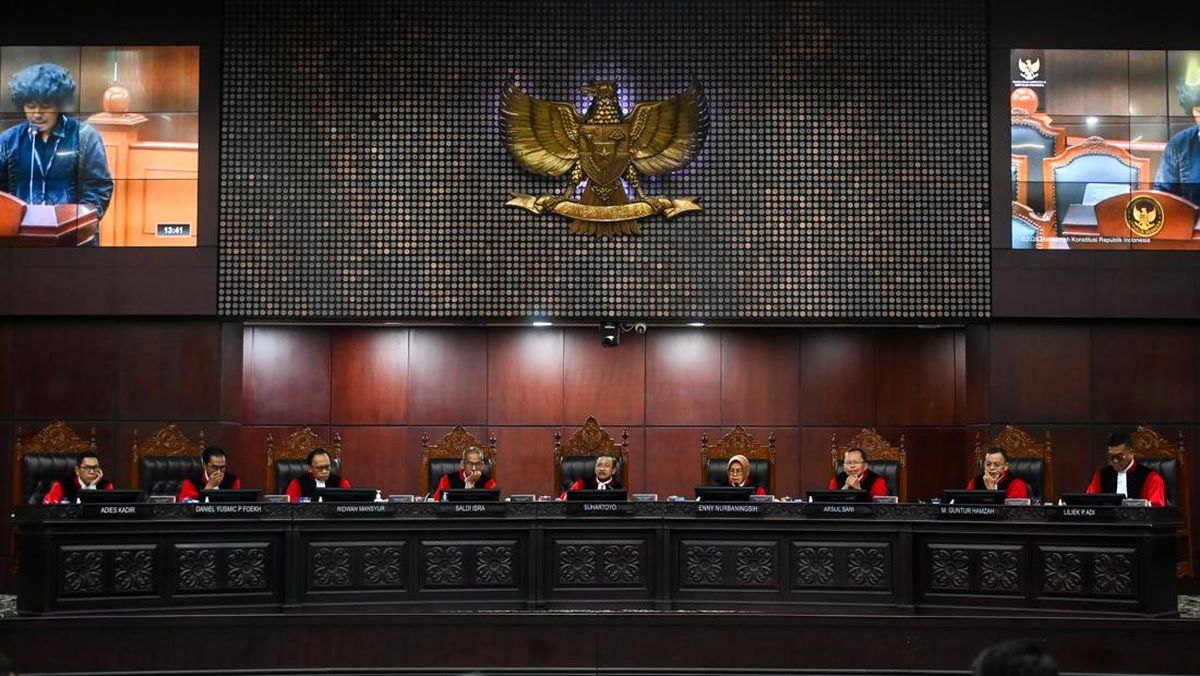
Three Indonesian citizens—Viktor Santoso Tandiasa, an advocate; Eko Prasetyo, a lecturer at the Faculty of Law of Universitas Islam Indonesia Yogyakarta; and Bernita Matondang, a law student—have filed a judicial review petition with the Constitutional Court against Article 5 paragraph (2) of the State Ministry Law and Article 1 point 7 and Article 76 paragraph (1) of the Human Rights Law. The petitioners were represented by lawyers from VST and Partners, Advocates & Legal Consultants, including Imamudin, Syamsul Agus Alam, Muhamad Arman, Judianto Simanjuntak, Nur Rizqi Khafifah, Gabby Mayang Sari, Didi Supandi, and Isam Saifudin.
The petitioners stated that they have suffered constitutional losses in the form of the right to fair legal certainty, protection, and guarantees as provided under Article 28C paragraph (1) and Article 28D paragraph (1) of the 1945 Constitution of the Republic of Indonesia. Viktor, the first petitioner and chairman of the Foundation for the Defence of Constitutional Rights, said the lawsuit was filed because of concrete and specific losses. He experienced losses while assisting victims of human rights violations, including a case involving a retired prosecutor being processed at Komnas HAM. During the assistance process, the Attorney General’s Office did not attend mediation, so Komnas HAM issued a recommendation. However, the recommendation was not implemented by the institutions named because it was not binding.
Eko Prasetyo, the second petitioner, felt disadvantaged by the unclear division of authority between the Ministry of Human Rights and Komnas HAM. This situation made it difficult to deliver teaching materials on the limits of authority of state institutions in the field of human rights. Bernita Matondang, the third petitioner, as part of the younger generation active in upholding constitutionalism, potentially faces similar legal uncertainty in the future when seeking recourse either to the Ministry of Human Rights or to Komnas HAM.
In the petition’s arguments, Gabby Mayang Sari, counsel for the petitioners, explained that the phrase ‘Human Rights’ in Article 5 paragraph (2) of the State Ministry Law opens room for the Ministry of Human Rights to also carry out the functions of protection and enforcement of human rights. In fact, this authority has been constitutionally delegated specifically to Komnas HAM as an independent state institution since the Human Rights Law was enacted in 1999 under Article 28I paragraphs (4) and (5) of the 1945 Constitution. This potentially creates overlapping authority and threatens the independence and objectivity of the human rights enforcement process, especially in cases involving state apparatus.
Furthermore, the formulation of Komnas HAM’s functions in Article 1 point 7 and Article 76 paragraph (1) of the Human Rights Law is limitative, covering only study, research, education, monitoring, and mediation. Gabby highlighted the absence of an adjudication function—dispute resolution involving a third party—that is binding, thus creating a systemic legal vacuum for victims of human rights violations outside the ‘gross’ category. ‘Because the final outcome of the process at Komnas HAM is only a non-binding recommendation that depends entirely on the good faith of the party committing the human rights violation,’ Gabby said.
Gabby explained that in Indonesian constitutional practice, several other independent state institutions have been granted adjudication functions with binding decisions, so the absence of a similar function at Komnas HAM contradicts the principles of the rule of law and fair legal certainty as guaranteed by Article 1 paragraph (3) and Article 28D paragraph (1) of the 1945 Constitution.
Muhammad Arman, also counsel for the petitioners, asked the Constitutional Court to grant the petition in its entirety by declaring: Article 5 paragraph (2) of the State Ministry Law regarding the phrase ‘Human Rights’ is conditionally unconstitutional with the 1945 Constitution insofar as it is not interpreted as ‘Government affairs in the field of human rights organised by the Ministry of Human Rights, only in administrative matters in carrying out the responsibility for the promotion and fulfilment of human rights.’ Article 1 point 7 of the Human Rights Law regarding the phrase ‘functions to carry out study, research, education and mediation’ is conditionally unconstitutional and has no binding legal force insofar as it is not interpreted as ‘functions to carry out study, research, education, mediation and/or adjudication.’ Article 76 paragraph (1) of the Human Rights Law regarding the phrase ‘functions of study, research, education, monitoring, and mediation’ is conditionally unconstitutional with the 1945 Constitution and has no binding legal force insofar as it is not interpreted as ‘functions of study, research, education, monitoring, mediation and/or adjudication.’
Source: jawawa.id (https://jawawa.id/newsitem/authority-of-ministry-of-human-rights-and-lack-of-adjudication-by-komnas-ham-challenged-in-constitutional-1787903546)
Originally published by CNN Indonesia (https://www.cnnindonesia.com/nasional/20260828131338-12-1397342/kewenangan-kemenham-ketiadaan-ajudikasi-komnas-ham-diuji-ke-mk), translated from Indonesian