
Attorney General Floats Merger of General and Special Crimes Units
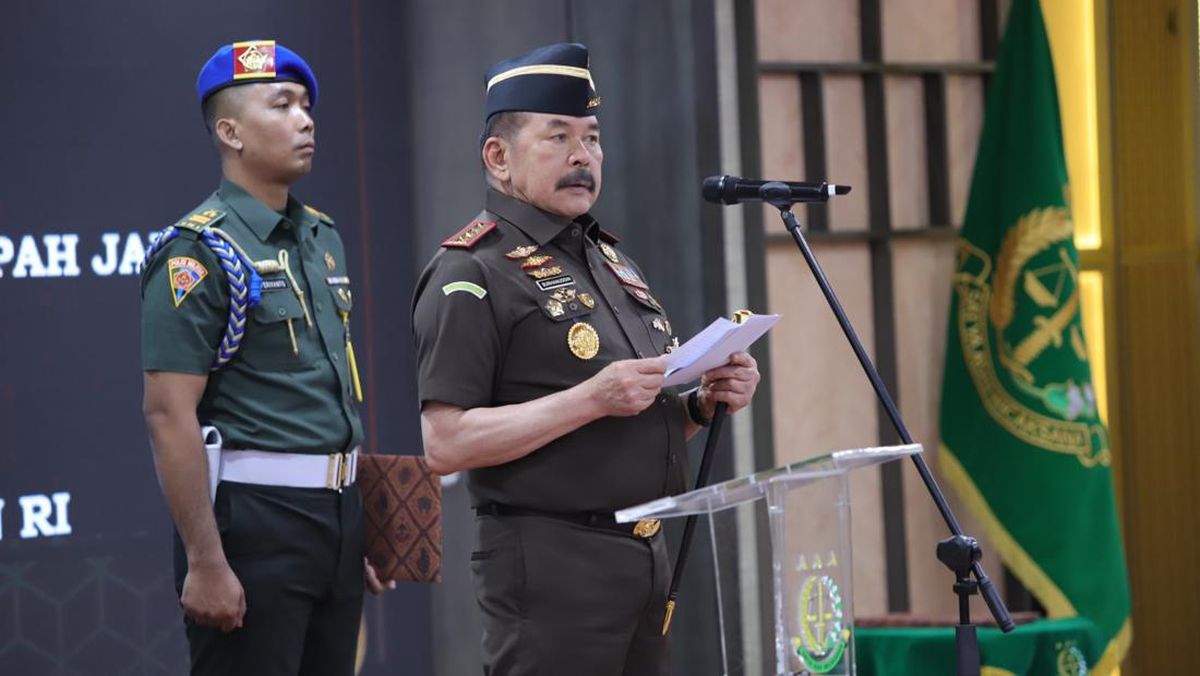
Attorney General Sanitiar Burhanuddin has raised the prospect of merging the working units of the Deputy Attorney General for General Crimes (Jampidum) and the Deputy Attorney General for Special Crimes (Jampidsus). He made the remarks during a National Seminar reflecting on six months of implementing the new Criminal Code (KUHP) and Criminal Procedure Code (KUHAP), along with a book review, at Al-Azhar University in Jakarta on Wednesday (25/6).
He assessed that the separate handling of cases between the two units has become less effective in implementing the new KUHP and KUHAP. Burhanuddin believes both units should ideally be under the single umbrella of a Deputy Attorney General for Operations.
“Why do I keep mentioning General Crimes here? Because for us, the ideal structure is actually a Deputy Attorney General for Operations, under which there would be General Crimes and Special Crimes,” he stated. He explained that currently, internal regulations for executing the law are often split between Jampidum and Jampidsus. This, he noted, causes confusion in the field and lengthens coordination processes.
“Right now, General Crimes and Special Crimes are separated, so people will wonder why General Crimes is always being prioritised. But perhaps later, Special Crimes will hold something similar as well,” he said. “However, I see this as actually being less effective. Why not utilise a Deputy Attorney General for Operations instead,” he added.
Therefore, he proposed the formation of a Deputy Attorney General for Operations to harmonise implementing regulations that were previously separate between General and Special Crimes. Nevertheless, Burhanuddin stressed that merging the units is still just a discourse. He hopes for input from experts so that the institutional structure of the Adhyaksa Corps can become more effective and efficient.
“In any case, we will further refine this Criminal Procedure Code so that in its implementation we hope it will be easier, more effective, and especially cheaper, without the lengthy separation between General and Special Crimes,” he explained.
On the same occasion, he also outlined the Prosecutor’s Office’s achievements during the first six months of the new KUHP and KUHAP’s enactment. “From a material perspective, the new KUHP shifts the paradigm of criminal law from merely an instrument of retribution towards corrective, restorative, and rehabilitative justice. The rehabilitation of the offender becomes the primary goal, not solely punishment,” he clarified.
Furthermore, during the period from January to May 2026, he noted that Jampidum had implemented 6 out of 9 new mechanisms regulated in the transitional regulations. These mechanisms include plea bargaining and Deferred Prosecution Agreements (DPA) for corporations.
However, Burhanuddin acknowledged ongoing challenges during this transition period. One is the pending issuance of a Government Regulation (PP) as the official implementing rule. “Thus, it must be understood that derivative regulations as executors of the KUHAP must be drafted in accordance with the corridors established by the law,” he added.
He also highlighted differing interpretations among law enforcement officers in the field and urged an end to convoluted bureaucracy and administration. “Don’t let the complex procedures hinder the achievement of restorative justice, which is the primary goal of law enforcement,” he concluded.