
Attending UN Forum, Environment Minister Reaffirms Indonesia's Commitment to Controlling Climate Change
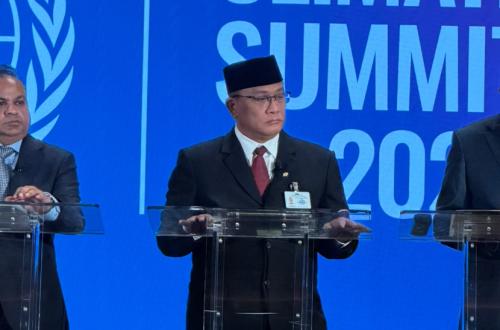
Indonesia has asserted that climate action must be translated into tangible results that support emission reductions alongside economic growth, energy security, poverty alleviation, job creation, and community resilience. The Minister of Environment/Head of the Environmental Management Agency (BPLH), Mohammad Jumhur Hidayat, stated that this is Indonesia’s commitment to translating climate change ambitions into action under the leadership of President Prabowo Subiability.
“The Paris Agreement is our compass. However, as the space to maintain the global temperature rise at 1.5 degrees Celsius narrows, our challenge is to bridge global commitments into real results, guided by justice and the principle of common but differentiated responsibilities and respective capabilities,” said Jumhur during the Interactive Leaders Dialogue on Climate Action and the Just Transition at the UN Headquarters in New York, USA, on Tuesday (23/9/2026).
In a press release, Jumhur stated that Indonesia is translating climate ambitions through the renewal of national commitments to reduce greenhouse gas emissions in accordance with the Paris Agreement, including the Enhanced NDC and Second NDC. This policy direction aims towards net-zero emissions by 2060 or sooner.
Jumhur noted that Indonesia is accelerating climate action across various economic sectors. In the forestry and other land use (FOLU) sector, Indonesia is pushing for increased greenhouse gas absorption to exceed emissions through the Net Sink 2030 target.
Meanwhile, in the waste sector, the government is strengthening efforts to reduce methane emissions through improved waste and wastewater management, the development of a circular economy, the application of technology, and increased local government capacity. Transformations are also being undertaken in the industrial sector.
According to Jumhur, the government is pursuing two complementary paths: decarbonising existing industries while simultaneously building low-carbon industries from the ground up. These efforts are supported by innovation and the responsible application of carbon capture, utilisation, and storage (CCUS) by leveraging geological formation potential and increasing Indonesia’s technological capacity.
In the energy sector, Indonesia is encouraging large-scale renewable energy development, including solar and geothermal energy. The government is also strengthening energy security through the national implementation of B50 biodiesel.
Jumhur added that the development of the electric vehicle ecosystem is part of the low-carbon industrial transformation and an effort to create domestic value-add.
“Our transition must be just, orderly, state-led, and people-centred. The energy transformation must strengthen energy security and affordability, create decent green jobs and local value-add, and protect vulnerable communities,” he said.
In addition to mitigation, Indonesia emphasised the importance of adaptation to the impacts of climate change. As an archipelagic nation, Indonesia faces various climate change risks, making adaptation efforts essential alongside emission reductions.
Indonesia is developing coastal area protection, including the Giant Sea Wall on the north coast of Java, alongside the protection and restoration of mangroves and coastal ecosystems. This approach is aimed at protecting communities, livelihoods, infrastructure, and the sustainability of development in coastal regions.
Thus, Indonesia’s climate action is directed not only towards emission reductions but also towards increasing the resilience of communities and ecosystems to the impacts of climate change.
In the forum, Jumhur also emphasised the importance of financial support for developing nations. He noted that developing countries cannot undertake the necessary transformation in scale and speed without adequate financial support.
Indonesia, he said, continues to mobilise domestic resources and develop carbon economic value instruments. However, international climate finance must be affordable, accessible, predictable, and commensurate with the magnitude of the climate change challenge.
Financial support also needs to cover the entire cycle of climate policy implementation, ranging from the provision of risk data, planning, programme and project preparation, technology, capacity building, implementation, to transparency, monitoring, and learning.
Indonesia also called for increased support for loss and damage, particularly for developing countries vulnerable to extreme weather events or the slow-onset impacts of climate change.
Ahead of the 31st Conference of the Parties (COP) in Antalya, Türkiye, Indonesia is pushing for progress in the implementation of climate action and the increase of new collective quantitative targets for climate finance, known as the New Collective Quantified Goal on Climate Finance (NCQG).
Jumhur stated that multilateralism must be able to produce concrete benefits for society, especially for groups most vulnerable to the impacts of climate change.
“Indonesia is ready to deepen partnerships capable of transforming climate ambition into real development, economic opportunity, and resilience for all,” he said.
Jumhur concluded that Indonesia’s message in the forum reaffirms that climate action must move from commitment to implementation, and from ambition to real results. Sectoral approaches must also be directed towards an integrated development transformation.