
Attack on UN Troops in Lebanon Classified as War Crime
The Muslim Lawyers Team (TPM) has stated that the attack on United Nations (UN) peacekeeping troops in Lebanon constitutes a serious violation falling under the category of war crimes.
This statement follows the deaths of three Indonesian National Armed Forces (TNI) soldiers involved in the United Nations Interim Force in Lebanon (UNIFIL) mission.
TPM representative Achmad Michdan described the attack as meeting the elements of a grave breach of international law, particularly as stipulated in the Rome Statute of the International Criminal Court.
“Under Article 18 Paragraph 2 Letter B Number 3 of the Rome Statute of the International Criminal Court at the ICC, an intentional attack directed against personnel, installations, material, units, or vehicles involved in a peacekeeping mission in accordance with the UN Charter is categorised as a war crime,” Michdan said in a press statement in Jakarta on Wednesday (1/4).
He added that the protection of peacekeeping troops is explicitly regulated in various instruments of international law, including UN Security Council Resolution 1701 of 2006 and the Fourth Geneva Convention.
“UN Security Council Resolution 1701 of 2006 and the Fourth Geneva Convention also explicitly protect peacekeeping troops from all forms of attack,” he continued.
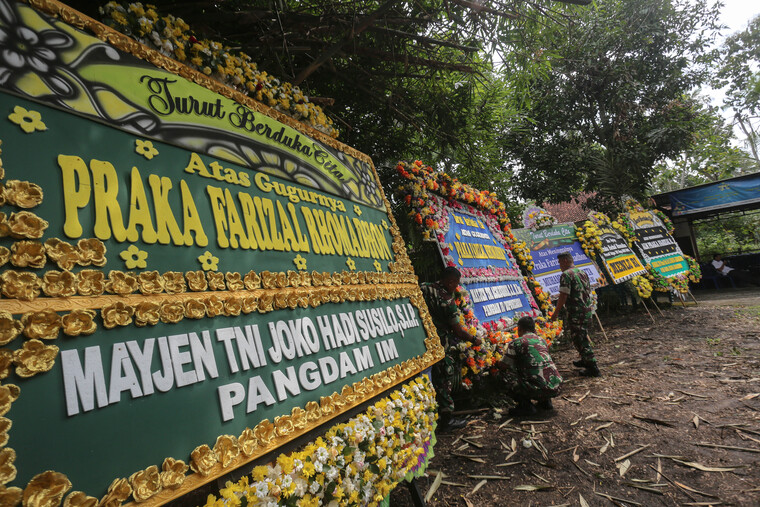
The three TNI soldiers who perished in the incident are Private First Class Farizal Rhomadhon, Captain (Inf) Zulmi Aditya Iskandar, and Sergeant Major Muhammad Nur Ichwan.
Private First Class Farizal was reported killed in an attack on the UNIFIL headquarters near Adchit Al Qusayr on Sunday (29/3), while the other two fell while carrying out UNIFIL vehicle escort duties in the Bani Hayyan area the following day.
TPM, along with MER-C Indonesia, considers this incident not merely a routine event in a conflict zone but one that must be followed up through international legal channels. They urge the Indonesian government to take firm steps immediately.
“We call on the government to take decisive diplomatic action by bringing this case to the International Court and the International Criminal Court,” he said, while also requesting an immediate evaluation of protection protocols for TNI personnel in conflict zones.
On the other hand, the process of evacuating the bodies of the fallen soldiers is still facing various obstacles due to the unstable security situation. TPM emphasises that the UN has a responsibility to ensure the safe and dignified return of the remains.
“The UN has an important role in the return of the remains on the basis that the UN requested the Indonesian government to send personnel involved in the UNIFIL contingent,” he continued.
MER-C Presidium Chairman Hadiki Habib also highlighted the high risks in the evacuation process in conflict areas. He reminded that the safety of the duty team must be the top priority.
“Indeed, victims who die in conflict areas face the greatest risk of not being able to be evacuated,” Hadiki stated.
He added that the repatriation process must not endanger other living personnel.
“This repatriation process should not endanger those still alive in returning them,” he said.
According to him, the on-the-ground situation indicates repeated risks, including the second attack incident that occurred during the evacuation efforts for the first victim.
This is seen as demonstrating that the UNIFIL operational area, which should be safe, is instead vulnerable to attacks.
MER-C also stressed the need for intensive coordination with various parties, including conflicting sides, to ensure security in every evacuation process or humanitarian mission.
Nevertheless, in the worst-case conditions, the option of burial in the conflict location must still be considered if evacuation is not possible.
“If it is indeed not safe, we must reach the point of accepting that the remains are laid to rest or buried in the war area,” Hadiki explained.
Amid the escalating conflict, MER-C expressed readiness to send a medical team to Lebanon to assist war victims. However, the departure of that team is still awaiting certainty on the security situation in the field.
This incident once again highlights the high risks faced by peacekeeping troops in conflict areas, while also prompting calls for the international community to ensure accountability for every attack on UN personnel.
The Iranian Ambassador to Indonesia, Mohammad Boroujerdi, expressed condolences over the deaths of the three Indonesian soldiers serving in the UN peacekeeping forces in Lebanon.
GKB-NU Condemns Israel’s Attack on Indonesian Peacekeeping Troops, Urges Prabowo to Focus on Advocating for Palestinian Independence.
Military expert Jaleswari Pramodhawardani stated that the deaths of TNI soldiers in the UNIFIL peacekeeping mission should not be responded to merely with condemnation but with a total evaluation.
The Indonesian government has issued a firm condemnation of the second attack that occurred in the southern Lebanon area of Bani Haiyyan on Monday (30/3).
The leadership of the Yogyakarta Special Region (DIY) Regional People’s Representative Council expressed deep condolences over the death of TNI soldier Private First Class Farizal Romadhon.