
ATR Minister Reveals Rice Fields Being Converted Into Industrial Estates, Hotels and Restaurants
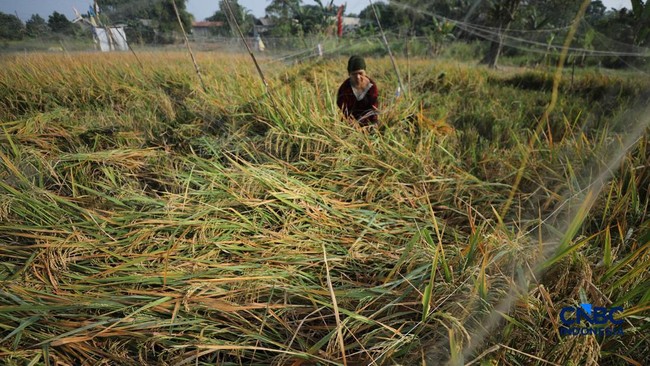
The Minister of Agrarian Affairs and Spatial Planning/Head of the National Land Agency (BPN), Nusron Wahid, has revealed ongoing problems of paddy land conversion in a number of Indonesian regions. Farmland in several areas has been converted into industrial zones, housing, and buildings for tourism.
Nusron said the situation poses a challenge for the government in pursuing its target of protecting paddy land to support national food security and self-sufficiency.
“There are still 7 provinces below 87% (of the government’s target), because the mandate is 87%. They are Riau, Jambi, Banten, Bali, West Kalimantan, East Kalimantan, and Papua,” Nusron said at a press conference at the Office of the Food Coordinating Ministry in Jakarta on Monday (7/9/2026).
He acknowledged that protecting farmland in Banten and Bali is no easy task. Amid development needs, farmland in both regions continues to be squeezed by the expansion of industry, housing, and the tourism sector. Yet Banten and Bali are among the regions with fertile land, which is why the government is striving to maintain their farmland proportions.
“Earlier there was a note from BPS that, specifically for Banten and Bali, we must reach 87% if at all possible. Because these are fertile farming regions. But it is indeed not easy. In Banten, a lot has already been converted for industry and housing. In Bali, a lot has been converted for villas, hotels, and tourism, especially restaurants in the middle of rice fields in the Badung area and elsewhere,” he said.
According to Ministry of ATR/BPN data as of 6 September 2026, the seven provinces indeed recorded Sustainable Food Agriculture Land (LP2B) designations below the 87% national target. Banten stands at 84.04%, Bali 86.61%, Riau 77.73%, Jambi 79.10%, West Kalimantan 77.81%, East Kalimantan 78.91%, and Papua 78%.
Nationally, proposed LP2B designations have reached 87.52%, or around 6.43 million hectares of the total Paddy Base Land (LBS) of approximately 7.35 million hectares.
This achievement has even surpassed the 2029 target. The government had previously set a minimum LP2B target of 87% by 2029, with milestones of 78% in 2026, 81% in 2027, and 84% in 2028.
Nusron explained that this achievement was the result of an eight-month acceleration effort together with the Ministry of Home Affairs and BPS under the coordination of the Food Coordinating Ministry.
“After working for 8 months with the Ministry of Home Affairs, BPS and everyone under the guidance of the Food Coordinating Ministry, thank God, nationally all district/city leaders have committed and signed provisional decrees. In aggregate, nationally it is 87.52%. So work that should have been completed in 2029 could be finished in 2026,” he said.
However, the problem is not entirely solved. In January 2026, Nusron revealed that LP2B designation based on Provincial Spatial Plans (RTRW) had only reached 68%. Referring to District/City RTRWs, the figure was even lower, at just 41.72%.
“Then if we refer to District RTRWs, our audit in January 2026 showed only 41.72%. District/City RTRWs that incorporate LP2B or the ‘paddy forever’ designation, which cannot be altered,” Nusron said.
According to him, protecting paddy land is an essential part of the government’s pursuit of food self-sufficiency, because the availability of land and water is the primary requirement for farming to continue.
“We are doing all of this to support food resilience and food self-sufficiency. Because food self-sufficiency simply cannot happen without land and water. Say there are no other subsidies — as long as there is land and water, farmers will still plant. That is what I believe,” he said.
To close the gap in the seven provinces, the government will ask regional heads to revise their RTRWs. Nusron said new regulations allow revisions without having to wait five years.
“Next, we will send letters to all regional heads urging them to promptly revise their RTRWs. Because under Government Regulation 34 of 2026, RTRW revisions are now permitted without waiting 5 years. They may be done at any time, even mid-year, and only partially for the spatial pattern. For example, only the paddy spatial pattern may be revised. So it is what we call a minor revision, not a holistic one,” he explained.
Food Coordinating Minister Zulkifli Hasan then asserted that the seven provinces still below 87% will be given time to expand their LP2B areas, but the figures already designated must not decline.
“Those 7 provinces, we decided, are below 87%. So we simply give them time to add and complete it so they can achieve more. Give them time. But it must not fall below that. We set the marker first. Some are at 77%, some 86%, some 80%, some 78% — they must not decrease from that. We lock it. Locked, yes, with time given to achieve more,” Zulhas said on the same occasion.
Zulhas said the move is part of the government’s effort to build a single spatial map while strengthening law enforcement against land use that does not conform to its designation.
“So spatial planning exists to create one map. When I was forestry minister, there was no single map. That is why we will make one map. Which areas are forest, which areas are this or that. It has actually already been detected. That is why in the map there are yellow colours, green colours, right? It already exists, we just lack discipline,” he said.
Meanwhile, Minister of Housing and Settlement Areas (PKP) Maruarar Sirait believes spatial planning certainty must be strengthened so that land designation is not easily changed. He even asked for the rules to be locked down so they cannot be shifted merely because of lobbying by particular interests.
“That is what I want. How can a great nation not be able to do this? Because, if I may say, policies at the lower level must not contradict those above. Just lock it, lock the arrangement in place,” Maruarar said.
“Anything outside that is a violation. A regional head who does that faces criminal liability. If it were up to me, it must be firm — do not let it be changed through lobbying, changed through lobbying. That would be chaos. In my view, we must be firm in upholding the law,” he asserted.
Source: jawawa.id (https://jawawa.id/newsitem/atr-minister-reveals-rice-fields-being-converted-into-industrial-estates-hotels-and-restaurants-1788781936)
Originally published by CNBC Indonesia (https://www.cnbcindonesia.com/news/20260907152020-4-765865/menteri-atr-ungkap-sawah-ri-beralih-jadi-industri-hotel-sampai-resto), translated from Indonesian