
Atma Jaya Professors and Ministry of Communication Highlight AI Challenges for Journalism
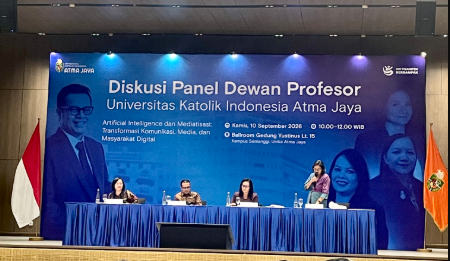
The Deputy Minister of Communication and Digital, Nezar Patria, believes that the shift in control over information distribution from newsrooms to digital platform algorithms poses a serious challenge to journalism and the quality of information received by the public.
According to Nezar, the development of social media platforms has altered the relationship between media and audiences. While conventional media previously held greater control over determining the information presented to readers, platform algorithms now increasingly dictate the content that appears before users.
These remarks were made during a panel discussion organised by the Board of Professors at Atma Jaya Catholic University of Indonesia (Unika Atma Jaya) titled “Artificial Intelligence and Mediatisation: Transformation of Communication, Media, and Digital Society” in South Jakarta on Thursday.
“Currently, media is losing its audience; it is the platforms that control the audience. Social media platforms are developing much faster, deeper, and more aggressively, thereby shifting the relationship patterns between conventional and traditional media and the audience,” Nezar stated.
Nezar explained that platform algorithms work by studying user behaviour. Every interaction, including likes, searches, and consumed content, becomes data used by the system to determine the next piece of information displayed to the user.
“So, everything we ‘like’ is recorded in the machine learning used by social media. Therefore, what we like will always come back to us; that is what is known as an echo chamber,” he explained.
He noted that this mechanism can cause individuals to be continuously exposed to information that aligns with their previous preferences. This condition has the potential to narrow user perspectives as information differing from their views becomes increasingly rare.
This issue, Nezar said, becomes more serious because information distribution today is not merely about delivering facts, but also about shaping public perception.
“What is happening is not delivering the truth, but creating perception,” Nezar emphasised.
He assessed that this situation could be exploited for various interests, including politics. Information that may not be true can be made to appear continuously so that it becomes embedded in the public memory. When a name, issue, or narrative becomes ‘top of mind’, public perception can be more easily directed.
Rosdiana Sijabat, Professor of Business Economics at the Faculty of Business and Social Innovation, Unika Atma Jaya, noted that social media algorithms are now not just distributing information, but also shaping public perception through the phenomena of echo chambers and filter bubbles.
According to Rosdiana, algorithms cause users to continuously receive content that matches their behaviour and preferences. This condition can make it increasingly difficult for the public to distinguish between true and false information.
“What is happening is not delivering the truth, but creating perception,” Rosdiana stated.
She remarked that in a political context, the power of information is sometimes determined not by its truth or falsehood, but by how strongly that information is embedded in the public memory.
“In social media campaigns, what is false can become true, and what is true can become false. The most important thing is that it becomes ’top of
mind’ first; that name must stick,” she said.
According to Rosdiana, this phenomenon then evolves into cognitive warfare. Narratives that have been strongly embedded can be directed to shape public perception according to specific interests.
This condition also poses a challenge to journalism. In addition to facing audience migration to digital platforms, media must maintain journalistic processes to remain oriented towards the search for and reporting of the truth.
The challenge grows even larger with the use of Artificial Intelligence (AI) in news production. Rosdiana stated that while AI can process data into writing, it cannot replace the processes of observation, verification, fact-checking, and editing performed by journalists.
“Because AI cannot work without data. And that data can also be wrong,” she said.
She warned of the threat of ‘data poisoning’, which is the manipulation of data that can cause AI systems to produce erroneous information.
Rosdiana also assessed that algorithms are increasingly influencing economic decisions through the ‘power to rank’, ‘power to recommend’, and ‘power to price’. Algorithms can determine product recommendations and even adjust prices based on user demand.
She also warned of the rise of AI-based fake content using public figures to build trust. Therefore, the public needs to strengthen digital literacy and perform verification before trusting or spreading information.
On the other hand, Rosdiana views AI as an opportunity for Indonesia. However, national capacity needs to be strengthened so that Indonesia does not merely become a user of AI technology, but also a developer.
“We do not want to be just AI users; we want to be AI developers,” she emphasised.
On the same occasion, V. Selvie Sinaga, Professor of International Intellectual Property Law at Unika Atma Jaya, assessed that the development of Artificial Intelligence (AI) presents increasingly complex legal issues, particularly regarding copyright and the ownership of works produced with the assistance of such technology.
According to Selvie, the changing way in which information and works are produced, distributed, and used means that legal frameworks must be able to keep pace with technological developments. One of the emerging issues is the lack of clear legal protection for works created with the assistance of AI.
Source: jawawa.id (https://jawawa.id/newsitem/atma-jaya-professors-and-ministry-of-communication-highlight-ai-challenges-for-journalism-1789102364)
Originally published by Media Indonesia (https://mediaindonesia.com/humaniora/932238/dewan-profesor-atma-jaya-dan-komdigi-soroti-tantangan-ai-bagi-jurnalisme), translated from Indonesian