
Atma Jaya Forum Highlights 'End of Reformasi' and the Consolidation of Oligarchy
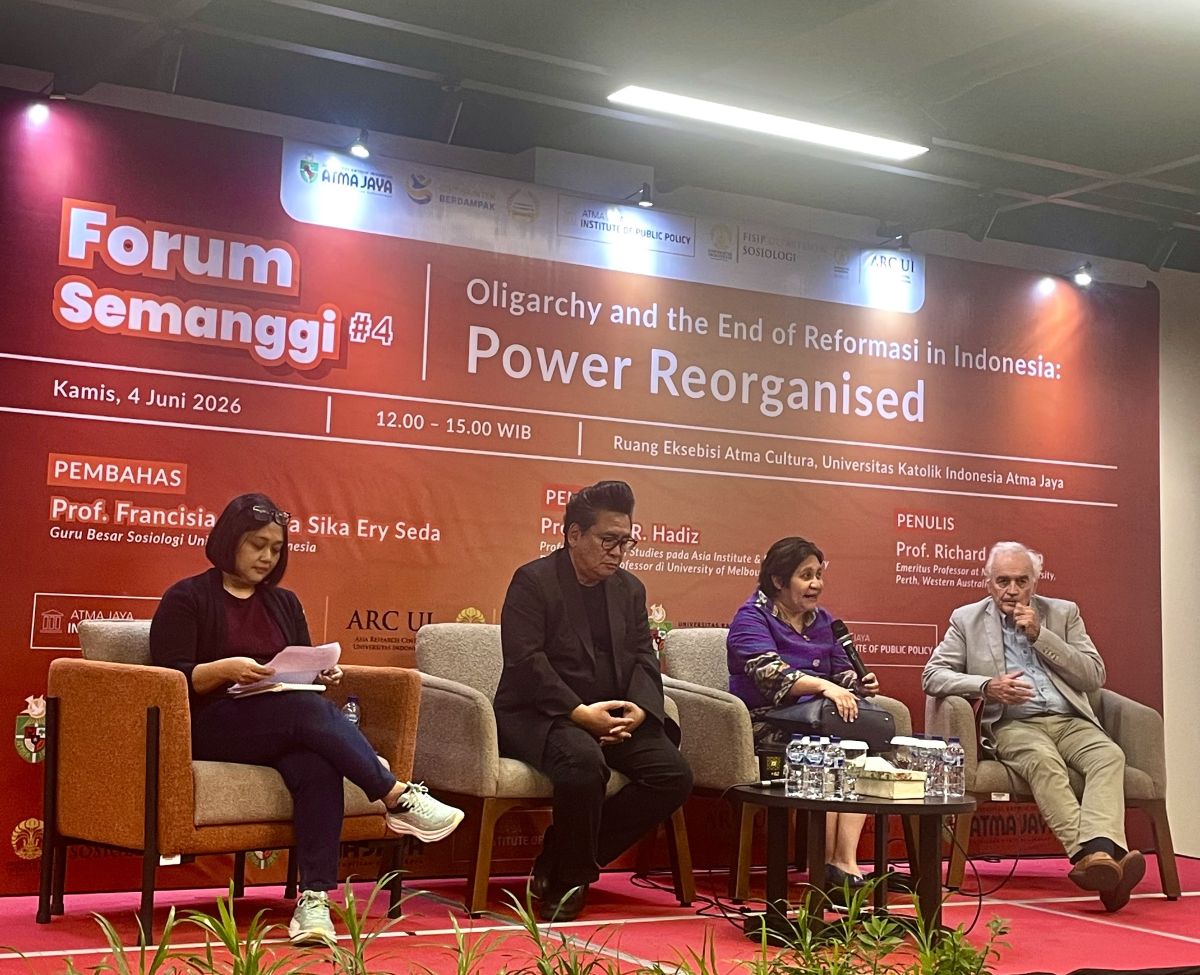
Professor of Asian Studies at the University of Melbourne, Australia, Vedi R. Hadiz, assesses that Indonesia is entering a new phase of oligarchic consolidation running in tandem with democracy. This condition is deemed a marker of what he calls the ‘end of Reformasi’. This view was delivered by Vedi during the Forum Semanggi #4 discussion titled ‘Oligarchy and the End of Reformasi in Indonesia: Power Reorganised’ at the Atma Jaya Campus, Central Jakarta, Thursday (4/6). The book was co-authored by Vedi and Murdoch University Emeritus Professor Richard Robison. In his presentation, Vedi stated that democracy has often been understood as a system that automatically weakens oligarchy. However, Indonesia’s political reality appears to show a different direction, indicating that democracy and oligarchy can coexist intimately to maintain power. According to him, this phenomenon is reinforced by the emergence of ‘incumbent populism’, namely the use of democratic legitimacy and electoral power to preserve the dominance of political and economic elites. The book is a revised and expanded version of the classic work ‘Reorganising Power in Indonesia’ published in 2004. If the previous book explained how oligarchy survived after the fall of the New Order, the latest edition attempts to read Indonesia’s political developments up to the era of President Prabowo Subianto’s administration. Vedi emphasised that the oligarchy he refers to is not merely specific conglomerate groups, but rather the structural relationship between political power, bureaucracy, and big business. He explained that the 1998 Reformasi indeed succeeded in toppling the political institutions of the New Order, but did not destroy the oligarchic power that underpinned it. Over the last two decades, oligarchy has actually managed to use democratic institutions to maintain political and economic dominance, albeit in a more fragmented and flexible form. The statement was made amid economic pressures that have resurrected comparisons with the 1998 crisis. The rupiah exchange rate on Thursday (4/6) was recorded at IDR18,035 per US dollar, nominally surpassing its weakest point during the 1998 monetary crisis. Nevertheless, Vedi cautioned the public not to expect that the current economic turmoil will give birth to a new reform like 1998. He noted that the fall of the Soeharto regime actually opened an opportunity for great change, but the power vacuum was instead filled by old elite groups with new faces. Progressive civil society did not fill the void, but rather similarly oligarchic classes did. Vedi also highlighted the formation of the state superholding Dan Antara, which he considers a new instrument for oligarchic consolidation and the centralisation of economic-political power. He further stated that the greatest challenge to change is not only the strength of oligarchy but also the weakness of progressive civil society. A similar view was conveyed by Emeritus Professor from Murdoch University, Australia, Richard Robison. According to him, Indonesia’s oligarchy is currently undergoing a process of power re-centralisation, calling it the end of Reformasi because economic and political power is now being re-centralised, even though democratic institutions still exist. He noted this process is visible through the strengthening of state instruments, increasing state intervention in the economy, and the resurgence of military influence in government, leading to re-militarisation and increasingly limited civic rights. Because the ruling regime is now much more consolidated and reconciled, Robison assessed that political change in Indonesia can no longer rely on the old reform pattern; it must come from building something different from past failures. Meanwhile, University of Indonesia Professor of Sociology Francisia Saveria Sika Ery Seda noted the revised book shows an important shift from oligarchy merely ‘surviving’ to becoming ‘consolidated’ within democracy.
Source: jawawa.id (https://jawawa.id/newsitem/atma-jaya-forum-highlights-end-of-reformasi-and-the-consolidation-of-oligarchy-1780645837)
Originally published by Media Indonesia (https://mediaindonesia.com/politik-dan-hukum/897324/forum-semanggi-atma-jaya-soroti-gejala-akhir-reformasi-dan-menguatnya-oligarki), translated from Indonesian