
At YESIST12 2026, Rushali Thakkar Urges Students to Serve Society Through Technology
A piece of technology might appear successful when its devices power on and its systems function. However, for the communities receiving the benefits, the measure of success can be much simpler: does the technology truly help resolve the problems they face?
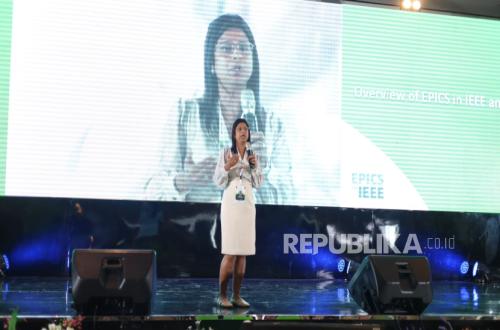
This question formed part of the message delivered by Rushali Thakkar, a Senior Member of IEEE and representative of EPICS in IEEE, during her keynote speech at the IEEE YESIST12 2026 series at the BSI Convention Centre, Bekasi, on Saturday (3/10/2026). The international event is being hosted by Nusa Mandiri University (UNM) under the theme “Age of Innovation”.
In her presentation, Rushali introduced Engineering Projects in Community Service, or EPICS in IEEE, a grant programme under the IEEE Educational Activities Board (EAB) designed to support the concept of service-learning. Established in 2009, the programme adopts the EPICS model from Purdue University. The concept brings together students and IEEE members to design and implement engineering-based technological solutions alongside local community organisations.
Through this approach, students do not only learn how to make technology work; they are also encouraged to understand the problems faced by the end-users of that technology.
“EPICS in IEEE focuses on four main pillars: Education & Outreach, Access & Abilities, Environment, and Human Services,” said Rushali on Saturday (3/10/2026).
When Engineering Meets Community Needs
The scale of EPICS in IEEE demonstrates that this approach has evolved into a global network. From 2009 to 2025, the programme has funded 303 projects with grants totalling more than US$1.6 million.
The programme involves over 13,000 students and 1,600 volunteers, with an estimated 1.67 million beneficiaries worldwide. Asia is the region with the largest project contribution, accounting for approximately 39 per cent of all global projects.
For Rushali, students hold a vital position within this ecosystem. They do not only bring the technical knowledge acquired in the classroom, but they also learn to confront issues that possess social context and real user needs.
This experience simultaneously develops skills that are not always gained through technical lectures, such as project management, leadership, teamwork, and communication. Several projects from Indonesia serve as examples of how this approach is applied. One such example is the implementation of Internet of Things (IoT) based Smart Farming technology for salak fruit cultivation in Sleman, developed by Multimedia Nusantara University.
Source: jawawa.id (https://jawawa.id/newsitem/at-yesist12-2026-rushali-thakkar-urges-students-to-serve-society-through-technology-1791114768)
Originally published by Republika (https://news.republika.co.id/berita/tmdpg2425/di-yesist12-2026-rushali-thakkar-dorong-mahasiswa-layani-masyarakat-lewat-teknologi), translated from Indonesian