
At the Crossroads of the World
Imagine a nation that, within a single week, appears to be “betraying” all sides—or remaining loyal to them all at once. Indonesia signs a military cooperation agreement with the United States, then flies to Moscow to meet Vladimir Putin. At the same time, it purchases the BrahMos missile system—a Russia-India collaboration—while quietly suspending its involvement in the Board of Peace proposed by Donald Trump. This is not a spy thriller script. This is Indonesia, 2026 edition.
At first glance, everything President Prabowo Subianto has been doing lately seems like acute confusion. Like a minibus driver yanking the steering wheel left and right simultaneously—and strangely, still moving forward.
But hold on. In international relations theory, there is one term that explains all these moves with cool, calm, and almost emotionless precision: hedging.
In contemporary literature, hedging is understood as a strategy to balance risks without fully aligning with any side. It is not indecisiveness. It is not flip-flopping. It is the art of survival in a world that no longer has a single centre of gravity.
The problem is that many people still view the world through old lenses: as if every country must choose a camp, like picking a football club—once in, loyal for life.
Yet in today’s multipolar world, that logic is becoming outdated. Countries are no longer seeking a “home”, but “tools”. They are no longer joining to submit, but to exploit.
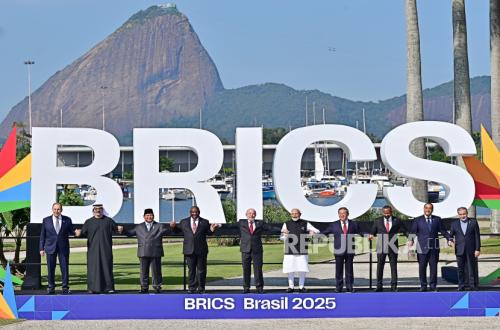
This is where the most classic misunderstanding often occurs: when a country like Indonesia joins a forum or bloc, such as BRICS, the public rushes to assume it signals loyalty. In reality, it may just be a calculated step.
Analysts like Andrew Korybko have long warned: mistaking BRICS for a military alliance is like mistaking a neighbourhood women’s savings group for a reserve military drill.
You know, the term BRIC was first popularised by Goldman Sachs economist Jim O’Neill in the early 2000s—referring to Brazil, Russia, India, and China as emerging economic powerhouses. South Africa joined later, completing the acronym to BRICS.
BRICS has always been a tool for financial coordination—not an Eastern version of NATO. Even Russia itself, through its sherpa, has affirmed this. Thus, when Indonesia joins BRICS, it is not handing over the keys to its sovereignty to Beijing or Moscow. It is simply adding a new drawer to its national strategy cabinet.
This is where we begin to see the pattern. Indonesia is not choosing a path. Indonesia is opening all paths, while ensuring no door can be locked from the outside.
The metaphor is simple: Indonesia is not a chess pawn. It is a player holding two boards at once. On one board, it plays with Washington—gaining access to cutting-edge military technology, from drones to submarine systems.
On the other board, it transacts with Moscow and New Delhi. The goal is clear: to accumulate deterrence power through supersonic missiles that can lock down the Malacca Strait like a giant padlock on the neck of global trade.
And the Malacca Strait itself is not just a sea route. It is the “oxygen tap” for the world economy, especially China. Around 80 per cent of China’s energy imports pass through there. This means that whoever controls Malacca does not merely guard the waters—they grasp the pulse of global industry.
Indonesia, with its geography like a seatbelt around the strait’s neck, suddenly is no longer just a typical developing nation. It transforms into a “gatekeeper” quietly determining who can breathe and who will choke. And in the world of energy, choking is no metaphor—it is a crisis.
But this game did not start yesterday afternoon. It is a long inheritance since 1945: the “free and active” foreign policy. A principle often misunderstood as neutrality, but more accurately described as “freedom from confinement”.
Indonesia has learned from a long history—from Dutch colonialism, Cold War pressures, to the Asian financial crisis—that getting too close to one power is the fastest way to lose sovereignty.
In more poetic terms, Indonesia is a child growing up between two often quarrelling giants. It has learned one important lesson: do not stand too close to either, but ensure both know you cannot be ignored.