
At KUII, Religious Affairs Minister Calls on Muslims to Support Government Priority Programmes
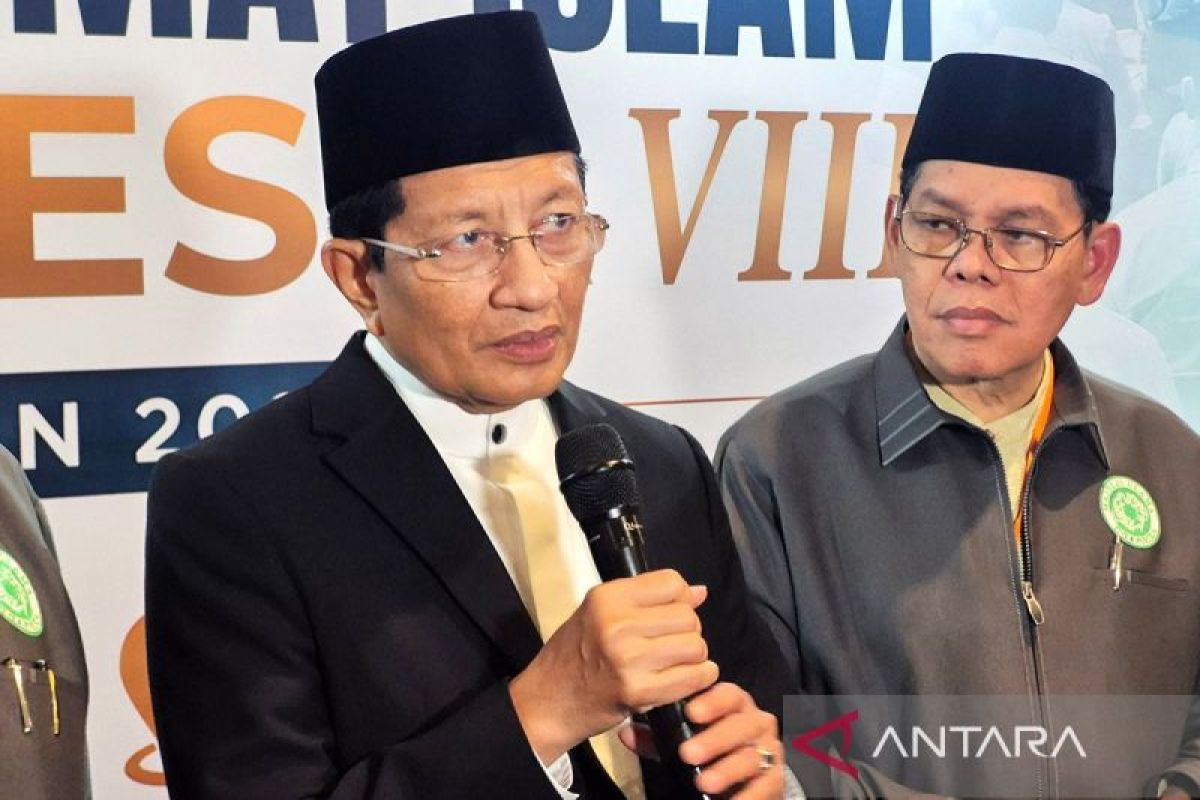
Religious Affairs Minister Nasaruddin Umar has called on all elements of the Muslim community and the Indonesian Ulema Council (MUI) to synergise and fully support the implementation of the national priority programmes initiated by the government. Closing the 8th Indonesian Muslim Congress (KUII) series and commemorating the 51st anniversary of MUI in Jakarta on Sunday evening, the minister stressed that collaboration between the government and religious leaders is crucial. He expressed confidence that the various priority programmes and pro-people policies launched by President Prabowo Subianto are ultimately aimed at the welfare of Muslims as the majority group in Indonesia. “We need to synergise and support President Prabowo’s commitment to fully implement Article 33 of the 1945 Constitution. If this policy is implemented, the main beneficiaries will be Muslims,” Nasaruddin said. The minister detailed several strategic national programmes that should be jointly overseen. These include industrial downstreaming policies, free school access for the public, expansion of LPDP scholarships for underprivileged groups, and the construction of thousands of houses and fishing villages. He also highlighted the government’s commitment to redistributing large tracts of vacant and abandoned land back to the community for management. According to him, this series of affirmative policies should foster a sense of optimism among the people. “Who will benefit most from downstreaming? Who will enjoy free public schools and scholarships for underprivileged children? It is our people. Therefore, I urge everyone to give full support to these kinds of policies,” he asserted. Beyond welfare programmes, the minister emphasised that the government’s vision is also closely aligned with the concerns of religious scholars in safeguarding the nation’s morals. This is evidenced by the issuance of Presidential Regulation Number 111 of 2025 concerning the general policy on state defence, which explicitly targets the eradication of non-military threats. The non-military threats currently being combated by the government, the minister continued, include the spread of atheism, the erosion of nationalism, the rise of online gambling practices, and the spread of LGBT culture and deviant behaviour. Apart from supporting government programmes, Nasaruddin also invited the MUI to seek non-economic approaches to boost the market share of national Islamic finance and banking. He lamented the fact that out of approximately 240 million Muslims in Indonesia, the market share of Islamic banking remains stagnant, hovering below 10 percent. In closing, the minister requested that all recommendations and formulations from the 8th KUII be formally submitted to the Ministry of Religious Affairs. He pledged to integrate the brilliant ideas from the scholars into the government’s concrete work programmes to realise Indonesia’s aspiration of becoming a centre of world Islamic civilisation glory.