
At ITB Campus, Singaporean Ambassador Shares Insights on Global Talent
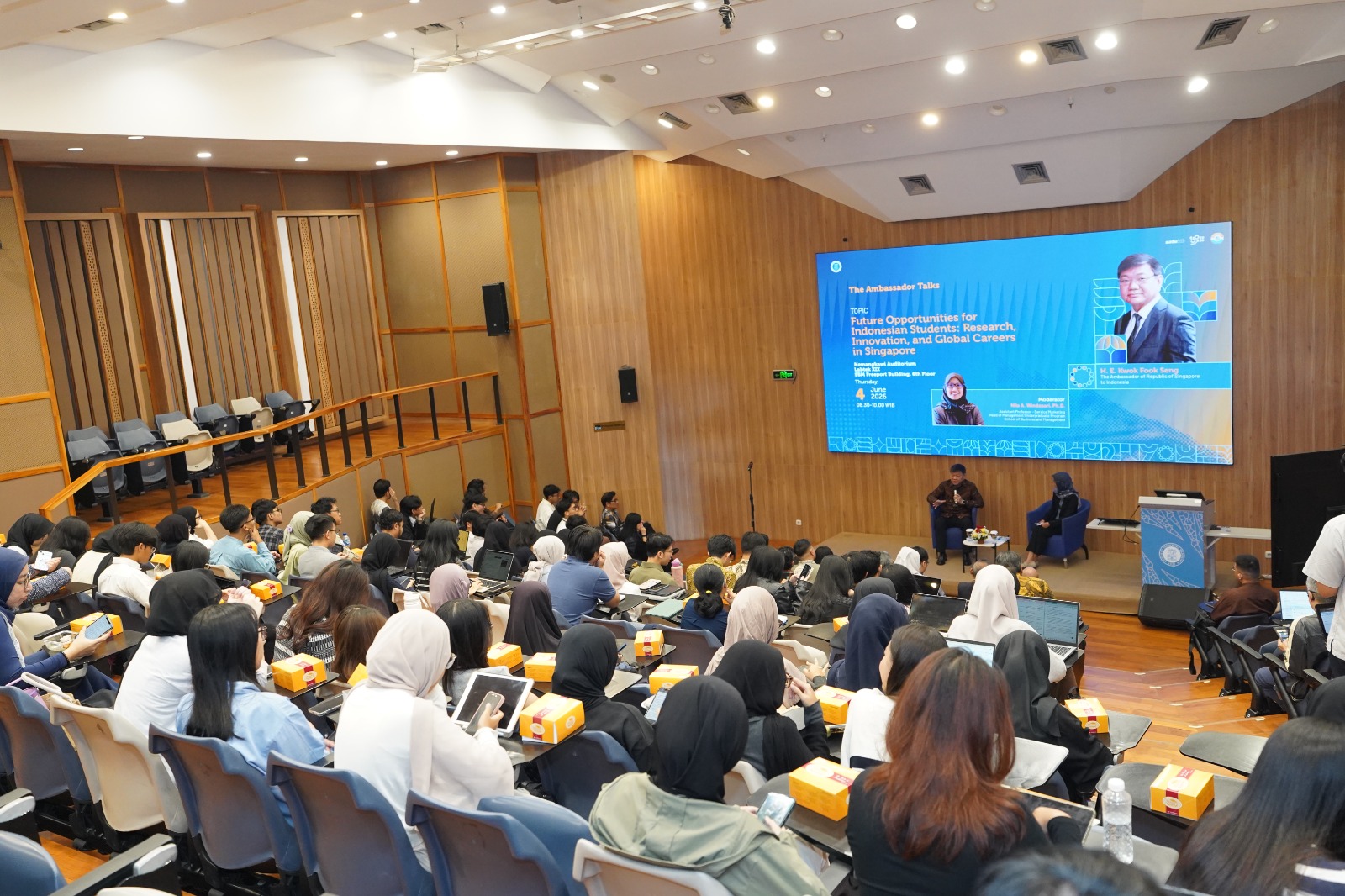
INSTITUT Teknologi Bandung (ITB) hosted a session of The Ambassador Talks featuring Singapore’s Ambassador to Indonesia, H.E. Kwok Fook Seng, on Thursday (4/6) at the Nemangkawi Auditorium, Labtek XIX, SBM Freeport Building, 6th Floor, ITB Ganesha Campus. ITB Rector, Prof. Dr. Ir. Tatacipta Dirgantara, expressed appreciation for Ambassador Kwok’s presence. He emphasised the importance of the session in strengthening ASEAN cooperation while encouraging brain circulation between countries. The collaborative relationship between ITB and Singapore has been established for over three decades since 1993. “Currently, this cooperation encompasses various leading institutions, such as the National University of Singapore (NUS), Nanyang Technological University (NTU), Singapore Management University (SMU), Singapore Institute of Technology (SIT), Temasek Polytechnic, LASALLE College of the Arts, AI Singapore, as well as industry partners like Intel Technology Asia,” he stated. Tata also encouraged students to think beyond borders, seize international opportunities, build global networks, and develop the competencies needed to face an ever-changing world. In his presentation, H.E. Kwok Fook Seng noted that Singapore has been one of the largest foreign investors in Indonesia for more than a decade. Over the past year, the value of Singapore’s investment in Indonesia reached approximately 20 billion US dollars. This reflects a high level of trust and long-term commitment between the two countries, while opening up wide spaces for academic and industrial collaboration. “Currently, various opportunities for Indonesian students in Singapore are available and can be utilised from an early stage. The door is already open,” he said. Kwok encouraged students to take advantage of the various pathways available, ranging from student exchange programmes, summer schools, double degree programmes, to internship and job placement opportunities. “Start early,” he stressed. Kwok noted that internships are not only a means of gaining work experience but also one of the recruitment pathways widely used by companies to identify and assess prospective talent before they graduate. He also highlighted several sectors expected to be the main drivers of economic growth and future global talent demand, namely energy, data and artificial intelligence (AI), sustainability, and the services sector. In the energy sector, he assessed that Indonesia has very significant potential, particularly in the field of renewable energy. “With renewable energy potential reaching approximately 3,700 GW and Singapore’s energy needs at only around 20 GW, there are ample opportunities for collaboration in green energy development, renewable energy certificate trading, and cross-border carbon markets,” he explained. According to Kwok, besides energy, data has become a strategic asset that increasingly determines a country’s competitiveness. Therefore, students need to build strong data analysis skills to generate innovation and make evidence-based decisions. In the field of AI, Ambassador Kwok reminded that the rapid development of technology presents both opportunities and challenges. Students, Kwok said, are encouraged not only to be users of AI, but also to be able to apply it to solve various real-world problems according to their respective fields of expertise. He also stressed the importance of sustainability aspects in the development of innovation and business. According to him, various global challenges, such as climate change and the energy transition, require sustainable solutions that have a broad impact on society. “Meanwhile, the services sector is seen to continue growing along with the increasing need for knowledge-based, technology, education, health, and digital economy services. This sector is considered to offer wide career opportunities for the young generation who possess good collaboration, communication, and problem-solving skills,” he explained. In addition, Kwok also highlighted a challenge often faced by first-generation startup founders, namely a lack of attention to local market adaptation. Innovation that is not accompanied by an understanding of local market characteristics and behaviour is often difficult to develop. He gave the example of how culinary businesses need to adapt their products in each region, while digital startups need to make adjustments to suit more specific and competitive market needs. “Regarding intellectual property, I encourage students and researchers to protect their inventions through appropriate mechanisms, while actively commercialising and sharing innovations to create a broader impact for society,” he continued. Closing the discussion session, Kwok affirmed that success at the global level is determined not only by technical skills, but also by human qualities, such as empathy, adaptability, and sensitivity to market needs. Kwok encouraged students to build a strong academic foundation, develop cross-disciplinary approaches, and utilise data to generate solutions quickly and accurately. “Many real challenges today cannot be solved from just one academic perspective, but require collaboration across various fields of science,” he concluded. Furthermore, he invited students to prepare themselves to become part of the global talent pool capable of contributing at the international level through mastery of technology, understanding of sustainability issues, and the ability to adapt amidst rapid change. Through this Ambassador Talks activity, ITB students gained insights into international collaboration opportunities and strategic sectors of the future.