
At Hipmi National Conference, Prabowo Finally Reveals Reason for Frequent Overseas Trips
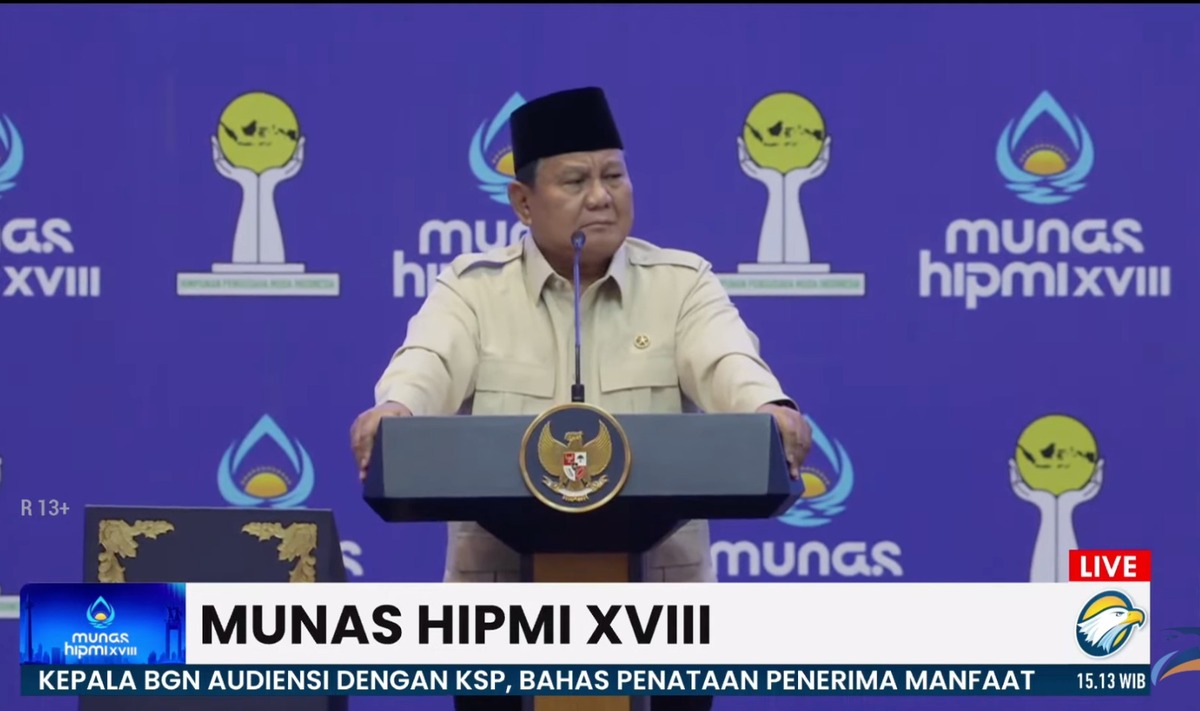
President Prabowo Subianto has revealed that the intensity of his overseas visits is not merely part of a routine diplomatic agenda, but an effort to safeguard national interests amid an increasingly complex and uncertain global geopolitical situation. Addressing participants at the Indonesian Young Entrepreneurs Association (Hipmi) National Conference in Lampung on Wednesday (10/6), Prabowo admitted he frequently becomes a target of criticism regarding his diplomatic activities. However, he argued Indonesia has no choice but to maintain good relations with all world powers. “The geopolitical dynamics are so chaotic now. We do not know who is a friend and who is a foe,” Prabowo said, as broadcast on the Presidential Secretariat’s YouTube channel. According to him, Indonesia is fortunate to inherit the foreign policy foundation built by the nation’s founders. The principles of being free and active, non-aligned, and not siding with any power bloc remain relevant for facing the current shifts in the global constellation. Therefore, since receiving the mandate as head of state, Prabowo stressed that he immediately continued this foreign policy line. “That is why, as soon as I received the mandate as president, I immediately outlined our foreign policy to continue non-aligned politics, non-bloc politics, free and active politics. A thousand friends are too few; one enemy is too many,” he said. Prabowo explained that his position as head of state requires him to maintain communication with all world leaders regardless of political blocs or geopolitical interests. He cited the good relations Indonesia maintains with various major countries. On one hand, he communicates with Russian President Vladimir Putin; on the other, relations with United States President Donald Trump are also maintained. According to Prabowo, this stance often draws criticism from various parties, but he considers it a consequence of Indonesia’s choice to stand in the middle and maintain relations with all countries. “Noise always exists. What matters is we are certain of our line. As long as I am convinced I am working for the Indonesian nation and people, I will never hesitate,” he said. In his speech, Prabowo also addressed criticism questioning the frequency of his overseas visits. He stressed that as a national leader, it is impossible for him to ignore official invitations from friendly heads of state. The president described the situation he faces when various major powers take turns inviting Indonesia for state visits. “If a superpower country, let’s say President Trump invites me to America, do I dare not come?” he said. According to Prabowo, Indonesia’s absence from important forums or visits could create a negative perception and potentially harm national interests. For this reason, when receiving invitations from the United States, Russia, China, India, and even Brazil, Indonesia must attend to maintain good relations while fighting for the people’s interests. He believes Indonesia’s position is increasingly strategic in the eyes of the world. Besides being the largest country in ASEAN, Indonesia is also a member of various important international forums such as APEC, the Organisation of Islamic Cooperation (OIC), BRICS, and the G20. This situation makes Indonesia increasingly sought after and invited to cooperate by various countries. “Indonesia is now liked. Indonesia is sought after because Indonesia is known not to want to have enemies,” Prabowo said. He added that in recent days he had received official requests from a number of ambassadors of friendly countries asking him to visit their respective nations. For Prabowo, this situation demonstrates the world’s significant attention to Indonesia. He stressed that the direction of Indonesia’s foreign policy will continue to be based on the principle of being a good partner to all parties. “That is why I say Indonesia’s politics is the politics of a good neighbour. We want to be a good neighbour to all countries around us and other countries in the world,” he concluded.