
At EKONIKLIM Summit, KLH and Coordinating Ministry for Food Highlight Carbon Economic Value and Climate Governance
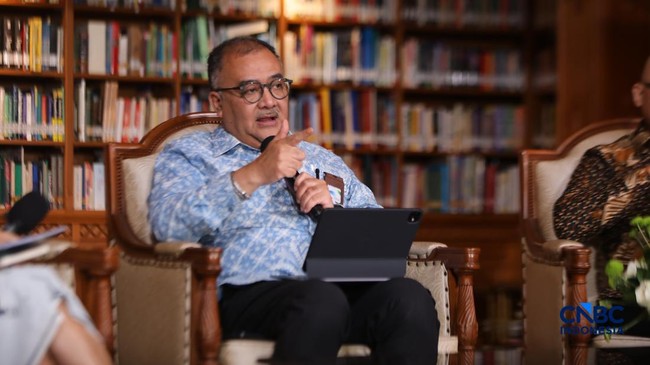
Climate Policy Initiative (CPI) Indonesia, in collaboration with CNBC Indonesia, presented the EKONIKLIM Talkshow as the 15th episode and closing instalment of EKONIKLIM Podcast Season 2. Under the theme ‘Orientation of Indonesia’s Climate Policy from an Economic and Financial Perspective,’ the talkshow discussed how climate policy can support energy security, food security, and Indonesia’s green economic growth.
As honoured guests, Ary Sudijanto, Deputy for Climate Change Control and Carbon Economic Value Governance at the Ministry of Environment, and Fajar Nuradi, Assistant Deputy for Food Production and Climate Change at the Coordinating Ministry for Food, highlighted various strategic aspects of Indonesia’s climate policy, ranging from government readiness to face the climate crisis and strengthening food and energy security, to the role of Carbon Economic Value (NEK) as an innovative financing instrument to close the funding gap for low-carbon development.
In the discussion on NEK, Ary stressed the importance of accountability principles in developing the ecosystem, including the carbon market, carbon tax, and the Carbon Unit Registry System (SRUK), to build market confidence in Indonesia’s high-integrity carbon system. ‘The development of Indonesia’s carbon market must be built on transparent, accountable, and credible governance. SRUK plays an important role in ensuring every carbon unit is properly recorded, preventing double counting, and increasing investor confidence in the integrity of Indonesia’s carbon market. With a strong system, NEK can become a strategic instrument to support the achievement of climate targets while opening greater financing opportunities for low-carbon development,’ Ary said.
Meanwhile, Fajar highlighted the importance of coordination across ministries, agencies, and stakeholders to ensure climate policy can support the national development agenda down to the regional level. The discussion also covered how food and energy programmes at the village level can drive local economic growth, strengthen community resilience, and ensure the benefits of green development are felt by farmers, fishers, local governments, and local communities. ‘Food security and climate change are two interrelated agendas. Amid increasing climate risks, food policy needs to be supported by an approach that not only maintains production but also strengthens community resilience and the local economy. NEK can be one of the innovative instruments to bridge financing needs, provided it is managed through strong coordination among ministries, agencies, and stakeholders,’ Fajar said.
The talkshow also highlighted that NEK’s great potential as a green growth engine can only be realised if supported by strong governance, fair benefit-sharing mechanisms, and consistent policy coordination between central government, regional governments, businesses, and communities. Furthermore, Indonesia’s competitiveness will increasingly be determined by its ability to adapt to global dynamics. The completion of the legal framework through the Climate Change Bill, strengthening NEK implementation, and readiness to face international policies such as the Carbon Border Adjustment Mechanism (CBAM) are important steps so that climate policy not only supports emission reductions but also strengthens national industrial competitiveness and long-term economic growth.
EKONIKLIM Podcast is part of CPI Indonesia’s efforts to improve public literacy on the interconnections between economy, finance, and the environment, including climate. By presenting accessible discussions, EKONIKLIM encourages more inclusive conversations on energy transition financing, strengthening economic and social resilience, and achieving national climate targets.
‘The second season of EKONIKLIM shows that energy transition and climate action are not only technology or environmental issues, but also economic, policy, and financing issues. Indonesia needs a credible NEK ecosystem, transparent governance, and financing instruments capable of turning climate commitments into real action and economic benefits for society. Through this final episode, we want to bring the discussion to a wider space. When the public, policymakers, market players, the financial sector, and communities share the same understanding, the opportunity to build an inclusive and sustainable green economy will be even greater,’ said CPI Indonesia Director Tiza Mafira.
Source: jawawa.id (https://jawawa.id/newsitem/at-ekoniklim-summit-klh-and-coordinating-ministry-for-food-highlight-carbon-economic-value-and-climate-1787212330)
Originally published by CNBC Indonesia (https://www.cnbcindonesia.com/news/20260820140516-4-760934/di-puncak-ekoniklim-klh-kemenko-pangan-soroti-nek-tata-kelola-iklim), translated from Indonesian