
At COP31 in Türkiye, Indonesia’s Regional Representative Council Proposes Three Climate Policy Measures
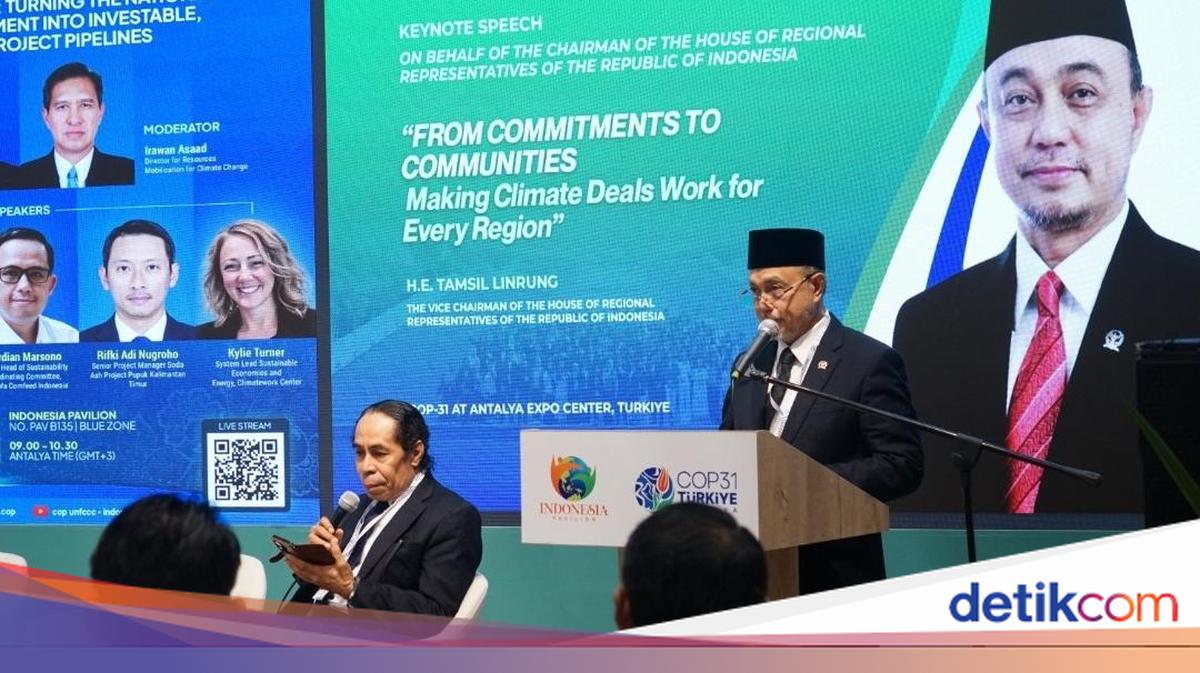
Deputy Speaker of Indonesia’s Regional Representative Council (DPD RI) Tamsil Linrung said the world was not short of commitments to address climate change. What was needed, he said, was fundamental change in implementation: how commitments are carried out at the local level.
Tamsil delivered the message in a keynote address entitled ‘From Commitments to Communities’ at the 31st Conference of the Parties (COP31) at the Antalya Expo Center in Türkiye.
He was the keynote speaker at a dialogue session in the Indonesia Pavilion in the Blue Zone, themed ‘From NDC to Deal: Turning the National Climate Commitment into Investable, Bankable Project Pipelines’. He represented DPD RI Speaker Sultan Baktiar Najamudin, who returned to Indonesia early amid political developments surrounding Vice-President Gibran Rakabuming Raka’s resignation.
“We no longer need too many negotiations. Nor are we short of commitments and promises, because plenty have already been made,” Tamsil said in a written statement on Friday (13 November 2026).
Tamsil said commitments now needed to be translated into financing, infrastructure and policy adjustments to transform industry and make it more environmentally friendly. He said conflicts of interest between countries had prevented successive COP meetings from resolving climate change, even though COP30 in Brazil had produced a roadmap to curb deforestation and accelerate the transition away from fossil fuels.
Tamsil put forward the idea of ‘The Next Mile of Climate Democracy’ as a link between global and national decisions and the lives of local communities. Regions, he said, were where the effects of climate change were felt most, where solutions emerged and where global investment needed to deliver direct benefits.
“Local communities are not passive recipients of climate policy. Climate-related decisions must be made together, rather than simply imposed on them as objects,” Tamsil said.
He warned that the most vulnerable groups bore the heaviest burden. Farmers, he said, faced increasingly unpredictable seasons; fishers struggled with changing sea conditions; and coastal and small-island residents risked losing their homes, land and livelihoods.
The success of climate agreements, therefore, could not be measured by promises alone, but by practical cooperation between countries.
Tamsil also stressed that national climate commitments must be supported by the readiness of cities and regions. Local governments needed clear divisions of responsibility, access to data, technical capacity and financing so that low-carbon action could genuinely cut emissions while benefiting communities.
In his speech, Tamsil introduced the Green Democracy paradigm developed by DPD RI Speaker Sultan Najamudin. Within the framework of deliberative democracy, Green Democracy challenges the high cost of democratic politics, which often encourages dependence on capital generated through the exploitation of natural resources.
To put the concept into practice, DPD RI has proposed 73 draft laws for inclusion in the National Legislation Programme (Prolegnas). Twenty-one concern ecology and the green economy, and are described as Green Legislation.
The drafts cover climate change management and carbon trading, urban areas, waste management, archipelagic regions and customary law communities. DPD RI has also introduced a digital system to incorporate public input into the drafting of legislation.
Tamsil said that, as of 2024, Indonesia’s net deforestation stood at about 175,400 hectares, while forested areas covered 95.5 million hectares, or around 51.1 per cent of the country’s land area. Indonesia was also implementing the Forest and Other Land Use (FOLU) Net Sink 2030 plan, rehabilitating 3.6 million hectares of land and 600,000 hectares of mangroves, enforcing carbon economic value regulations and launching the Indonesia Carbon Exchange.
“Indonesia has shown that nature conservation and improvements in human welfare can go hand in hand,” Tamsil said.
According to Tamsil, local climate action remained unsatisfactory because many international financing efforts had yet to materialise. Domestic actors also faced technical obstacles in carbon markets, including uncertainty over cost calculations, reporting and verification, a shortage of professional capacity in regions, and inequitable benefit-sharing.
DPD RI put forward three proposals to strengthen global partnerships. The first was the importance of multilevel climate governance.
This would require a clear division of authority between central, provincial and municipal or district governments, covering carbon project development, emissions data registries and accountability for results.
The second proposal was to establish facilities for subnational projects. International financing institutions and multilateral development banks were invited to provide technical support for feasibility studies and urban emissions data infrastructure, as well as subsidies or standardised costs for measurement, reporting and verification (MRV). This would help projects in provinces with limited fiscal capacity remain economically viable.
DPD RI also highlighted the need for fair benefit-sharing. Every carbon transaction, it said, should ensure transparency in contracts and revenue, involve affected communities and provide a complaints mechanism.
With more than 14,400 cities and 300 local governments registered on the UNFCCC’s NAZCA platform, Tamsil said DPD RI was ready to take a leading role in building a coalition of local and regional parliaments in Asia, across the Global South and beyond.
The coalition would oversee climate-finance accountability, connect local governments with global funding partners and ensure that follow-up after COP31 was reviewed regularly. At the end of his speech, Tamsil invited all countries participating in COP31 to join Indonesia in advancing ‘Green Actions’.
“Earth is not an inheritance that we may damage. It is a trust placed in our care, to be protected for our children and grandchildren yet to be born,” he concluded.
Source: jawawa.id (https://jawawa.id/newsitem/at-cop31-in-turkiye-indonesias-regional-representative-council-proposes-three-climate-policy-measures-1794585134)
Originally published by detikcom (https://news.detik.com/berita/d-8752244/di-cop31-turki-dpd-ri-tawarkan-3-usulan-kebijakan-komitmen-iklim), translated from Indonesian