
At 51st ASCOPE Meeting, Pertamina Pushes Regional Collaboration to Strengthen Upstream Oil and Gas
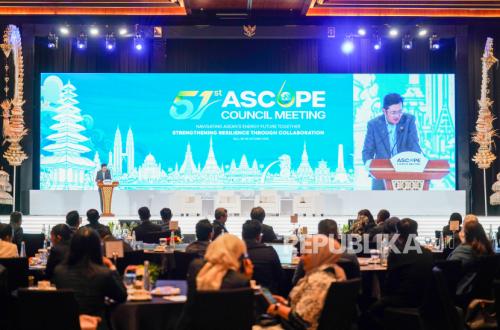
SANUR — PT Pertamina (Persero) is supporting stronger regional collaboration to optimise upstream oil and gas assets, sustain production and increase exploration potential across South-east Asia.
These efforts are becoming increasingly important amid the challenges of maintaining productivity at existing fields and attracting investment to discover new oil and gas resources.
ASCOPE Secretary in Charge (ASIC) Henricus Herwin said ASEAN countries faced similar challenges in managing upstream oil and gas assets. These ranged from maintaining the economics of fields that have been producing for decades to developing exploration opportunities and managing facilities that have reached the end of their operating lives.
“We have gathered at this forum to help our region [ASEAN] maximise the potential of every upstream oil and gas asset throughout its life cycle,” Henricus said at the opening of the 51st ASCOPE Council Meeting in Sanur, Bali, on Monday, 26 October 2026.
Henricus said optimising upstream assets required a comprehensive approach, including maintaining the productivity of existing fields, developing exploration opportunities, and closing facilities safely, responsibly and cost-effectively.
He said countries did not have to tackle these challenges separately. Through the ASEAN Council on Petroleum (ASCOPE), members could strengthen cooperation by sharing data, evidence and experience to support better decisions in managing their respective assets.
“By sharing progress, data and experience among ASCOPE members, we can help each member make better decisions about the assets it manages, while turning regional knowledge into tangible, practical results,” he said.
One of ASCOPE’s activities is the Exploration and Production Task Force (EPTF), which brings together stakeholders from 11 ASEAN countries to discuss the implementation, regulation and planning of upstream oil and gas operations.
The collaboration also aligns with efforts to boost exploration in Indonesia. The Special Task Force for Upstream Oil and Gas Business Activities (SKK Migas) is targeting 2.6 billion barrels of oil equivalent (BBOE) in potential resources from exploration in 2026.
“Indonesia offers a diverse portfolio of opportunities for investors with different strategies and risk tolerances,” said Rikky Rahmat Firdaus, SKK Migas deputy for exploration, development and working area management.
He said 12 high-impact wells were projected to account for about 80% of the pre-drill resource target, with potential of around 2.2 BBOE. According to SKK Migas data, five of the 12 high-impact wells are operated by Pertamina through its various entities.
The five wells are Besar-1, operated by Pertamina East Natuna (PEN); Banyu Geni-01 and Wijaya Kusuma-1, operated by Pertamina EP (PEP); Padang Pancuran-002, also operated by PEP; and Tingkilan-1, operated by Pertamina Hulu Energi Lepas Pantai Bunyu (PHE LPB).
The exploration activity is part of efforts to identify oil and gas resources that could support the sustainability of the upstream industry and national energy security. However, the targeted resources still need to be confirmed through drilling and further technical evaluation.
Alongside asset management and resource development, improving the quality of human resources is also essential to sustaining the energy industry.
LEMIGAS head Ikhsan Kiat stressed that energy security could not be supported solely by the availability of natural resources and infrastructure; it also required people with the expertise to manage and develop that potential.
“A nation’s greatest resource is not what lies underground or beneath the sea, but what lies within its people. This is what we call human energy,” Ikhsan said.
He added that regional cooperation through ASCOPE should be expanded beyond connecting energy infrastructure and markets to developing the capabilities of the sector’s workforce.
With stronger regional collaboration, asset optimisation, exploration development and improvements in workforce skills, the upstream oil and gas industry in ASEAN is expected to sustain production and strengthen energy security amid shifts in the global industry.