
Asymmetric Elections
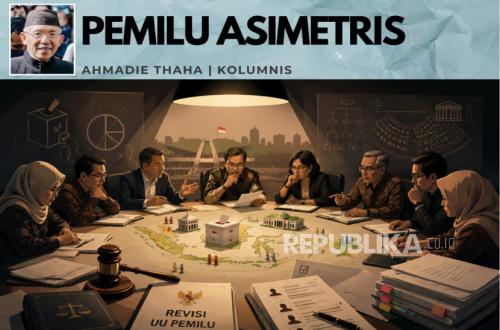
If anyone assumes that preparations for the 2029 General Election have not yet begun because there are no billboards as large as futsal pitches or banners stretching from utility poles to mango trees, they may be deceived by a calm surface. Outside, Senayan appears ordinary. There are no parades of flags, no convoys of loudspeakers, and no three-story smiling faces promising a bright future while hiding the bills of the past.
However, inside the DPR building, the kitchen is already active. Through the parliament’s official social media, the Deputy Speaker of the DPR, Sufmi Dasco Ahmad, has promised that the discussion regarding the revision of the Election Law will be open, careful, and involve widespread public participation. Yet, the comment sections reveal a task much larger than merely drafting articles. Some netizens question why the Asset Forfeiture Bill is progressing so slowly. Others suspect that changes to the regulations will be more beneficial to political parties and legislative candidates. Some even describe it as merely a change of masks for those in power. That is the core issue: democracy is not just about producing good rules, but also about building the conviction that those rules are made for the interests of the people, not just for political players.
While debates rage in the digital world, preparations for the 2029 General Election continue within parliamentary meeting rooms. Hour by hour, day by day, academics, researchers, observers, and civil society groups take turns providing their perspectives. The discussions are not about the names of presidential or gubernatorial candidates; what is being prepared is far more fundamental: the rules of the game. In politics, what is most decisive is often not who the players are, but who draws the field, determines the size of the goal, and establishes the regulations.
One compelling voice comes from a senior researcher at BRIN, Professor Siti Zuhro, who has proposed ‘asymmetric’ regional elections. Her idea is simple yet carries significant consequences: not all regions should use the same mechanism. Some might choose direct elections, some through the Regional House of Representatives (DPRD), and others might use different mechanisms suited to their specific regional characteristics.
The logic is easy to grasp. Indonesia is not a small country that can be explored while sipping coffee from end to end. Indonesia is a massive archipelago with diverse fiscal capabilities, bureaucratic quality, and political cultures. The problem is that something logical is not necessarily easy to accept. For the past two decades, the public has been accustomed to one belief: the more directly the people vote, the more democratic the system is considered. Consequently, any proposal that reduces elements of direct election is almost always suspected of being a step backward, even if the reality is not that simple.