
Astronomers Discover Dark Matter Secrets in Old Hubble Photo
A chance glance at an old photo archive belonging to the Hubble Space Telescope has led to a highly valuable astronomical discovery. The finding has significant potential to help scientists dissect one of the greatest mysteries in the universe: dark matter.
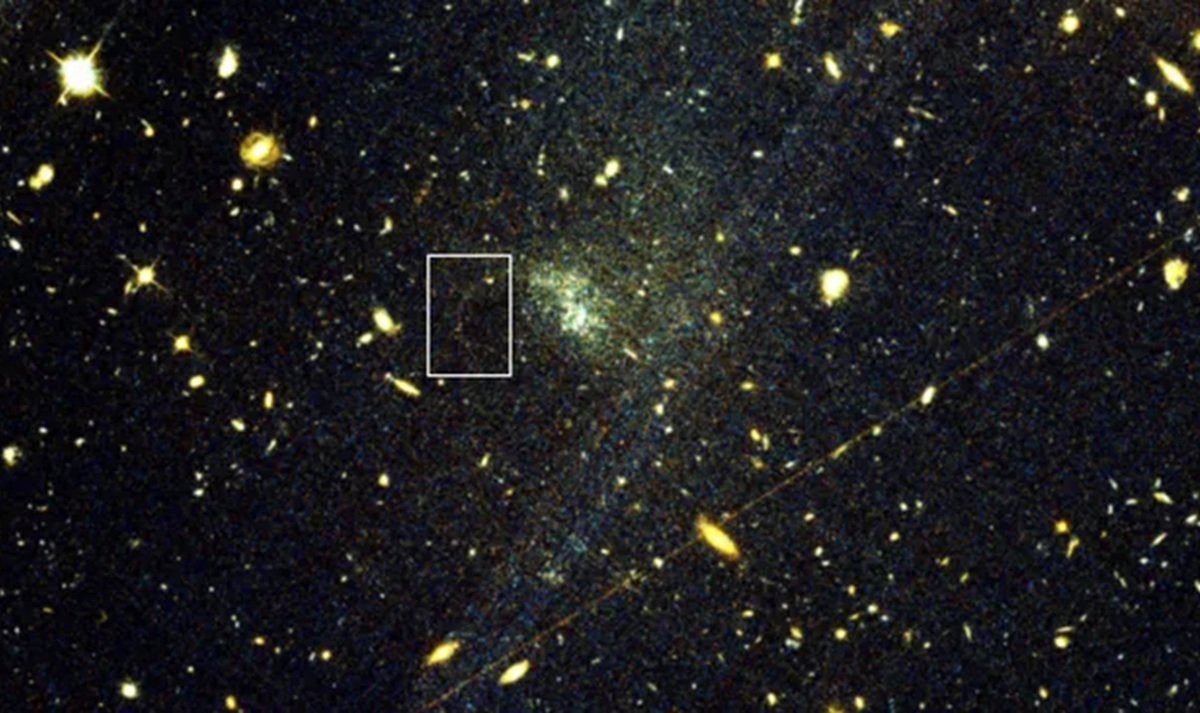
The photo, taken a year earlier by Hubble, shows UGC 9050-Dw1, a dwarf galaxy located about 115 million light-years from Earth. The galaxy appears as a faint, blurry blue-white point of light, or what astronomers categorise as an ultra-diffuse galaxy.
This type of galaxy has a very small population of stars, so most of its mass is believed to consist of dark matter, an invisible substance that makes up more than 80% of the matter in the universe.
Interest began when former astronomer Hendel, who had studied thousands of similar structures, recognised a subtle interaction in the arc-like feature of light in the photo. He noticed a similarity in the colours of the stars and a curved trajectory leading towards a small bright clump along its path.
These clues matched the characteristics of a stellar stream. The stream, named “Oyashio”, is the remnant of a dense globular cluster that was torn apart and pulled by the gravitational force of UGC 9050-Dw1.
The discovery of the Oyashio stream gives researchers a new, still very natural laboratory for testing and investigating the characteristics of dark matter. This object is considered far purer because it has minimal disturbance from other astrophysical forces that often disrupt similar searches in the Milky Way galaxy.
Emily Cunningham, an assistant professor at Boston University who studies stellar streams and dark matter halos but was not involved in the research, welcomed the discovery.
“The discovery of Oyashio is a ‘very impressive step forward’. Using the technique described in this paper, we will detect many more streams around other galaxies through future observations from facilities such as the Vera Rubin Observatory and the Nancy Grace Roman Space Telescope,” Emily Cunningham told Space.com.
A follow-up study in 2023 using the same Hubble image noted a very high population of star clusters near the galaxy. The authors concluded that UGC 9050-Dw1 likely formed from the merger of two similarly sized galaxies around 10 billion years ago. The merger was calm enough that gas from both galaxies survived and triggered a surge in new star formation.
The research team also tested various alternative explanations to ensure the validity of the finding, ranging from the possibility of stars coincidentally aligning, gravitational lensing effects, to dusty regions resembling the shape of a stellar stream. However, no alternative scenario could explain all the evidence comprehensively.
Holm, one of the scientists involved, explained the verification process.
“It was an interesting process because there was no single moment where we immediately said, ‘Okay, now we know what this is.’ We started with the assumption that from its appearance, it looked like something. How many different ways could we try to prove that this is not a stellar stream?” Holm told Space.com.
Nevertheless, to maintain scientific discipline, the team acknowledged that they could not completely rule out every other possibility.
“There is still a possibility that some stars coincidentally fell into this pattern. But again… for all these things to align so neatly would require too many coincidences,” Holm added.
Source: jawawa.id (https://jawawa.id/newsitem/astronomers-discover-dark-matter-secrets-in-old-hubble-photo-1787817046)
Originally published by Media Indonesia (https://mediaindonesia.com/teknologi/926464/iseng-cek-foto-lama-hubble-astronom-temukan-rahasia-materi-gelap-universe), translated from Indonesian