
Astra Agro Optimises Productivity on Suboptimal Land While Safeguarding Environmental Sustainability
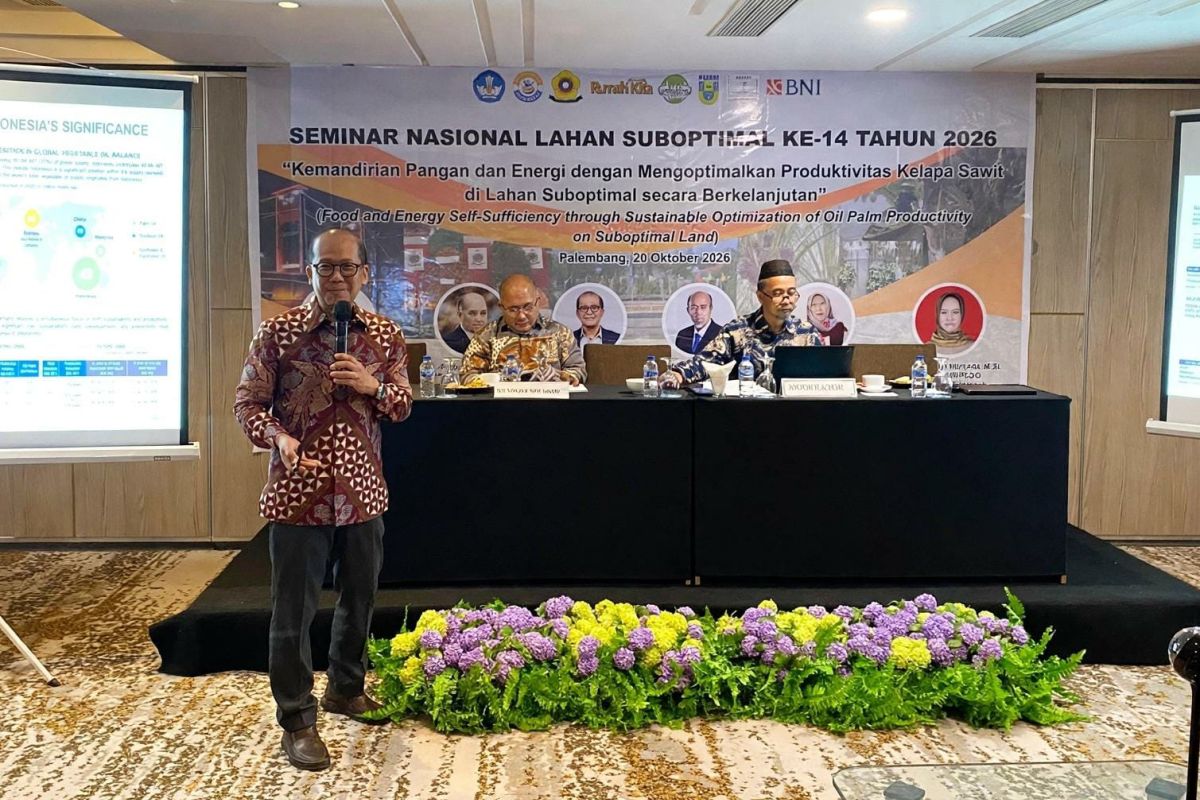
Palembang (ANTARA) — PT Astra Agro Lestari Tbk (AALI) is applying four strategies to optimise oil-palm productivity on suboptimal land: using superior varieties, applying soil amendments, improving soil conditions with biofertilisers, and implementing optimal water-management systems. The approach is tailored to the characteristics of each site to support plantation productivity while safeguarding environmental sustainability.
The strategies were outlined by Dr Bandung Sahari, Astra Agro Lestari’s Director of Agronomy and Sustainability, who was a keynote speaker at the 14th National Seminar on Suboptimal Land 2026, organised by Sriwijaya University (Unsri) on Tuesday, 20 October 2026. The seminar, themed “Food and Energy Self-Sufficiency through the Sustainable Optimisation of Oil-Palm Productivity on Suboptimal Land”, was attended in person and online by participants from across Indonesia.
In his presentation, Bandung stressed the importance of site-specific plantation management. The approach recognises that each type of land has distinct characteristics and limiting factors, and therefore requires an appropriate cultivation strategy. Improving productivity does not simply depend on adding inputs, but also on managing soil, crops and water resources effectively.
“Efforts to increase oil-palm productivity should focus on optimising land that is already in use, particularly as global demand for vegetable oils continues to rise while land availability is limited. The key is to apply strategies suited to the characteristics of each site, from selecting superior varieties and improving soil conditions to using biofertilisers and managing water properly. A site-specific approach creates opportunities to raise productivity more efficiently and sustainably,” Bandung said.
Prof Dr Ir Siti Herlinda, head of Sriwijaya University’s Centre of Excellence for Suboptimal Land Development Research (PUR-PLSO), said oil palm was one of Indonesia’s leading commodities, with wide-ranging benefits and an important role in meeting demand for vegetable oils. Developing productivity by optimising suboptimal land was therefore a strategic way to sustain the plantation sector.
“Oil palm is one of Indonesia’s leading commodities and brings substantial benefits. The challenge is how to increase productivity sustainably, including by optimising the potential of suboptimal land. This requires an approach based on land characteristics, supported by superior varieties, improved soil quality, biofertilisers and appropriate water management,” she said.
Herlinda said collaboration between universities and industry was needed to translate research findings into approaches relevant to conditions on the ground. Exchanges between academics and practitioners also created opportunities to develop agronomic innovations that boost productivity while taking account of environmental carrying capacity and supporting sustainable agriculture.
Suboptimal land has physical, chemical or environmental limitations that result in relatively low natural productivity. It includes a range of land types, from dry areas and inland swamps to tidal land and peatland. Their differing characteristics mean they cannot be managed uniformly; the limiting factors at each site must first be identified.
On peatland and tidal land, for example, water management is crucial. Controlling the groundwater level using infrastructure such as sluice gates, drainage channels, pump houses and piezometers helps maintain water availability for crops. Proper management is also needed to reduce environmental risks, including organic-matter oxidation, subsidence and fires.
For Astra Agro, efforts to optimise suboptimal land are also linked to strengthening agronomic research and development, including the development of superior varieties to support productivity and cultivation efficiency. Innovations in planting material need to be matched by appropriate soil, nutrient and water management to realise the plants’ full potential.
The quality of planting material is also being strengthened through Astra Agro subsidiary PT Gunung Sejahtera Ibu Pertiwi, which has obtained SNI ISO 9001:2015 quality-management-system certification from PT TÜV NORD Indonesia. The certification covers seed research and production, from research and breeding through to the production and marketing of oil-palm sprouts.
This approach is aligned with Astra Agro’s Sustainability Aspirations 2030, which sets out sustainability initiatives through its Triple-P Roadmap: Portfolio, People and Public Contribution, with Good Corporate Governance (GCG) as a key enabler. Under this framework, productivity goes hand in hand with environmental management, people’s capacity-building, contributions to communities and responsible governance.
Through sustainable intensification, Astra Agro views suboptimal land not merely as an agronomic challenge, but as an opportunity to use land already under cultivation more productively and responsibly. With the support of research, innovation and site-specific management, land optimisation is expected to help strengthen national oil-palm productivity while contributing sustainably to food and energy security.
Source: jawawa.id (https://jawawa.id/newsitem/astra-agro-optimises-productivity-on-suboptimal-land-while-safeguarding-environmental-sustainability-1792594516)
Originally published by Antara (Indonesian) (https://www.antaranews.com/berita/5802893/jaga-keberlanjutan-lingkungan-perusahaan-sawit-astra-agro-optimalkan-produktivitas-lahan-suboptimal), translated from Indonesian